
We read your photo as:
Solve the following equations: Q.5: 3x + 4 = 19 − 2x; Q.6: Find the zeroes of 2x2 - 7x + 3; Q.7: Find the hypotenuse of a right-angled triangle with legs 6cm and 8cm.
ScanSolve AI Answer
Step-by-step solution
9 stepsQ.5
Gather terms involving on one side and constant terms on the other side.
The given equation is .
Add to both sides:Subtract 4 from both sides:
Solve for .
Divide both sides by 5:
The final answer is .
Q.6
Set the quadratic polynomial to zero to find its zeroes.
The polynomial is .
Factor the quadratic expression.
We look for two numbers that multiply to and add up to . These numbers are and .
Rewrite the middle term:Factor by grouping:
Set each factor to zero and solve for .
The zeroes of the polynomial are and 3.
The final answer is .Q.7
Identify the given information for the right-angled triangle.
In , it is right-angled at B.
The lengths of the two legs are cm and cm.
We need to find the length of the hypotenuse .Apply the Pythagorean theorem.
For a right-angled triangle, the square of the hypotenuse (the side opposite the right angle) is equal to the sum of the squares of the other two sides (legs).
Substitute the given values and calculate .
Take the square root of both sides:
The final answer is .
Q.8
Recall the standard trigonometric value for .
The tangent of an angle in a right-angled triangle is the ratio of the length of the opposite side to the length of the adjacent side. For , the opposite and adjacent sides are equal.
The final answer is .
Still stuck on this one?
Ask a follow-up, and the answer starts from this question.
More Mathematics Questions
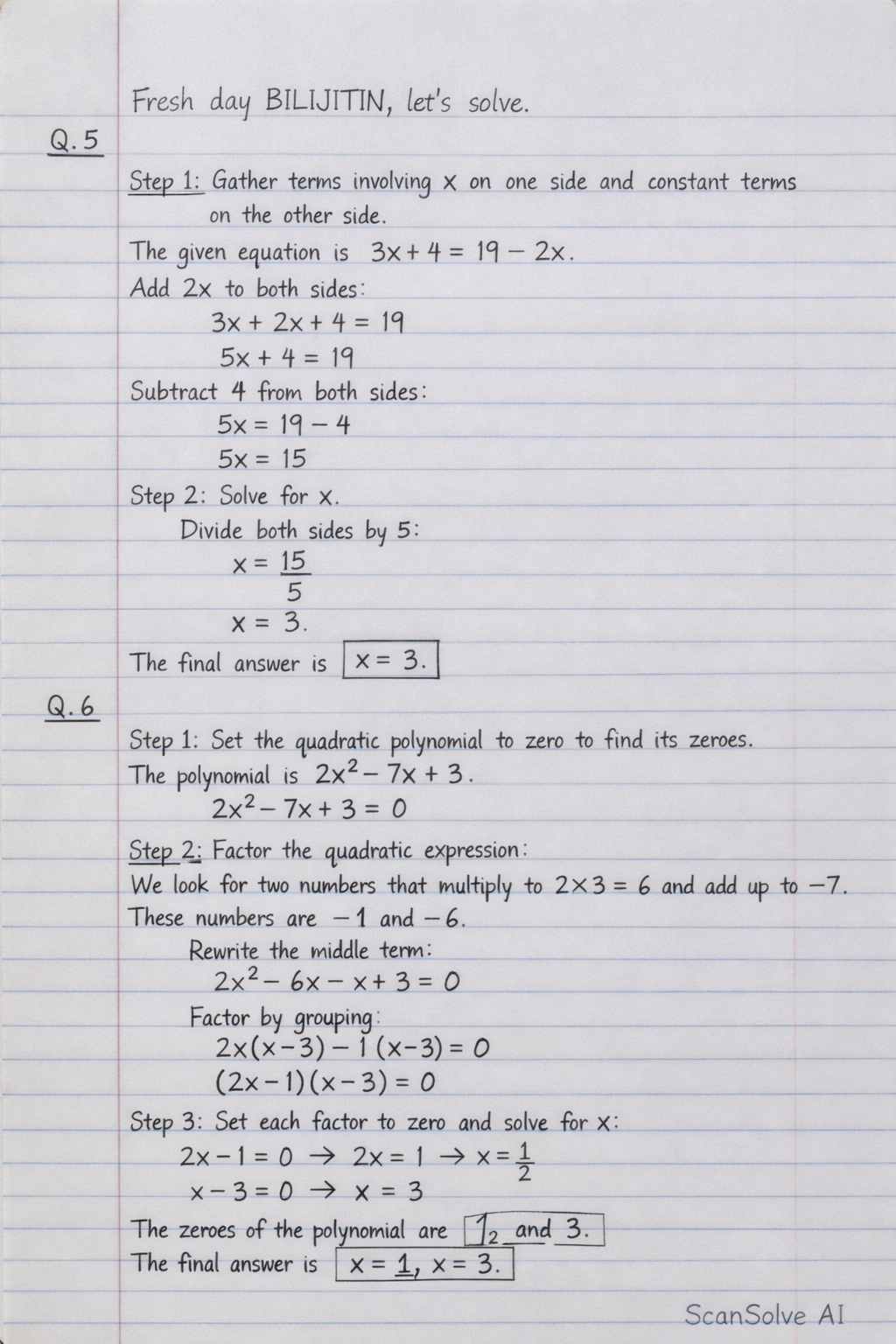
Handwritten Step-by-Step Solution
Get this as a handwritten image on WhatsApp — like a tutor wrote it for you.
Try on WhatsApp