
We read your photo as:
Prove the following formulas: sumk=1ⁿ k2 = (n(n+1)(2n+1))/(6) and sumk=1ⁿ (2k−1)2 = (1)/(3)n(4n2-1)
ScanSolve AI Answer
Answer
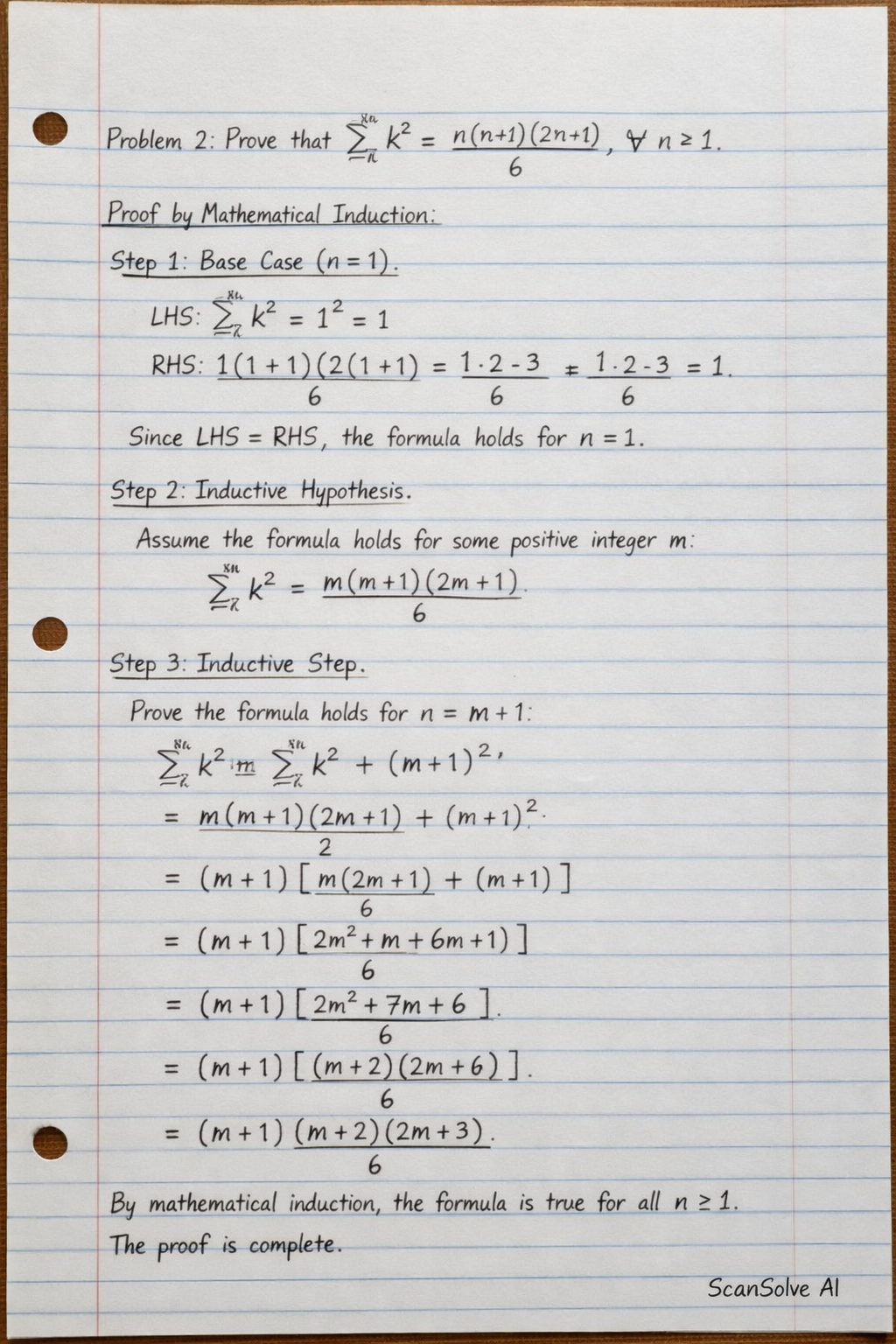
Problem 2: Prove that , .
Step-by-step solution
10 stepsProof by Mathematical Induction:
Base Case ().
LHS: .
RHS: .
Since LHS = RHS, the formula holds for .Inductive Hypothesis.
Assume the formula holds for some positive integer :
Inductive Step.
Prove the formula holds for :
Substitute the inductive hypothesis:
Factor out :
Factor the quadratic :
This is the RHS for .
By mathematical induction, the formula is true for all .
The proof is complete.: Prove that .
Expand the term .
Split the summation and apply known summation formulas.
Using , , and :
Factor out and simplify.
This matches the RHS.
The proof is complete.: Prove that is divisible by 6 for all .
Factor the expression .
Using the difference of squares formula, :
Rearrange the factors.
This expression represents the product of three consecutive integers.
Demonstrate divisibility by 2 and 3.
- Divisibility by 2: In any set of three consecutive integers, at least one integer must be even. Therefore, their product is always divisible by 2.
- Divisibility by 3: In any set of three consecutive integers, exactly one integer must be a multiple of 3. Therefore, their product is always divisible by 3.
Conclude divisibility by 6.
Since the product is divisible by both 2 and 3, and 2 and 3 are coprime, the product must be divisible by .
Thus, is divisible by 6 for all .
The proof is complete.
Still stuck on this one?
Ask a follow-up, and the answer starts from this question.
More Mathematics Questions
Handwritten Step-by-Step Solution
Get this as a handwritten image on WhatsApp — like a tutor wrote it for you.
Try on WhatsApp