We read your photo as:

Solve the following geometry problems involving circles and chords.

Mathematics

ScanSolve AI Answer

Answers

2 parts
3.1

5 cm\text{5 cm}

3.2

6 cm\text{6 cm}

Step-by-step solution

6 steps

Here are the solutions to your geometry problems.

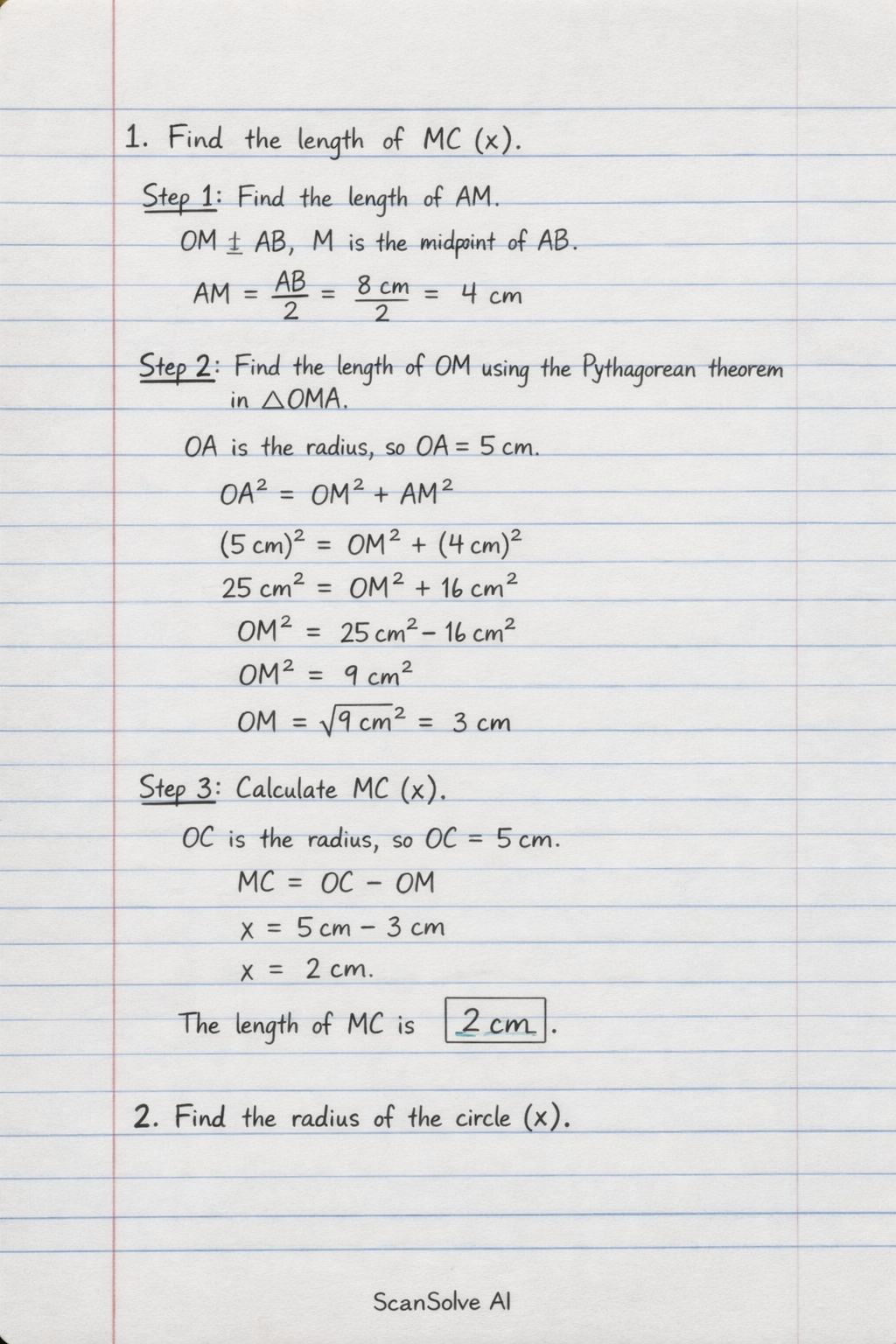
1. Calculate the length of MC (x).

Step 1: Find the length of AMAM.
Since OM⊥ABOM \perp AB, MM is the midpoint of ABAB.

AM=AB2=8 cm2=4 cmAM = \frac{AB}{2} = \frac{8 \text{ cm}}{2} = 4 \text{ cm}

Step 2: Find the length of OMOM using the Pythagorean theorem in △OMA\triangle OMA.
OAOA is the radius, so OA=5 cmOA = 5 \text{ cm}.

OA2=OM2+AM2OA^2 = OM^2 + AM^2 (5 cm)2=OM2+(4 cm)2(5 \text{ cm})^2 = OM^2 + (4 \text{ cm})^2 25 cm2=OM2+16 cm225 \text{ cm}^2 = OM^2 + 16 \text{ cm}^2 OM2=25 cm2−16 cm2OM^2 = 25 \text{ cm}^2 - 16 \text{ cm}^2 OM2=9 cm2OM^2 = 9 \text{ cm}^2 OM=9 cm2=3 cmOM = \sqrt{9 \text{ cm}^2} = 3 \text{ cm}

Step 3: Calculate MC(x)MC (x).
OCOC is the radius, so OC=5 cmOC = 5 \text{ cm}.

MC=OC−OMMC = OC - OM x=5 cm−3 cmx = 5 \text{ cm} - 3 \text{ cm} x=2 cmx = 2 \text{ cm}

The length of MCMC is 2 cm\boxed{\text{2 cm}}.

2. Calculate the radius of the circle (x).

Step 1: Identify the relationship between OMOM and ABAB.
Since AM=MB=15 unitsAM = MB = 15 \text{ units}, MM is the midpoint of chord ABAB. A line from the center to the midpoint of a chord is perpendicular to the chord. Therefore, △OMA\triangle OMA is a right-angled triangle with the right angle at MM.

Step 2: Use the Pythagorean theorem in △OMA\triangle OMA.
OAOA is the radius of the circle, denoted as xx.

OA2=OM2+AM2OA^2 = OM^2 + AM^2 x2=(8 units)2+(15 units)2x^2 = (8 \text{ units})^2 + (15 \text{ units})^2 x2=64 units2+225 units2x^2 = 64 \text{ units}^2 + 225 \text{ units}^2 x2=289 units2x^2 = 289 \text{ units}^2 x=289 units2x = \sqrt{289 \text{ units}^2} x=17 unitsx = 17 \text{ units}

The radius of the circle is 17 units\boxed{\text{17 units}}.

3. Calculate, giving reasons, the length of UA and TS.

Part 3.1· 2 steps

**Calculate UA.

  1. Find the length of PQPQ.

    Since UU is the center and UQ⊥PRUQ \perp PR, QQ is the midpoint of chord PRPR. (Reason: Line from center perpendicular to chord bisects the chord).

    PQ=PR2=8 cm2=4 cmPQ = \frac{PR}{2} = \frac{8 \text{ cm}}{2} = 4 \text{ cm}
  2. Find the length of UPUP (which is the radius, and UAUA is likely referring to the radius).

    In △UQP\triangle UQP, we have a right-angled triangle at QQ.

    UP2=UQ2+PQ2UP^2 = UQ^2 + PQ^2 UP2=(3 cm)2+(4 cm)2UP^2 = (3 \text{ cm})^2 + (4 \text{ cm})^2 UP2=9 cm2+16 cm2UP^2 = 9 \text{ cm}^2 + 16 \text{ cm}^2 UP2=25 cm2UP^2 = 25 \text{ cm}^2 UP=25 cm2UP = \sqrt{25 \text{ cm}^2} UP=5 cmUP = 5 \text{ cm}

    Assuming UAUA refers to the radius of the circle (since UU is the center and AA is not defined as a specific point on the circumference), then UA=UPUA = UP.
    The length of UAUA is 5 cm\boxed{\text{5 cm}}.

Part 3.2

6 cm\text{6 cm}

**Calculate TS.

  1. Find the length of the diameter TRTR.

    TRTR is the diameter, and UU is the center. UPUP is the radius.

    TR=2×UP=2×5 cm=10 cmTR = 2 \times UP = 2 \times 5 \text{ cm} = 10 \text{ cm}
  2. Use the Pythagorean theorem in △TSR\triangle TSR.

    Since TRTR is the diameter, the angle subtended by the diameter at any point on the circumference is 90∘90^\circ. (Reason: Angle in a semicircle is 90∘90^\circ). Therefore, ∠TSR=90∘\angle TSR = 90^\circ.

    TR2=TS2+SR2TR^2 = TS^2 + SR^2 (10 cm)2=(x cm)2+((x+2) cm)2(10 \text{ cm})^2 = (x \text{ cm})^2 + ((x+2) \text{ cm})^2 100=x2+(x2+4x+4)100 = x^2 + (x^2 + 4x + 4) 100=2x2+4x+4100 = 2x^2 + 4x + 4 0=2x2+4x+4−1000 = 2x^2 + 4x + 4 - 100 0=2x2+4x−960 = 2x^2 + 4x - 96
  3. Solve the quadratic equation for xx.

    Divide the entire equation by 2:

    0=x2+2x−480 = x^2 + 2x - 48

    Factor the quadratic equation:
    We need two numbers that multiply to -48 and add to 2. These numbers are 8 and -6.

    (x+8)(x−6)=0(x+8)(x-6) = 0

    So, x+8=0x+8=0 or x−6=0x-6=0.

    x=−8orx=6x = -8 \quad \text{or} \quad x = 6

    Since length cannot be negative, we discard x=−8x = -8.
    Therefore, x=6 cmx = 6 \text{ cm}.

  4. Calculate TSTS.

    TS=x cmTS = x \text{ cm}.

    TS=6 cmTS = 6 \text{ cm}

    The length of TSTS is 6 cm\boxed{\text{6 cm}}.

Was this helpful?

Try one yourself

A new problem that tests the same skill.

Still stuck on this one?

Ask a follow-up, and the answer starts from this question.

Got a different question?Ask your own question
Handwritten step-by-step solution preview

Handwritten Step-by-Step Solution

Get this as a handwritten image on WhatsApp — like a tutor wrote it for you.

Try on WhatsApp