
We read your photo as:
Evaluate the following limits: 1. lim x->1 (x-1)/(x-1) 2. lim x->1 (x2-1)/(x2-1) 3. lim x->3 (x3-27)/(x-9) 4. lim x->0 ((3+x)2-9)/x
ScanSolve AI Answer
Step-by-step solution
31 stepsHere are the solutions to the problems.
1.
Substitute into the expression.
This is an indeterminate form.
Simplify the expression.
For , the expression simplifies to 1.
Evaluate the limit.
The limit is .
2.
Substitute into the expression.
This is an indeterminate form.
Simplify the expression.
For , the expression simplifies to 1.
Evaluate the limit.
The limit is .
3.
Substitute into the expression.
This is not an indeterminate form.
Evaluate the limit.
The limit is .
4.
Substitute into the expression.
This is an indeterminate form.
Expand the numerator.
Simplify the expression.
Evaluate the limit.
The limit is .
5.
Substitute into the expression.
This is an indeterminate form.
Factor the numerator and denominator.
The numerator is a difference of cubes: .
The denominator is a quadratic: .Simplify the expression.
Evaluate the limit.
The limit is .
6.
Substitute into the expression.
This is an indeterminate form.
Factor the numerator and denominator.
The numerator is a quadratic: .
The denominator is a difference of squares: .Simplify the expression.
Evaluate the limit.
The limit is .
For questions 7-11, we will find the derivative .
7.
Rewrite the function.
Differentiate with respect to .
The derivative is .
8.
Rewrite the function.
Differentiate with respect to .
The derivative is .
9.
Apply the chain rule.
Let . Then .
Find and .
Substitute back .
The derivative is .
10.
Differentiate with respect to .
The derivative is .
11.
Apply the chain rule.
Let . Then .
Find and .
Substitute back .
The derivative is .
Still stuck on this one?
Ask a follow-up, and the answer starts from this question.
More Mathematics Questions
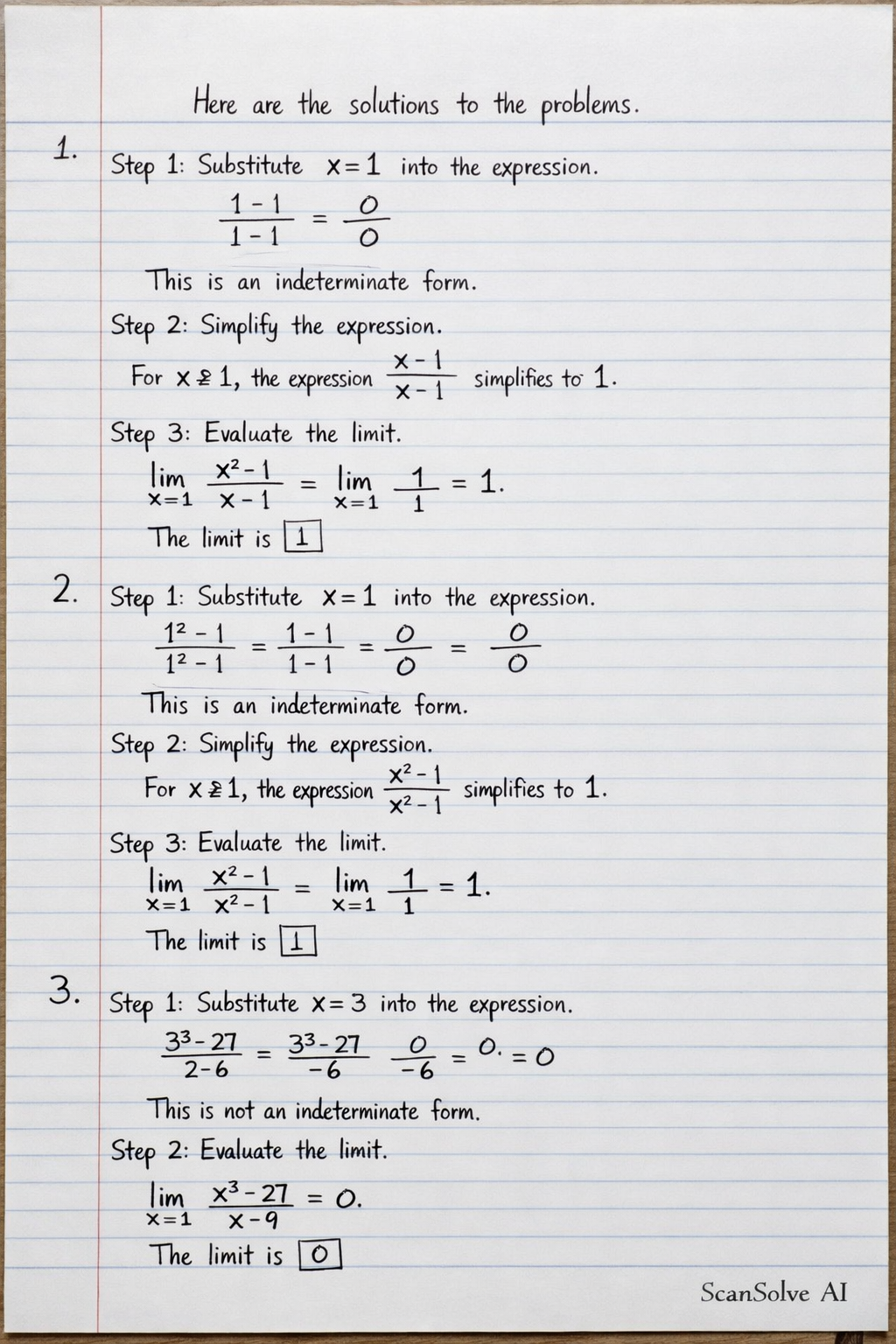
Handwritten Step-by-Step Solution
Get this as a handwritten image on WhatsApp — like a tutor wrote it for you.
Try on WhatsApp