
We read your photo as:
Please solve the following problems: 1. If 3x+5=20, find the value of x. 2. Solve: 2(x−3)+5=17. 3. Factorise: x2-5x+6. 4. Expand and simplify: (x+2)(x-3).
ScanSolve AI Answer
Step-by-step solution
40 stepshere are the solutions for all the problems from the image.
: If , find the value of .
Subtract 5 from both sides of the equation.
Divide both sides by 3.
The value of is:
: Solve: .
Distribute the 2 into the parenthesis.
Combine the constant terms on the left side.
Add 1 to both sides of the equation.
Divide both sides by 2.
The value of is:
: Factorise: .
Find two numbers that multiply to 6 and add up to -5.
The numbers are -2 and -3, since and .
Write the quadratic expression in factored form using these numbers.
The factored form is:
: Expand and simplify: .
Use the FOIL method (First, Outer, Inner, Last) to expand the product.
Combine the like terms.
The expanded and simplified expression is:
: Solve the equation: .
Factor the quadratic expression.
Find two numbers that multiply to -12 and add up to -4.
The numbers are -6 and 2, since and .Set each factor equal to zero and solve for .
The solutions for are:
: If , find the value of .
Use the Pythagorean identity .
Substitute the given value of :
Subtract from both sides.
Take the square root of both sides.
Assuming is an acute angle (in the first quadrant), is positive.
The value of is:: In , , . Find .
The sum of the angles in a triangle is .
Substitute the given values for and .
Subtract from both sides to find .
The measure of is:
: Find the area of a triangle with base 10 cm and height 6 cm.
Use the formula for the area of a triangle
Area .
Calculate the area.
The area of the triangle is:
: The perimeter of a rectangle is 40 cm and its length is 14 cm. Find its breadth.
Use the formula for the perimeter of a rectangle
, where is the perimeter, is the length, and is the breadth.
Substitute the given values: cm and cm.Divide both sides by 2.
Subtract 14 from both sides to find .
The breadth of the rectangle is:
: A bag contains 3 red balls, 4 blue balls and 5 green balls. One ball is drawn at random. What is the probability of getting a blue ball?
Calculate the total number of balls in the bag.
Identify the number of blue balls.
Calculate the probability of drawing a blue ball using the formula
Simplify the fraction.
The probability of getting a blue ball is:
: Simplify: .
Apply the square to both the numerator and the denominator.
Calculate the squares.
The simplified expression is:
: Find the value of if .
Subtract 3 from both sides of the equation.
Multiply both sides by 2.
The value of is:
: Find the coordinates of the midpoint of the line segment joining and .
Use the midpoint formula
.
Let and .Substitute the coordinates into the formula.
Calculate the sums and divide by 2.
The coordinates of the midpoint are:
: In the figure, lines and are parallel. Find the value of .
Identify the relationship between the angles.
The angle and the angle adjacent to it on line form a linear pair, so their sum is . Let this adjacent angle be .
Recognize that and are corresponding angles because lines and are parallel.
Corresponding angles are equal.
The value of is:
: Prove that: .
Start with the left-hand side of the equation.
Expand the square as a product of two binomials.
Use the distributive property (FOIL method) to multiply the binomials.
Combine the like terms ( and are the same).
This matches the right-hand side of the equation, thus the identity is proven.
All done
Still stuck on this one?
Ask a follow-up, and the answer starts from this question.
More Mathematics Questions
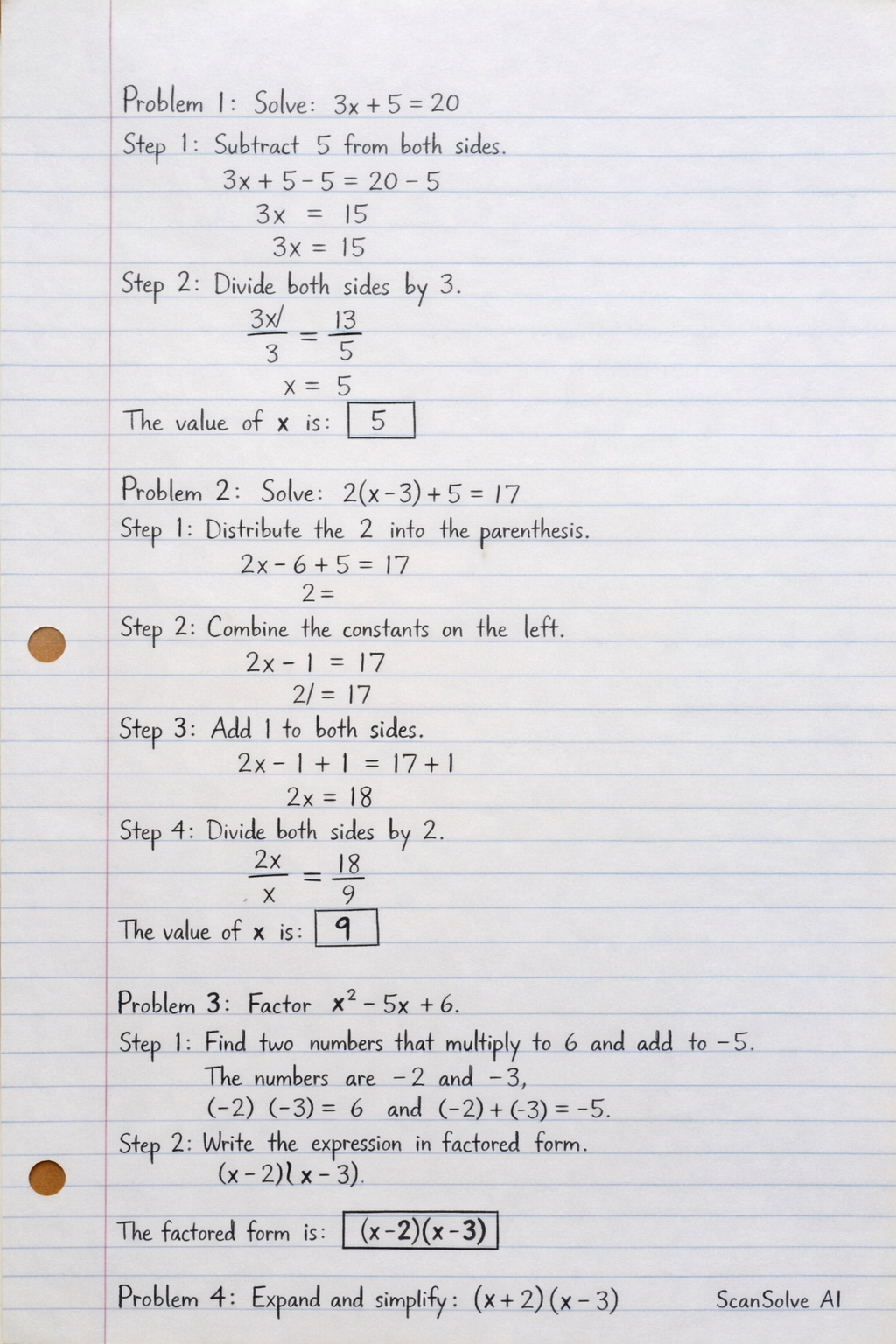
Handwritten Step-by-Step Solution
Get this as a handwritten image on WhatsApp — like a tutor wrote it for you.
Try on WhatsApp