We read your photo as:

Solve the following system of equations: 1) 2(3 (x−1)) = 3 x 2) y = sqrt(x+1)

Mathematics

ScanSolve AI Answer

Step-by-step solution

3 steps

To solve the given system of equations simultaneously, we will first solve the logarithmic equation for xx, and then substitute the value of xx into the second equation to find yy.

The given equations are:

  1. 2(log⁡3(x−1))=log⁡3x2(\log_3 (x-1)) = \log_3 x
  2. y=x+1y = \sqrt{x+1}
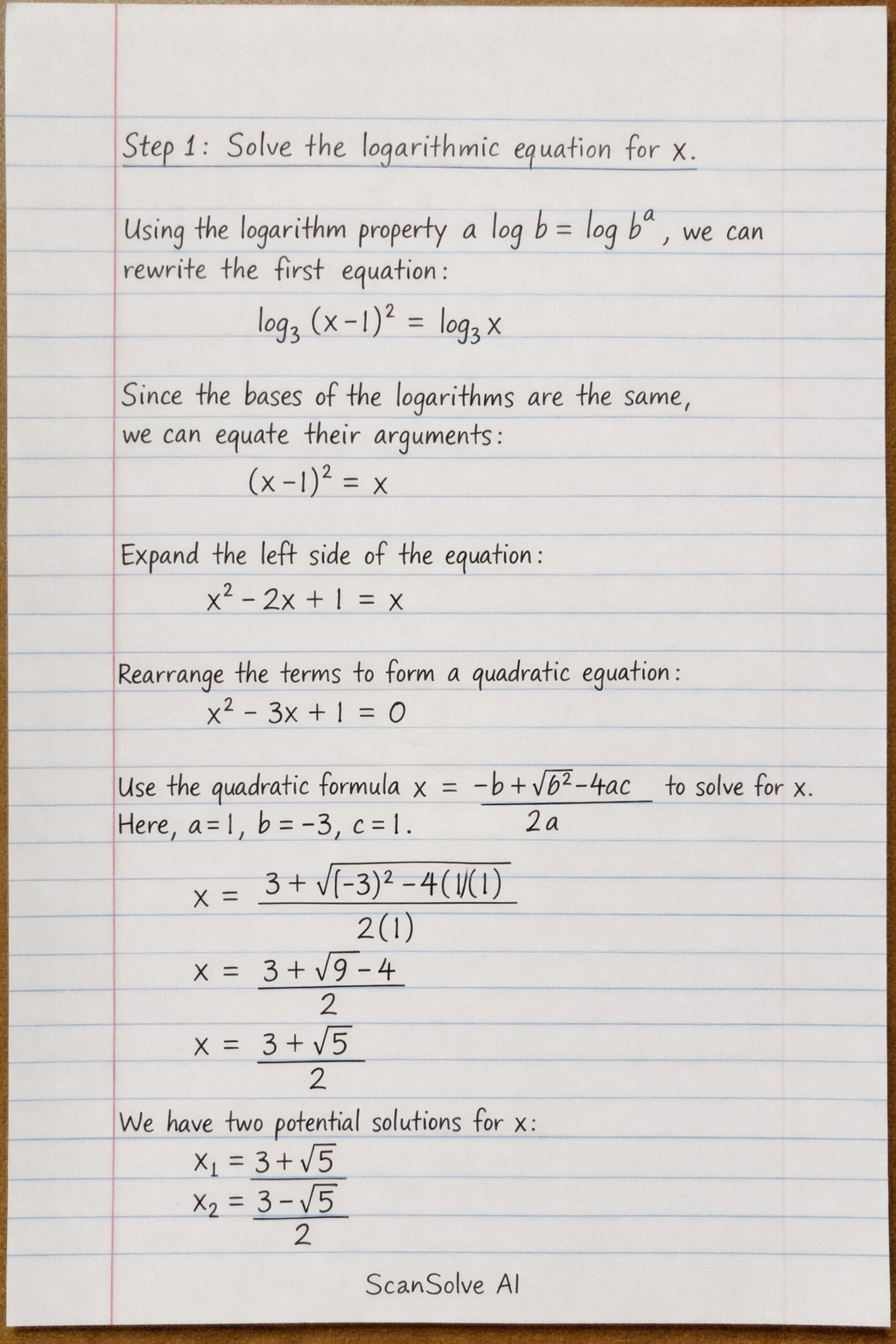
  1. Solve the logarithmic equation for xx.

    Using the logarithm property alog⁡b=log⁡baa \log b = \log b^a, we can rewrite the first equation:

    log⁡3(x−1)2=log⁡3x\log_3 (x-1)^2 = \log_3 x

    Since the bases of the logarithms are the same, we can equate their arguments:

    (x−1)2=x(x-1)^2 = x

    Expand the left side of the equation:

    x2−2x+1=xx^2 - 2x + 1 = x

    Rearrange the terms to form a quadratic equation:

    x2−3x+1=0x^2 - 3x + 1 = 0

    Use the quadratic formula x=−b±b2−4ac2ax = \frac{-b \pm \sqrt{b^2 - 4ac}}{2a} to solve for xx. Here, a=1a=1, b=−3b=-3, c=1c=1.

    x=−(−3)±(−3)2−4(1)(1)2(1)x = \frac{-(-3) \pm \sqrt{(-3)^2 - 4(1)(1)}}{2(1)} x=3±9−42x = \frac{3 \pm \sqrt{9 - 4}}{2} x=3±52x = \frac{3 \pm \sqrt{5}}{2}

    We have two potential solutions for xx: x1=3+52x_1 = \frac{3 + \sqrt{5}}{2} and x2=3−52x_2 = \frac{3 - \sqrt{5}}{2}.

  2. Check the domain of the logarithmic equation.

    For log⁡3(x−1)\log_3 (x-1) to be defined, x−1>0  ⟹  x>1x-1 > 0 \implies x > 1.
    For log⁡3x\log_3 x to be defined, x>0x > 0.
    Both conditions require x>1x > 1.
    Let's evaluate the two potential solutions:
    For x1=3+52x_1 = \frac{3 + \sqrt{5}}{2}: Since 5≈2.236\sqrt{5} \approx 2.236, x1≈3+2.2362=5.2362=2.618x_1 \approx \frac{3 + 2.236}{2} = \frac{5.236}{2} = 2.618. This value is greater than 1, so it is a valid solution.
    For x2=3−52x_2 = \frac{3 - \sqrt{5}}{2}: Since 5≈2.236\sqrt{5} \approx 2.236, x2≈3−2.2362=0.7642=0.382x_2 \approx \frac{3 - 2.236}{2} = \frac{0.764}{2} = 0.382. This value is not greater than 1, so it is not a valid solution.
    Therefore, the only valid value for xx is x=3+52x = \frac{3 + \sqrt{5}}{2}.

  3. Substitute the value of xx into the second equation to find yy.

    y=x+1y = \sqrt{x+1}

    Substitute x=3+52x = \frac{3 + \sqrt{5}}{2}:

    y=(3+52)+1y = \sqrt{\left(\frac{3 + \sqrt{5}}{2}\right) + 1}

    Combine the terms under the square root:

    y=3+52+22y = \sqrt{\frac{3 + \sqrt{5}}{2} + \frac{2}{2}} y=3+5+22y = \sqrt{\frac{3 + \sqrt{5} + 2}{2}} y=5+52y = \sqrt{\frac{5 + \sqrt{5}}{2}}

    The simultaneous solution is:

    x=3+52,y=5+52\boxed{x = \frac{3 + \sqrt{5}}{2}, y = \sqrt{\frac{5 + \sqrt{5}}{2}}}
Was this helpful?

Still stuck on this one?

Ask a follow-up, and the answer starts from this question.

Got a different question?Ask your own question
Handwritten step-by-step solution preview

Handwritten Step-by-Step Solution

Get this as a handwritten image on WhatsApp — like a tutor wrote it for you.

Try on WhatsApp