
We read your photo as:
Define the following terms: (i) measurement (ii) quantity (iii) unit (iv) accuracy (v) precision
ScanSolve AI Answer
Step-by-step solution
17 stepsHere are the answers to your questions:
GSE 212: BASIC GENERAL MATHEMATICS III (1C)
Question 1:
a) Define the following terms:
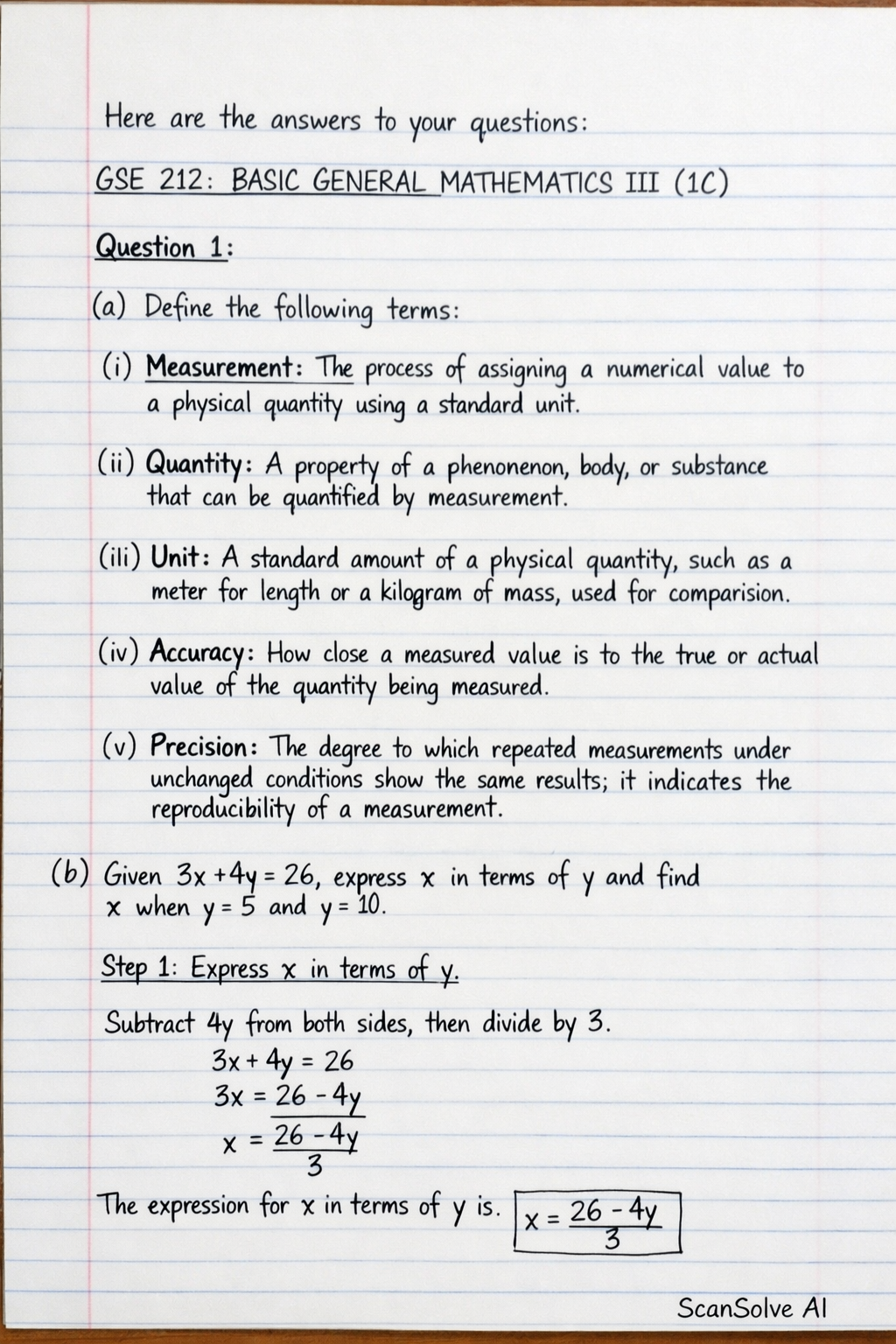
- (i) Measurement: The process of assigning a numerical value to a physical quantity using a standard unit.
- (ii) Quantity: A property of a phenomenon, body, or substance that can be quantified by measurement.
- (iii) Unit: A standard amount of a physical quantity, such as a meter for length or a kilogram for mass, used for comparison.
- (iv) Accuracy: How close a measured value is to the true or actual value of the quantity being measured.
- (v) Precision: The degree to which repeated measurements under unchanged conditions show the same results; it indicates the reproducibility of a measurement.
b) Given , express in terms of and find when and .
Express in terms of .
Subtract from both sides, then divide by 3.
The expression for in terms of is .
Find when .
Substitute into the expression for .
When , .
Find when .
Substitute into the expression for .
When , .
c) In the diagram, PQST is a parallelogram, PR is a straight line. , and area of triangle PSR . Find the value of .
Find the length of the base PR using the area of triangle PSR.
The area of a triangle is given by . Here, the base is PR and the height is SM.
Determine the length of PQ.
Since PQST is a parallelogram, opposite sides are equal in length. Therefore, .
Calculate the value of $|QR|$.
From the diagram, PR is a straight line, so .
The value of is .
Question 2:
a) The formula gives the approximate mass, tonnes, of a ship metres long and metres wide.
i) Make the subject of the formula.
Multiply both sides by 21.
Divide both sides by .
Add to both sides.
The formula with as the subject is .
ii) Calculate the length of a 4500 tonnes ship if it is 20m wide, giving your answer to the nearest 5m.
Substitute the given values into the formula for .
Given tonnes and m.
Perform the calculations.
Round the answer to the nearest 5m.
71.0625 m is closer to 70 m than 75 m.
The length of the ship is approximately .b) A wooden structure in form of a cone mounted on a hemispherical base. The vertical height of the cone is 24cm and the base radius 7cm. Calculate, correct to 3 Significant figures, the surface area of the structure. ().
Calculate the slant height () of the cone.
The slant height can be found using the Pythagorean theorem: .
Calculate the curved surface area of the cone ().
The formula for the curved surface area of a cone is .
Calculate the curved surface area of the hemisphere ().
The formula for the curved surface area of a hemisphere is .
Calculate the total surface area of the structure.
The total surface area is the sum of the curved surface area of the cone and the curved surface area of the hemisphere (the base of the cone is covered by the hemisphere).
Express the answer correct to 3 significant figures.
is already expressed to 3 significant figures.
The surface area of the structure is .
Still stuck on this one?
Ask a follow-up, and the answer starts from this question.
More Mathematics Questions
Handwritten Step-by-Step Solution
Get this as a handwritten image on WhatsApp — like a tutor wrote it for you.
Try on WhatsApp