
We read your photo as:
For a square with side length s, the length of the diagonal d can be found using the Pythagorean theorem: d² = s² + s².
Mathematics
ScanSolve AI Answer
Answer
Step-by-step solution
3 steps❌ Incorrect.
The final numerical answer for the diagonal is correct, but there are errors in the calculation steps shown.
Here's the corrected calculation for the diagonal:
Apply the Pythagorean theorem
For a square with side length , the diagonal is given by:
Calculate the diagonal length
Approximate the numerical value
Using :
The error in your work was in the simplification of . It should be , not . Also, the line was incorrect.
Was this helpful?
Try one yourself
A new problem that tests the same skill.
Still stuck on this one?
Ask a follow-up, and the answer starts from this question.
Got a different question?Ask your own question
More Mathematics Questions
QUnderstand the geometry of a square and its diagonal.QWhat is the side length of a square with a diagonal of 10 cm?QSolve for the total charge C = 50 + 20k and the side s of a square with diagonal d = 10 cm.QComplete the table showing the relationship between the side length of a square and its area.QWhat is the sides of a square whose diagnals is 12cm
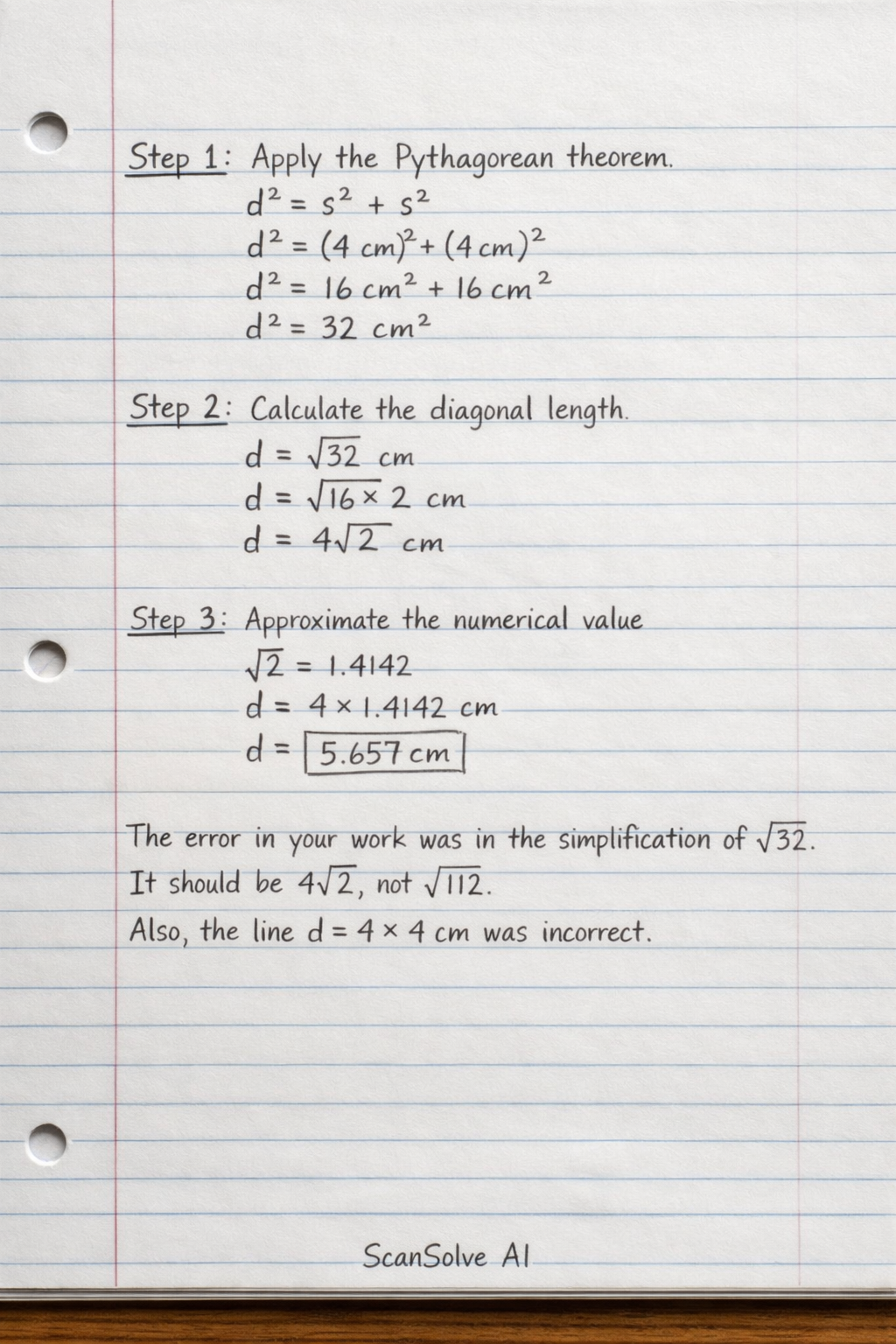
Handwritten Step-by-Step Solution
Get this as a handwritten image on WhatsApp — like a tutor wrote it for you.
Try on WhatsApp