We read your photo as:

For the following quadratic functions, determine their shape, turning point, and x-intercepts: a) f(x) = x2, b) y = 2x2 − 2, c) 10x2 + 5y = -20

Mathematics

ScanSolve AI Answer

Step-by-step solution

18 steps

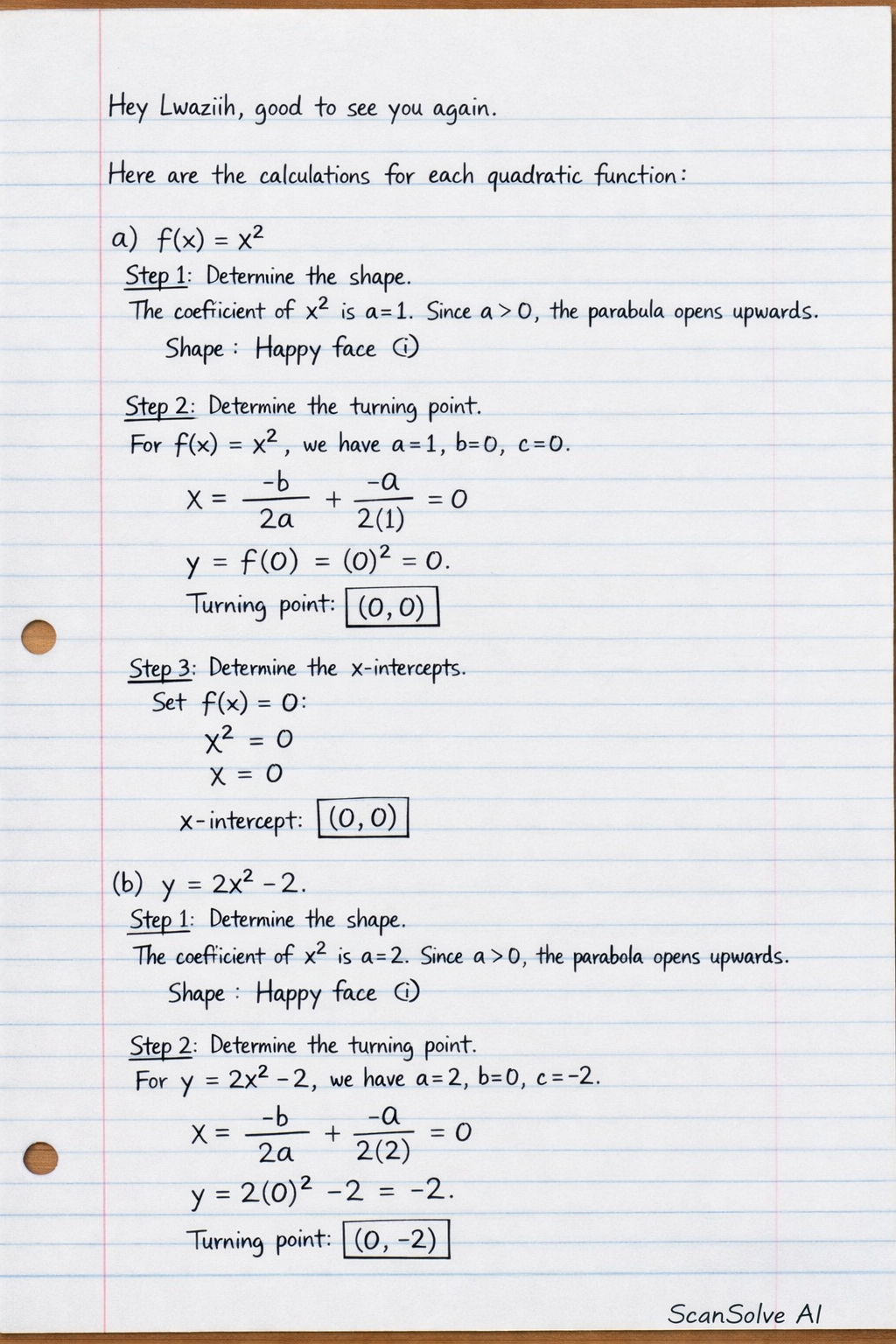
Here are the calculations for each quadratic function:

Part a· 3 steps

f(x)=x2f(x) = x^2

  1. Determine the shape.

    The coefficient of x2x^2 is a=1a=1. Since a>0a > 0, the parabola opens upwards.
    Shape: Happy face

  2. Determine the turning point.

    For f(x)=x2f(x) = x^2, we have a=1a=1, b=0b=0, c=0c=0.
    The x-coordinate of the turning point is x=−b2a=−02(1)=0x = -\frac{b}{2a} = -\frac{0}{2(1)} = 0.
    The y-coordinate is f(0)=(0)2=0f(0) = (0)^2 = 0.
    Turning point: (0,0)\boxed{(0, 0)}

  3. Determine the x-intercepts.

    Set f(x)=0f(x) = 0:

    x2=0x^2 = 0 x=0x = 0

    x-intercept: (0,0)\boxed{(0, 0)}

Part b· 3 steps

y=2x2−2y = 2x^2 - 2

  1. Determine the shape.

    The coefficient of x2x^2 is a=2a=2. Since a>0a > 0, the parabola opens upwards.
    Shape: Happy face

  2. Determine the turning point.

    For y=2x2−2y = 2x^2 - 2, we have a=2a=2, b=0b=0, c=−2c=-2.
    The x-coordinate of the turning point is x=−b2a=−02(2)=0x = -\frac{b}{2a} = -\frac{0}{2(2)} = 0.
    The y-coordinate is y=2(0)2−2=−2y = 2(0)^2 - 2 = -2.
    Turning point: (0,−2)\boxed{(0, -2)}

  3. Determine the x-intercepts.

    Set y=0y = 0:

    2x2−2=02x^2 - 2 = 0 2x2=22x^2 = 2 x2=1x^2 = 1 x=±1x = \pm\sqrt{1} x=±1x = \pm 1

    x-intercepts: (−1,0) and (1,0)\boxed{(-1, 0) \text{ and } (1, 0)}

Part c· 3 steps

10x2+5y=−2010x^2 + 5y = -20

  1. Rewrite the equation in standard form y=ax2+bx+cy = ax^2 + bx + c.

    5y=−10x2−205y = -10x^2 - 20 y=−2x2−4y = -2x^2 - 4

    The coefficient of x2x^2 is a=−2a=-2. Since a<0a < 0, the parabola opens downwards.
    Shape: Sad face

  2. Determine the turning point.

    For y=−2x2−4y = -2x^2 - 4, we have a=−2a=-2, b=0b=0, c=−4c=-4.
    The x-coordinate of the turning point is x=−b2a=−02(−2)=0x = -\frac{b}{2a} = -\frac{0}{2(-2)} = 0.
    The y-coordinate is y=−2(0)2−4=−4y = -2(0)^2 - 4 = -4.
    Turning point: (0,−4)\boxed{(0, -4)}

  3. Determine the x-intercepts.

    Set y=0y = 0:

    −2x2−4=0-2x^2 - 4 = 0 −2x2=4-2x^2 = 4 x2=−2x^2 = -2

    Since x2x^2 cannot be negative for real numbers, there are no real x-intercepts.
    x-intercepts: No real x-intercepts\boxed{\text{No real x-intercepts}}

Part d· 3 steps

f(x)=−4x2+16f(x) = -4x^2 + 16

  1. Determine the shape.

    The coefficient of x2x^2 is a=−4a=-4. Since a<0a < 0, the parabola opens downwards.
    Shape: Sad face

  2. Determine the turning point.

    For f(x)=−4x2+16f(x) = -4x^2 + 16, we have a=−4a=-4, b=0b=0, c=16c=16.
    The x-coordinate of the turning point is x=−b2a=−02(−4)=0x = -\frac{b}{2a} = -\frac{0}{2(-4)} = 0.
    The y-coordinate is f(0)=−4(0)2+16=16f(0) = -4(0)^2 + 16 = 16.
    Turning point: (0,16)\boxed{(0, 16)}

  3. Determine the x-intercepts.

    Set f(x)=0f(x) = 0:

    −4x2+16=0-4x^2 + 16 = 0 −4x2=−16-4x^2 = -16 x2=4x^2 = 4 x=±4x = \pm\sqrt{4} x=±2x = \pm 2

    x-intercepts: (−2,0) and (2,0)\boxed{(-2, 0) \text{ and } (2, 0)}

Part e· 3 steps

f(x)=4−x2f(x) = 4 - x^2

  1. Rewrite the equation in standard form f(x)=ax2+bx+cf(x) = ax^2 + bx + c.

    f(x)=−x2+4f(x) = -x^2 + 4

    The coefficient of x2x^2 is a=−1a=-1. Since a<0a < 0, the parabola opens downwards.
    Shape: Sad face

  2. Determine the turning point.

    For f(x)=−x2+4f(x) = -x^2 + 4, we have a=−1a=-1, b=0b=0, c=4c=4.
    The x-coordinate of the turning point is x=−b2a=−02(−1)=0x = -\frac{b}{2a} = -\frac{0}{2(-1)} = 0.
    The y-coordinate is f(0)=−(0)2+4=4f(0) = -(0)^2 + 4 = 4.
    Turning point: (0,4)\boxed{(0, 4)}

  3. Determine the x-intercepts.

    Set f(x)=0f(x) = 0:

    −x2+4=0-x^2 + 4 = 0 −x2=−4-x^2 = -4 x2=4x^2 = 4 x=±4x = \pm\sqrt{4} x=±2x = \pm 2

    x-intercepts: (−2,0) and (2,0)\boxed{(-2, 0) \text{ and } (2, 0)}

Part f· 3 steps

2y−8x2=22y - 8x^2 = 2

  1. Rewrite the equation in standard form y=ax2+bx+cy = ax^2 + bx + c.

    2y=8x2+22y = 8x^2 + 2 y=4x2+1y = 4x^2 + 1

    The coefficient of x2x^2 is a=4a=4. Since a>0a > 0, the parabola opens upwards.
    Shape: Happy face

  2. Determine the turning point.

    For y=4x2+1y = 4x^2 + 1, we have a=4a=4, b=0b=0, c=1c=1.
    The x-coordinate of the turning point is x=−b2a=−02(4)=0x = -\frac{b}{2a} = -\frac{0}{2(4)} = 0.
    The y-coordinate is y=4(0)2+1=1y = 4(0)^2 + 1 = 1.
    Turning point: (0,1)\boxed{(0, 1)}

  3. Determine the x-intercepts.

    Set y=0y = 0:

    4x2+1=04x^2 + 1 = 0 4x2=−14x^2 = -1 x2=−14x^2 = -\frac{1}{4}

    Since x2x^2 cannot be negative for real numbers, there are no real x-intercepts.
    x-intercepts: No real x-intercepts\boxed{\text{No real x-intercepts}}

Was this helpful?

Still stuck on this one?

Ask a follow-up, and the answer starts from this question.

Got a different question?Ask your own question
Handwritten step-by-step solution preview

Handwritten Step-by-Step Solution

Get this as a handwritten image on WhatsApp — like a tutor wrote it for you.

Try on WhatsApp