
We read your photo as:
For the length of AD. The diagram shows a right angle at point B, which means that ABD is a right-angled triangle. The sides AB and BD are the legs, and AD is the hypotenuse. We
ScanSolve AI Answer
Step-by-step solution
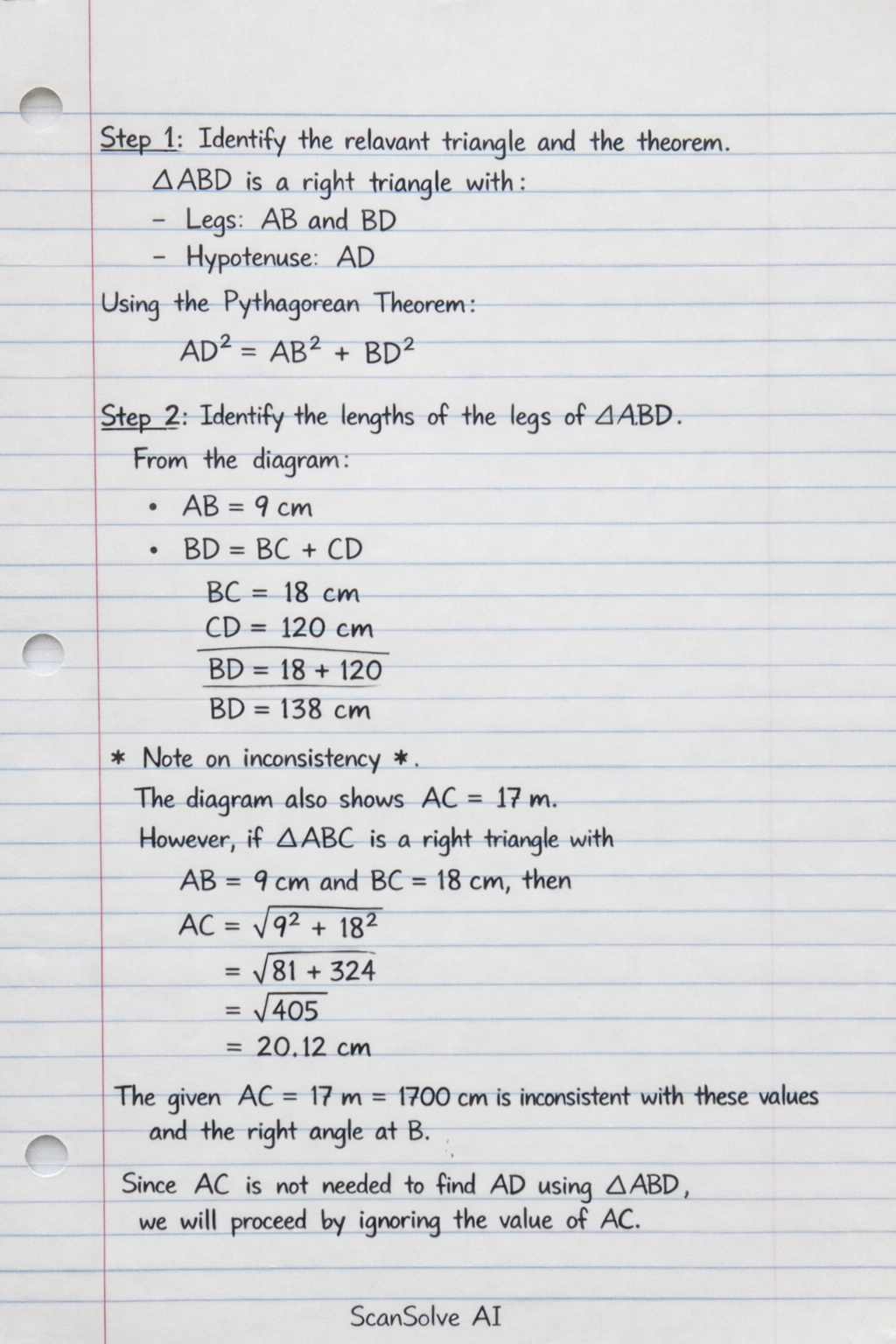
7 stepsIdentify the relevant triangle and the theorem.
The problem asks for the length of . The diagram shows a right angle at point , which means that is a right-angled triangle. The sides and are the legs, and is the hypotenuse. We will use the Pythagorean theorem:
Identify the lengths of the legs of .
From the diagram:
- The length of leg .
- The length of leg is the sum of and .
Given and .
Note on inconsistency: The diagram also shows . However, if is a right-angled triangle at with and , then should be . The given is inconsistent with these values and the right angle at . Since is not needed to find using , we will proceed by ignoring the value of .
Calculate the length of .
Substitute the lengths of and into the Pythagorean theorem.
Calculate the squares of the side lengths.
Add the squared values.
Solve for by taking the square root.
Still stuck on this one?
Ask a follow-up, and the answer starts from this question.
More Mathematics Questions
Handwritten Step-by-Step Solution
Get this as a handwritten image on WhatsApp — like a tutor wrote it for you.
Try on WhatsApp