Work out. 1 1/5 + 2 1/3 m = 2 x 3^a x 7^b and n = 3 x 72 x 11 Given that m > 126, find the smallest values of a and b which make m a multiple of 126. Explain why 33n is a perfect square.

Mathematics
Work out. 1 1/5 + 2 1/3 m = 2 x 3^a x 7^b and n = 3 x 72 x 11 Given that m > 126, find the smallest values of a and b which make m a multiple of 126. Explain why 33n is a perfect square.

ScanSolve AI Answer

Answer

3815\mathbf{3\frac{8}{15}}

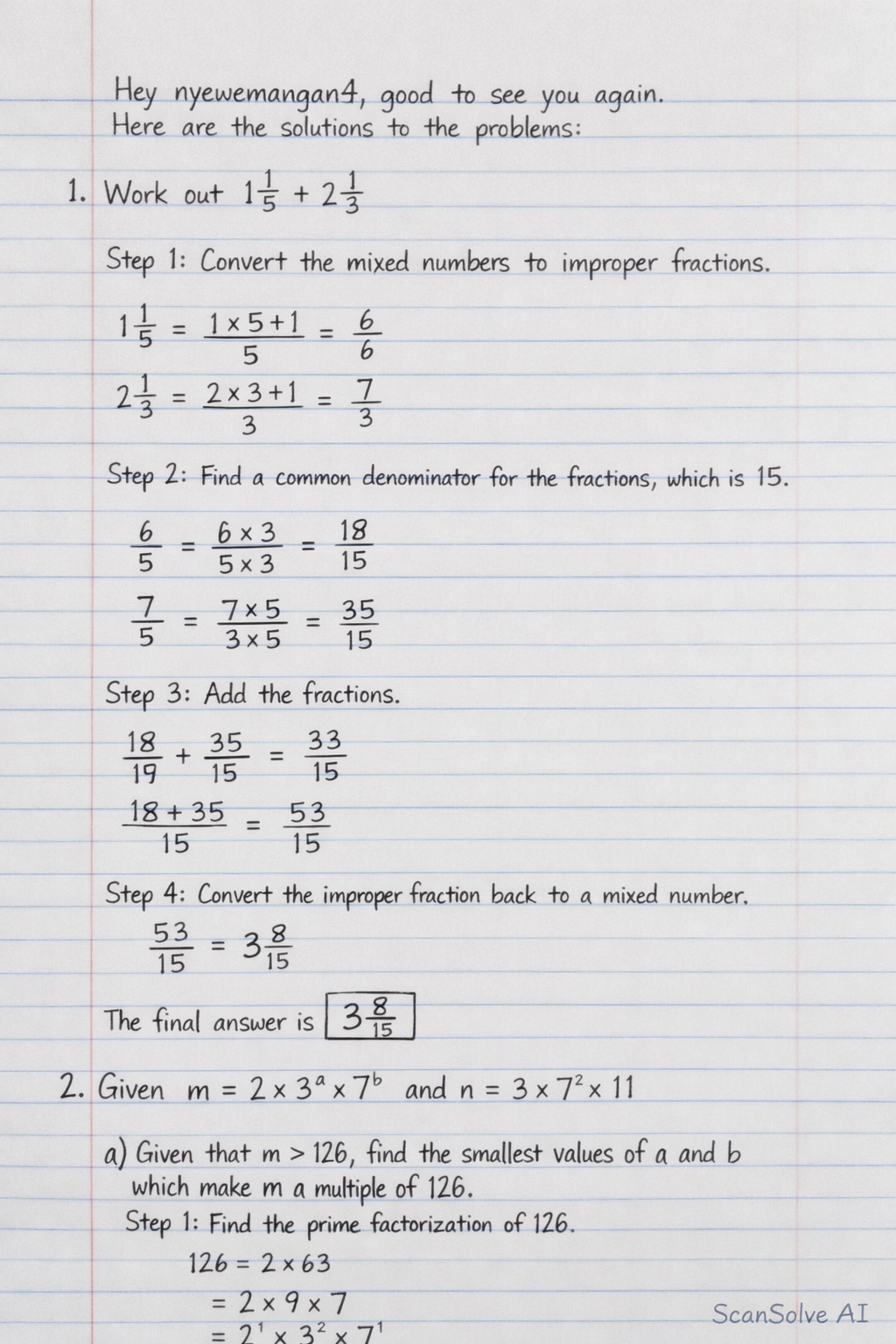
Here are the solutions to the problems:

1. Work out 115+2131\frac{1}{5} + 2\frac{1}{3}

Step 1: Convert the mixed numbers to improper fractions. 115=1×5+15=651\frac{1}{5} = \frac{1 \times 5 + 1}{5} = \frac{6}{5} 213=2×3+13=732\frac{1}{3} = \frac{2 \times 3 + 1}{3} = \frac{7}{3}

Step 2: Find a common denominator for the fractions, which is 15. 65=6×35×3=1815\frac{6}{5} = \frac{6 \times 3}{5 \times 3} = \frac{18}{15} 73=7×53×5=3515\frac{7}{3} = \frac{7 \times 5}{3 \times 5} = \frac{35}{15}

Step 3: Add the fractions. 1815+3515=18+3515=5315\frac{18}{15} + \frac{35}{15} = \frac{18 + 35}{15} = \frac{53}{15}

Step 4: Convert the improper fraction back to a mixed number. 5315=3815\frac{53}{15} = 3\frac{8}{15} The final answer is \boxed{3\frac{8{15}}}.

2. Given m=2×3a×7bm = 2 \times 3^a \times 7^b and n=3×72×11n = 3 \times 7^2 \times 11

a) Given that m>126m > 126, find the smallest values of aa and bb which make mm a multiple of 126.

Step 1: Find the prime factorization of 126. 126=2×63=2×9×7=21×32×71126 = 2 \times 63 = 2 \times 9 \times 7 = 2^1 \times 3^2 \times 7^1

Step 2: For m=2×3a×7bm = 2 \times 3^a \times 7^b to be a multiple of 126=21×32×71126 = 2^1 \times 3^2 \times 7^1, the exponents of its prime factors must be greater than or equal to those of 126. For the prime factor 2: 212^1 in mm matches 212^1 in 126. For the prime factor 3: 3a3^a in mm means a2a \ge 2. For the prime factor 7: 7b7^b in mm means b1b \ge 1.

Step 3: Consider the condition m>126m > 126. If we take the smallest possible values from Step 2 (a=2,b=1a=2, b=1), then m=2×32×71=2×9×7=126m = 2 \times 3^2 \times 7^1 = 2 \times 9 \times 7 = 126. This value of mm is not strictly greater than 126, so we need to increase mm. To do this, we must increase either aa or bb by at least 1.

Step 4: Find the smallest aa and bb that satisfy a2a \ge 2, b1b \ge 1, and m>126m > 126. Let's test the smallest possible value for aa, which is a=2a=2. If a=2a=2, then m=2×32×7b=18×7bm = 2 \times 3^2 \times 7^b = 18 \times 7^b. We need 18×7b>12618 \times 7^b > 126. Divide by 18: 7b>12618=77^b > \frac{126}{18} = 7. So, 7b>717^b > 7^1, which implies b>1b > 1. Since bb must be an integer and b1b \ge 1, the smallest integer value for bb that satisfies b>1b > 1 is b=2b=2. Therefore, the smallest values are a=2a=2 and b=2b=2. Let's check this: m=2×32×72=2×9×49=18×49=882m = 2 \times 3^2 \times 7^2 = 2 \times 9 \times 49 = 18 \times 49 = 882. 882882 is a multiple of 126126 (882=7×126882 = 7 \times 126) and 882>126882 > 126.

The final answer is a=2,b=2\boxed{a=2, b=2}.

b) Explain why 33n33n is a perfect square.

Step 1: Substitute the expression for nn into 33n33n. Given n=3×72×11n = 3 \times 7^2 \times 11. 33n=33×(3×72×11)33n = 33 \times (3 \times 7^2 \times 11)

Step 2: Express 33 as a product of its prime factors. 33=3×1133 = 3 \times 11

Step 3: Substitute the prime factors of 33 into the expression for 33n33n and combine like terms. 33n=(3×11)×(3×72×11)33n = (3 \times 11) \times (3 \times 7^2 \times 11) 33n=31×111×31×72×11133n = 3^1 \times 11^1 \times 3^1 \times 7^2 \times 11^1 33n=31+1×72×111+133n = 3^{1+1} \times 7^2 \times 11^{1+1} 33n=32×72×11233n = 3^2 \times 7^2 \times 11^2

Step 4: Explain why the result is a perfect square. A number is a perfect square if all the exponents in its prime factorization are even. In the expression 32×72×1123^2 \times 7^2 \times 11^2, all the exponents (2, 2, and 2) are even. Therefore, 33n33n is a perfect square. It can also be written as (3×7×11)2=(231)2(3 \times 7 \times 11)^2 = (231)^2.

The final answer is Becausetheprimefactorizationof33nis32×72×112,whereallprimefactorshaveevenexponents.\boxed{Because the prime factorization of 33n is 3^2 \times 7^2 \times 11^2, where all prime factors have even exponents.}

Send me the next one 📸

Was this helpful?

Need help with your own homework?

Get instant step-by-step solutions to any question. Free to start.

Ask Your Question
Handwritten step-by-step solution preview

Handwritten Step-by-Step Solution

Get this as a handwritten image on WhatsApp — like a tutor wrote it for you.

Try on WhatsApp

Still have questions?

Quick Answer

1. Work out 1(1)/(5) + 2(1)/(3) Step 1: Convert the mixed numbers to improper fractions.

Work out. 1 1/5 + 2 1/3 m = 2 x 3^a x 7^b and n = 3 x 72 x 11 Given that m > 126, find the smallest values of a and b which make m a multiple of 126. Explain why 33n is a perfect square.
Mathematics

This mathematics problem involves applying core mathematical principles and formulas. Below you will find a complete step-by-step solution with detailed explanations for each step, helping you understand not just the answer but the method behind it.

ScanSolve AI Answer
Here are the solutions to the problems: 1. Work out 1(1)/(5) + 2(1)/(3) Step 1: Convert the mixed numbers to improper fractions. 1(1)/(5) = (1 × 5 + 1)/(5) = (6)/(5) 2(1)/(3) = (2 × 3 + 1)/(3) = (7)/(3) Step 2: Find a common denominator for the fractions, which is 15. (6)/(5) = (6 × 3)/(5 × 3) = (18)/(15) (7)/(3) = (7 × 5)/(3 × 5) = (35)/(15) Step 3: Add the fractions. (18)/(15) + (35)/(15) = (18 + 35)/(15) = (53)/(15) Step 4: Convert the improper fraction back to a mixed number. (53)/(15) = 3(8)/(15) The final answer is 3(8)/(15). 2. Given m = 2 × 3^a × 7^b and n = 3 × 7^2 × 11 a) Given that m > 126, find the smallest values of a and b which make m a multiple of 126. Step 1: Find the prime factorization of 126. 126 = 2 × 63 = 2 × 9 × 7 = 2^1 × 3^2 × 7^1 Step 2: For m = 2 × 3^a × 7^b to be a multiple of 126 = 2^1 × 3^2 × 7^1, the exponents of its prime factors must be greater than or equal to those of 126. For the prime factor 2: 2^1 in m matches 2^1 in 126. For the prime factor 3: 3^a in m means a 2. For the prime factor 7: 7^b in m means b 1. Step 3: Consider the condition m > 126. If we take the smallest possible values from Step 2 (a=2, b=1), then m = 2 × 3^2 × 7^1 = 2 × 9 × 7 = 126. This value of m is not strictly greater than 126, so we need to increase m. To do this, we must increase either a or b by at least 1. Step 4: Find the smallest a and b that satisfy a 2, b 1, and m > 126. Let's test the smallest possible value for a, which is a=2. If a=2, then m = 2 × 3^2 × 7^b = 18 × 7^b. We need 18 × 7^b > 126. Divide by 18: 7^b > (126)/(18) = 7. So, 7^b > 7^1, which implies b > 1. Since b must be an integer and b 1, the smallest integer value for b that satisfies b > 1 is b=2. Therefore, the smallest values are a=2 and b=2. Let's check this: m = 2 × 3^2 × 7^2 = 2 × 9 × 49 = 18 × 49 = 882. 882 is a multiple of 126 (882 = 7 × 126) and 882 > 126. The final answer is a=2, b=2. b) Explain why 33n is a perfect square. Step 1: Substitute the expression for n into 33n. Given n = 3 × 7^2 × 11. 33n = 33 × (3 × 7^2 × 11) Step 2: Express 33 as a product of its prime factors. 33 = 3 × 11 Step 3: Substitute the prime factors of 33 into the expression for 33n and combine like terms. 33n = (3 × 11) × (3 × 7^2 × 11) 33n = 3^1 × 11^1 × 3^1 × 7^2 × 11^1 33n = 3^1+1 × 7^2 × 11^1+1 33n = 3^2 × 7^2 × 11^2 Step 4: Explain why the result is a perfect square. A number is a perfect square if all the exponents in its prime factorization are even. In the expression 3^2 × 7^2 × 11^2, all the exponents (2, 2, and 2) are even. Therefore, 33n is a perfect square. It can also be written as (3 × 7 × 11)^2 = (231)^2. The final answer is Because the prime factorization of 33n is 3^2 × 7^2 × 11^2, where all prime factors have even exponents. Send me the next one 📸