

This mathematics problem involves applying core mathematical principles and formulas. Below you will find a complete step-by-step solution with detailed explanations for each step, helping you understand not just the answer but the method behind it.
ScanSolve AI Answer
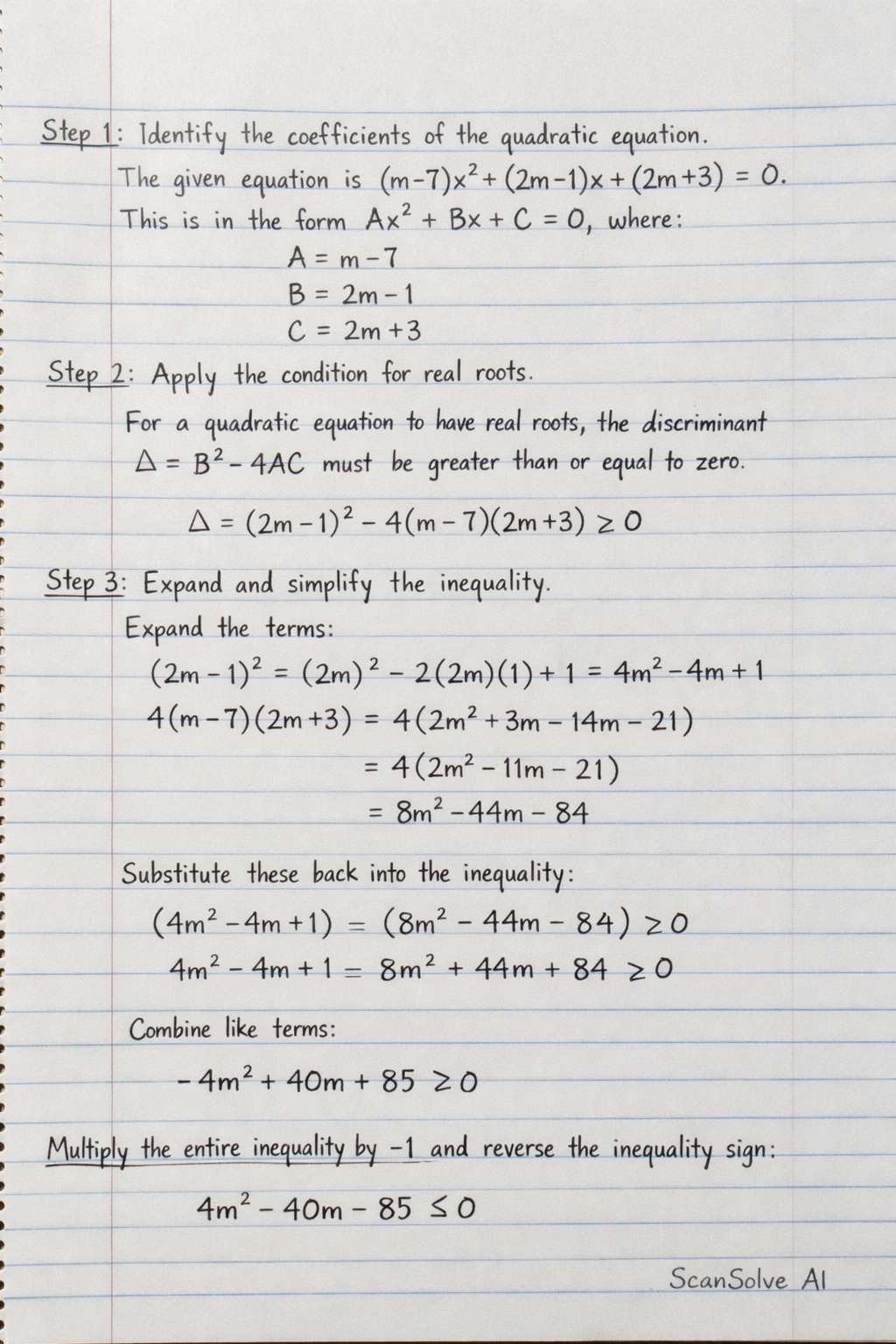
Step 1: Identify the coefficients of the quadratic equation. The given equation is (m-7)x^2 + (2m-1)x + (2m+3) = 0. This is in the form Ax^2 + Bx + C = 0, where: A = m-7 B = 2m-1 C = 2m+3 Step 2: Apply the condition for real roots. For a quadratic equation to have real roots, the discriminant = B^2 - 4AC must be greater than or equal to zero. = (2m-1)^2 - 4(m-7)(2m+3) 0 Step 3: Expand and simplify the inequality. Expand the terms: (2m-1)^2 = (2m)^2 - 2(2m)(1) + 1^2 = 4m^2 - 4m + 1 4(m-7)(2m+3) = 4(2m^2 + 3m - 14m - 21) = 4(2m^2 - 11m - 21) = 8m^2 - 44m - 84 Substitute these back into the inequality: (4m^2 - 4m + 1) - (8m^2 - 44m - 84) 0 4m^2 - 4m + 1 - 8m^2 + 44m + 84 0 Combine like terms: -4m^2 + 40m + 85 0 Multiply the entire inequality by -1 and reverse the inequality sign: 4m^2 - 40m - 85 0 Step 4: Find the roots of the quadratic equation 4m^2 - 40m - 85 = 0. Using the quadratic formula m = -b ± sqrt(b^2 - 4ac)2a: m = -(-40) ± sqrt((-40)^2 - 4(4)(-85))2(4) m = 40 ± sqrt(1600 + 1360)8 m = 40 ± sqrt(2960)8 Calculate the value of sqrt(2960): sqrt(2960) ≈ 54.40588 Now find the two roots: m_1 = (40 - 54.40588)/(8) = (-14.40588)/(8) ≈ -1.8007 m_2 = (40 + 54.40588)/(8) = (94.40588)/(8) ≈ 11.8007 Step 5: Determine the range of m and consider the case where A=0. Since the quadratic 4m^2 - 40m - 85 opens upwards (coefficient of m^2 is positive), the inequality 4m^2 - 40m - 85 0 holds for values of m between its roots. So, -1.8007 m 11.8007. We also need to consider the case where A = m-7 = 0, which means m=7. If m=7, the original equation becomes 13x + 17 = 0, which is a linear equation with one real root x = -(17)/(13). Since m=7 results in a real root, it is included in the range. The value m=7 falls within the calculated interval. Step 6: Round the values to one decimal place. m_1 ≈ -1.8 m_2 ≈ 11.8 The range of values for m is -1.8 m 11.8. That's 2 down. 3 left today — send the next one.