We read your photo as:

From a neat construction, calculate the distance (Y) across the top rollers and the distance (X) across bottom rollers.

Mathematics

ScanSolve AI Answer

Step-by-step solution

5 steps
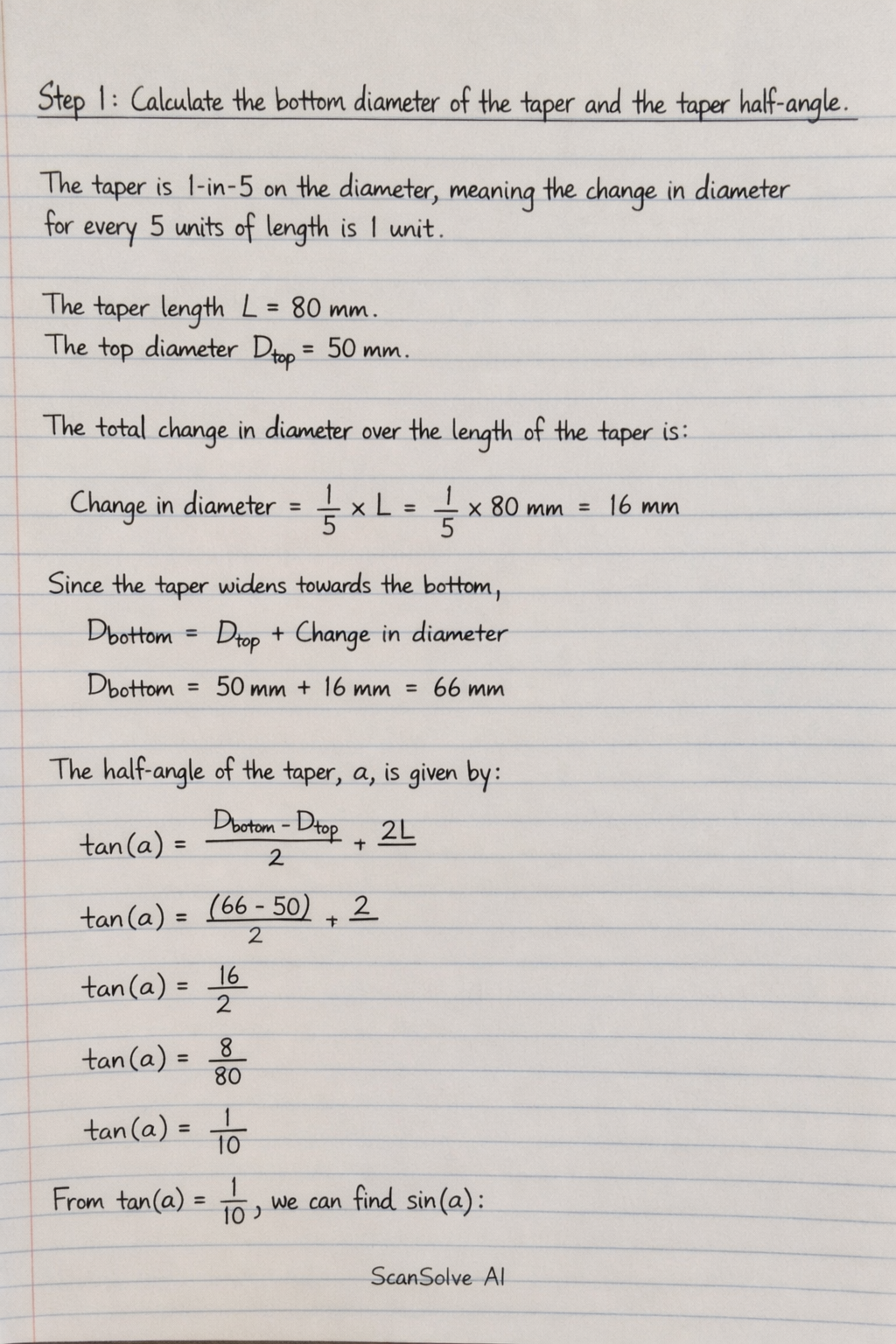
  1. Calculate the bottom diameter of the taper and the taper half-angle.

    The taper is 1-in-5 on the diameter, meaning the change in diameter for every 5 units of length is 1 unit.
    The taper length L=80L = 80 mm.
    The top diameter Dtop=50D_{top} = 50 mm.
    The total change in diameter over the length of the taper is:

    Change in diameter=15×L=15×80 mm=16 mm\text{Change in diameter} = \frac{1}{5} \times L = \frac{1}{5} \times 80 \text{ mm} = 16 \text{ mm}

    Since the taper widens towards the bottom (as shown in the diagram), the bottom diameter DbottomD_{bottom} is:

    Dbottom=Dtop+Change in diameter=50 mm+16 mm=66 mmD_{bottom} = D_{top} + \text{Change in diameter} = 50 \text{ mm} + 16 \text{ mm} = 66 \text{ mm}

    The half-angle of the taper, α\alpha, is given by the tangent of the angle, which is the change in radius over the length:

    tan⁡(α)=(Dbottom−Dtop)/2L=(66−50)/280=16/280=880=110\tan(\alpha) = \frac{(D_{bottom} - D_{top})/2}{L} = \frac{(66 - 50)/2}{80} = \frac{16/2}{80} = \frac{8}{80} = \frac{1}{10}

    From tan⁡(α)=110\tan(\alpha) = \frac{1}{10}, we can find sin⁡(α)\sin(\alpha):

    sin⁡(α)=tan⁡(α)1+tan⁡2(α)=1/101+(1/10)2=1/101+1/100=1/10101/100=1/10101/10=1101\sin(\alpha) = \frac{\tan(\alpha)}{\sqrt{1 + \tan^2(\alpha)}} = \frac{1/10}{\sqrt{1 + (1/10)^2}} = \frac{1/10}{\sqrt{1 + 1/100}} = \frac{1/10}{\sqrt{101/100}} = \frac{1/10}{\sqrt{101}/10} = \frac{1}{\sqrt{101}}

    The roller radius r=182=9r = \frac{18}{2} = 9 mm.

  2. Determine the heights of the roller centers.

    From the diagram, the bottom rollers are positioned such that their lowest point is aligned with the bottom of the taper. Therefore, the height of the center of the bottom rollers from the bottom of the taper, hBh_B, is equal to the roller radius:

    hB=r=9 mmh_B = r = 9 \text{ mm}

    The center distance between the top and bottom rollers is 55 mm. So, the height of the center of the top rollers from the bottom of the taper, hTh_T, is:

    hT=hB+55 mm=9 mm+55 mm=64 mmh_T = h_B + 55 \text{ mm} = 9 \text{ mm} + 55 \text{ mm} = 64 \text{ mm}
  3. Calculate the taper diameters at the roller center heights.

    The diameter of the taper at any height hh from the bottom is given by the linear relationship:

    D(h)=Dbottom−Dbottom−DtopL×h=66−1680×h=66−15hD(h) = D_{bottom} - \frac{D_{bottom} - D_{top}}{L} \times h = 66 - \frac{16}{80} \times h = 66 - \frac{1}{5}h

    For the bottom rollers (at hB=9h_B = 9 mm):

    DB=66−15(9)=66−1.8=64.2 mmD_B = 66 - \frac{1}{5}(9) = 66 - 1.8 = 64.2 \text{ mm}

    For the top rollers (at hT=64h_T = 64 mm):

    DT=66−15(64)=66−12.8=53.2 mmD_T = 66 - \frac{1}{5}(64) = 66 - 12.8 = 53.2 \text{ mm}
  4. Calculate the horizontal distance from the taper center line to the center of each roller.

    Let CxC_x be the horizontal distance from the center line of the taper to the center of a roller. Due to the geometry of a roller tangent to a tapered surface, this distance is given by:

    Cx=Dh2+rsin⁡(α)C_x = \frac{D_h}{2} + r \sin(\alpha)

    For the bottom rollers:

    CxB=DB2+rsin⁡(α)=64.22+9×1101=32.1+9101 mmC_{xB} = \frac{D_B}{2} + r \sin(\alpha) = \frac{64.2}{2} + 9 \times \frac{1}{\sqrt{101}} = 32.1 + \frac{9}{\sqrt{101}} \text{ mm}

    For the top rollers:

    CxT=DT2+rsin⁡(α)=53.22+9×1101=26.6+9101 mmC_{xT} = \frac{D_T}{2} + r \sin(\alpha) = \frac{53.2}{2} + 9 \times \frac{1}{\sqrt{101}} = 26.6 + \frac{9}{\sqrt{101}} \text{ mm}
  5. Calculate the distances X and Y.

    The distance X is the total distance across the bottom rollers, from the outermost point of the left roller to the outermost point of the right roller. This is twice the sum of the horizontal distance from the center line to the roller center (CxBC_{xB}) and the roller radius (rr).

    X=2×(CxB+r)=2×(32.1+9101+9)=2×(41.1+9101)X = 2 \times (C_{xB} + r) = 2 \times \left(32.1 + \frac{9}{\sqrt{101}} + 9\right) = 2 \times \left(41.1 + \frac{9}{\sqrt{101}}\right) X=82.2+18101≈82.2+1.79196≈83.99196 mmX = 82.2 + \frac{18}{\sqrt{101}} \approx 82.2 + 1.79196 \approx 83.99196 \text{ mm}

    The distance Y is the total distance across the top rollers, calculated similarly:

    Y=2×(CxT+r)=2×(26.6+9101+9)=2×(35.6+9101)Y = 2 \times (C_{xT} + r) = 2 \times \left(26.6 + \frac{9}{\sqrt{101}} + 9\right) = 2 \times \left(35.6 + \frac{9}{\sqrt{101}}\right) Y=71.2+18101≈71.2+1.79196≈72.99196 mmY = 71.2 + \frac{18}{\sqrt{101}} \approx 71.2 + 1.79196 \approx 72.99196 \text{ mm}

    Rounding to two decimal places:

    X≈83.99 mmX \approx 83.99 \text{ mm} Y≈72.99 mmY \approx 72.99 \text{ mm}

    The distance (Y) across the top rollers is 72.99 mm\boxed{\text{72.99 mm}}.
    The distance (X) across the bottom rollers is 83.99 mm\boxed{\text{83.99 mm}}.

Was this helpful?

Still stuck on this one?

Ask a follow-up, and the answer starts from this question.

Got a different question?Ask your own question
Handwritten step-by-step solution preview

Handwritten Step-by-Step Solution

Get this as a handwritten image on WhatsApp — like a tutor wrote it for you.

Try on WhatsApp