We read your photo as:

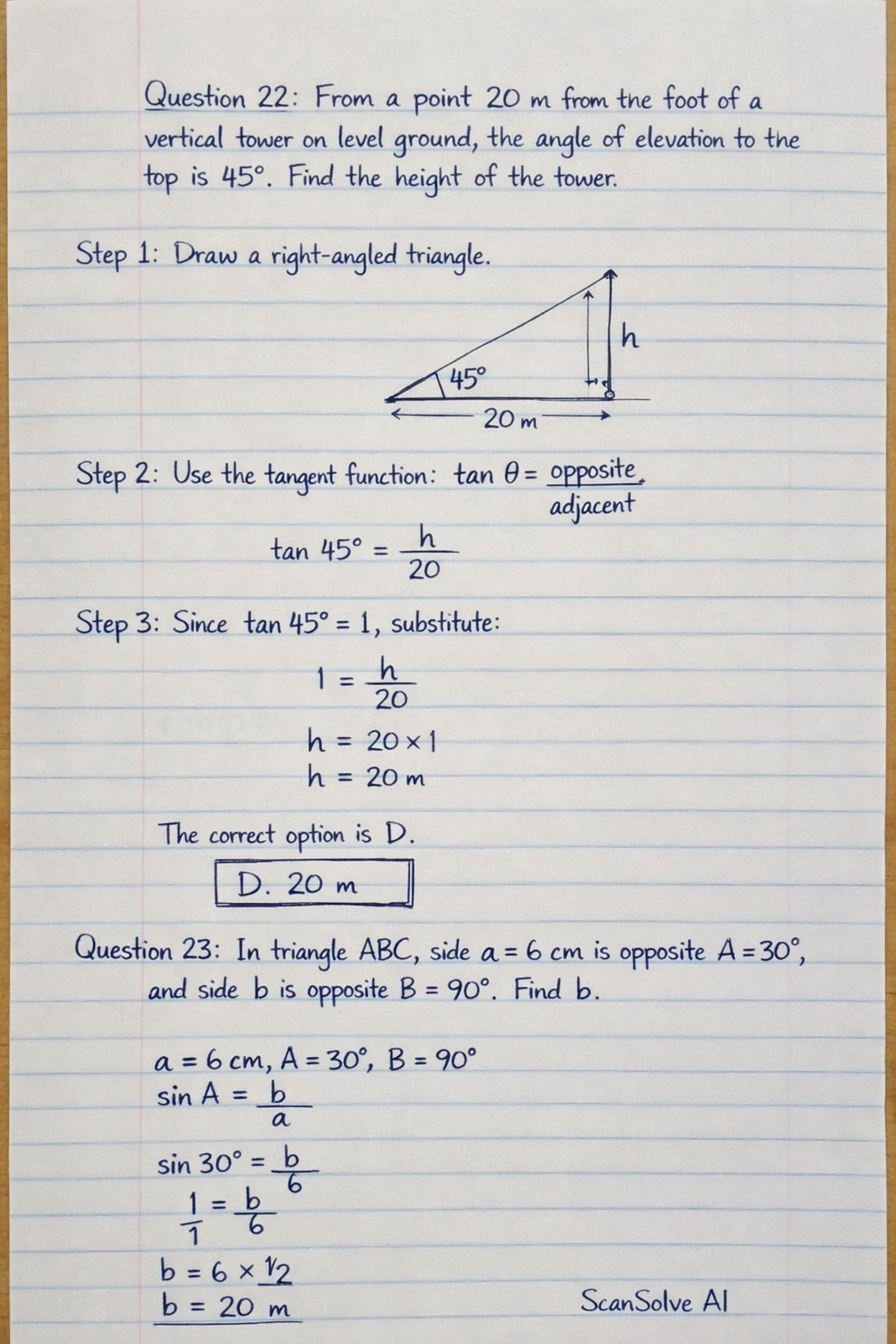
From a point 20 m from the foot of a vertical tower on level ground, the angle of elevation to the top is 45°. Find the height of the tower.

Mathematics

ScanSolve AI Answer

Answer

D

Step-by-step solution

28 steps

Part 22· 3 steps

From a point 20 m from the foot of a vertical tower on level ground, the angle of elevation to the top is 45∘45^\circ. Find the height of the tower.

  1. Draw a right-angled triangle.

    The distance from the foot of the tower is the adjacent side (20 m), and the height of the tower is the opposite side (hh). The angle of elevation is 45∘45^\circ.

  2. Use the tangent function, which relates the opposite and adjacent sides

    tan⁡θ=oppositeadjacent\tan \theta = \frac{\text{opposite}}{\text{adjacent}}.

    tan⁡45∘=h20\tan 45^\circ = \frac{h}{20}
  3. Since tan⁡45∘=1\tan 45^\circ = 1, substitute this value into the equation.

    1=h201 = \frac{h}{20} h=20×1h = 20 \times 1 h=20 mh = 20 \text{ m}

    The correct option is D.

    D. 20 m\boxed{\text{D. } 20 \text{ m}}

Part 23· 3 steps

In triangle ABC, side a=6a = 6 cm is opposite A=30∘A = 30^\circ, and side bb is opposite B=90∘B = 90^\circ. Find bb.

  1. Use the Sine Rule, which states asin⁡A=bsin⁡B\frac{a}{\sin A} = \frac{b}{\sin B}.

  2. Substitute the given values into the formula.

    6sin⁡30∘=bsin⁡90∘\frac{6}{\sin 30^\circ} = \frac{b}{\sin 90^\circ}
  3. Recall that sin⁡30∘=0.5\sin 30^\circ = 0.5 and sin⁡90∘=1\sin 90^\circ = 1.

    60.5=b1\frac{6}{0.5} = \frac{b}{1} 12=b12 = b b=12 cmb = 12 \text{ cm}

    The correct option is B.

    B. 12 cm\boxed{\text{B. } 12 \text{ cm}}

Part 24· 4 steps

Two sides of a triangle are 5 cm and 7 cm, and their included angle is 60∘60^\circ. Find the length of the third side.

  1. Use the Cosine Rule, which states c2=a2+b2−2abcos⁡Cc^2 = a^2 + b^2 - 2ab \cos C.

    Here, let a=5a = 5 cm, b=7b = 7 cm, and the included angle C=60∘C = 60^\circ.

  2. Substitute the values into the formula.

    c2=52+72−2(5)(7)cos⁡60∘c^2 = 5^2 + 7^2 - 2(5)(7) \cos 60^\circ
  3. Recall that cos⁡60∘=0.5\cos 60^\circ = 0.5.

    c2=25+49−2(35)(0.5)c^2 = 25 + 49 - 2(35)(0.5) c2=74−35c^2 = 74 - 35 c2=39c^2 = 39
  4. Take the square root to find cc.

    c=39 cmc = \sqrt{39} \text{ cm}

    The correct option is B.

    B. 39 cm\boxed{\text{B. } \sqrt{39} \text{ cm}}

Part 25· 3 steps

A chord subtends an angle of 40∘40^\circ at a point on the major arc of a circle. Find the angle subtended by the same chord at the centre on the minor-arc side.

  1. Apply the circle theorem that states the angle subtended by a chord at the centre of a circle is twice the angle subtended by the same chord at any point on the circumference.

  2. The angle at the circumference (on the major arc) is given as 40∘40^\circ.

  3. Calculate the angle at the centre.

    Angle at centre=2×Angle at circumference\text{Angle at centre} = 2 \times \text{Angle at circumference} Angle at centre=2×40∘\text{Angle at centre} = 2 \times 40^\circ Angle at centre=80∘\text{Angle at centre} = 80^\circ

    This angle is on the minor-arc side.
    The correct option is A.

    A. 80∘\boxed{\text{A. } 80^\circ}

Part 26· 3 steps

Find the area of a sector of radius 6 cm and angle 60∘60^\circ. Leave your answer in terms of π\pi.

  1. Use the formula for the area of a sector

    Area =θ360∘×πr2= \frac{\theta}{360^\circ} \times \pi r^2.

  2. Substitute the given values

    radius r=6r = 6 cm and angle θ=60∘\theta = 60^\circ.

    Area=60∘360∘×π(6)2\text{Area} = \frac{60^\circ}{360^\circ} \times \pi (6)^2
  3. Simplify the expression.

    Area=16×π(36)\text{Area} = \frac{1}{6} \times \pi (36) Area=6π cm2\text{Area} = 6\pi \text{ cm}^2

    The correct option is C.

    C. 6π cm2\boxed{\text{C. } 6\pi \text{ cm}^2}

Part 27· 3 steps

Find the volume of a cone of radius 3 cm and perpendicular height 7 cm. Use π=227\pi = \frac{22}{7}.

  1. Use the formula for the volume of a cone

    Volume =13πr2h= \frac{1}{3} \pi r^2 h.

  2. Substitute the given values

    radius r=3r = 3 cm, height h=7h = 7 cm, and π=227\pi = \frac{22}{7}.

    Volume=13×227×(3)2×7\text{Volume} = \frac{1}{3} \times \frac{22}{7} \times (3)^2 \times 7
  3. Simplify the expression.

    Volume=13×227×9×7\text{Volume} = \frac{1}{3} \times \frac{22}{7} \times 9 \times 7 Volume=13×22×9\text{Volume} = \frac{1}{3} \times 22 \times 9 Volume=22×3\text{Volume} = 22 \times 3 Volume=66 cm3\text{Volume} = 66 \text{ cm}^3

    The correct option is B.

    B. 66 cm3\boxed{\text{B. } 66 \text{ cm}^3}

Part 28· 3 steps

The values 1, 2 and 3 have frequencies 2, 3 and 5 respectively. Find the mean.

  1. Calculate the sum of the products of each value and its frequency (∑xifi\sum x_i f_i).

    ∑xifi=(1×2)+(2×3)+(3×5)\sum x_i f_i = (1 \times 2) + (2 \times 3) + (3 \times 5) ∑xifi=2+6+15\sum x_i f_i = 2 + 6 + 15 ∑xifi=23\sum x_i f_i = 23
  2. Calculate the sum of the frequencies (∑fi\sum f_i).

    ∑fi=2+3+5\sum f_i = 2 + 3 + 5 ∑fi=10\sum f_i = 10
  3. Calculate the mean using the formula

    Mean =∑xifi∑fi= \frac{\sum x_i f_i}{\sum f_i}.

    Mean=2310\text{Mean} = \frac{23}{10} Mean=2.3\text{Mean} = 2.3

    The correct option is C.

    C. 2.3\boxed{\text{C. } 2.3}

Part 29· 3 steps

Two fair coins are tossed independently. Find the probability of exactly one head.

  1. List all possible outcomes when tossing two fair coins

    • Head, Head (HH)
    • Head, Tail (HT)
    • Tail, Head (TH)
    • Tail, Tail (TT) There are 4 possible outcomes.
  2. Identify the outcomes with exactly one head

    • HT
    • TH There are 2 favorable outcomes.
  3. Calculate the probability

    Probability =Number of favorable outcomesTotal number of outcomes= \frac{\text{Number of favorable outcomes}}{\text{Total number of outcomes}}.

    Probability=24\text{Probability} = \frac{2}{4} Probability=12\text{Probability} = \frac{1}{2}

    The correct option is A.

    A. 12\boxed{\text{A. } \frac{1}{2}}

Part 30· 3 steps

A bag contains 4 red and 3 blue balls. Two balls are drawn at random without replacement. Find the probability that both are red.

  1. Calculate the probability of drawing the first red ball.

    There are 4 red balls out of a total of 4+3=74 + 3 = 7 balls.

    P(1st ball is red)=47P(\text{1st ball is red}) = \frac{4}{7}
  2. Calculate the probability of drawing the second red ball, given that the first ball drawn was red and not replaced.

    Now there are 4−1=34 - 1 = 3 red balls left and a total of 7−1=67 - 1 = 6 balls remaining.

    P(2nd ball is red∣1st ball was red)=36=12P(\text{2nd ball is red} | \text{1st ball was red}) = \frac{3}{6} = \frac{1}{2}
  3. Multiply the probabilities to find the probability that both balls drawn are red.

    P(both are red)=P(1st is red)×P(2nd is red∣1st was red)P(\text{both are red}) = P(\text{1st is red}) \times P(\text{2nd is red} | \text{1st was red}) P(both are red)=47×12P(\text{both are red}) = \frac{4}{7} \times \frac{1}{2} P(both are red)=414P(\text{both are red}) = \frac{4}{14} P(both are red)=27P(\text{both are red}) = \frac{2}{7}

    The correct option is B.

    B. 27\boxed{\text{B. } \frac{2}{7}}
Was this helpful?

Try one yourself

A new problem that tests the same skill.

Still stuck on this one?

Ask a follow-up, and the answer starts from this question.

Got a different question?Ask your own question
Handwritten step-by-step solution preview

Handwritten Step-by-Step Solution

Get this as a handwritten image on WhatsApp — like a tutor wrote it for you.

Try on WhatsApp