
We read your photo as:
From the top of a 4.2m high platform, a student observes a flower on the ground. The angle of depression is 42 degrees. Calculate the horizontal distance from the foot of the platform to the flower.
ScanSolve AI Answer
Answer
Step-by-step solution
4 stepsIdentify the given values and the unknown.
The height of the platform () is 4.2 m.
The angle of depression () is .
We need to find the horizontal distance () from the foot of the platform to the flower.Relate the values using trigonometry.
When a student views a flower on the ground, a right-angled triangle is formed. The height of the platform is the side opposite to the angle of elevation from the flower to the student, which is equal to the angle of depression. The horizontal distance is the adjacent side.
We use the tangent function:In this case, and .
Solve for the distance .
Rearrange the formula to solve for :
Calculate the value:
Rounding to the nearest whole number, .
Select the correct option.
The calculated distance is approximately , which matches option (d). The scale given (1 cm to represent 100m) is not needed for this calculation.
The final answer is .
Here are the explanations for the following terms:
-
Angle of Elevation: This is the angle formed between the horizontal line of sight and the line of sight upwards to an object. It occurs when an observer looks up at an object.
-
Angle of Depression: This is the angle formed between the horizontal line of sight and the line of sight downwards to an object. It occurs when an observer looks down at an object.
-
Bearing: This is a direction measured in degrees clockwise from North. It is commonly used in navigation and surveying to specify a direction.
-
Try one yourself
A new problem that tests the same skill.
Still stuck on this one?
Ask a follow-up, and the answer starts from this question.
More Mathematics Questions
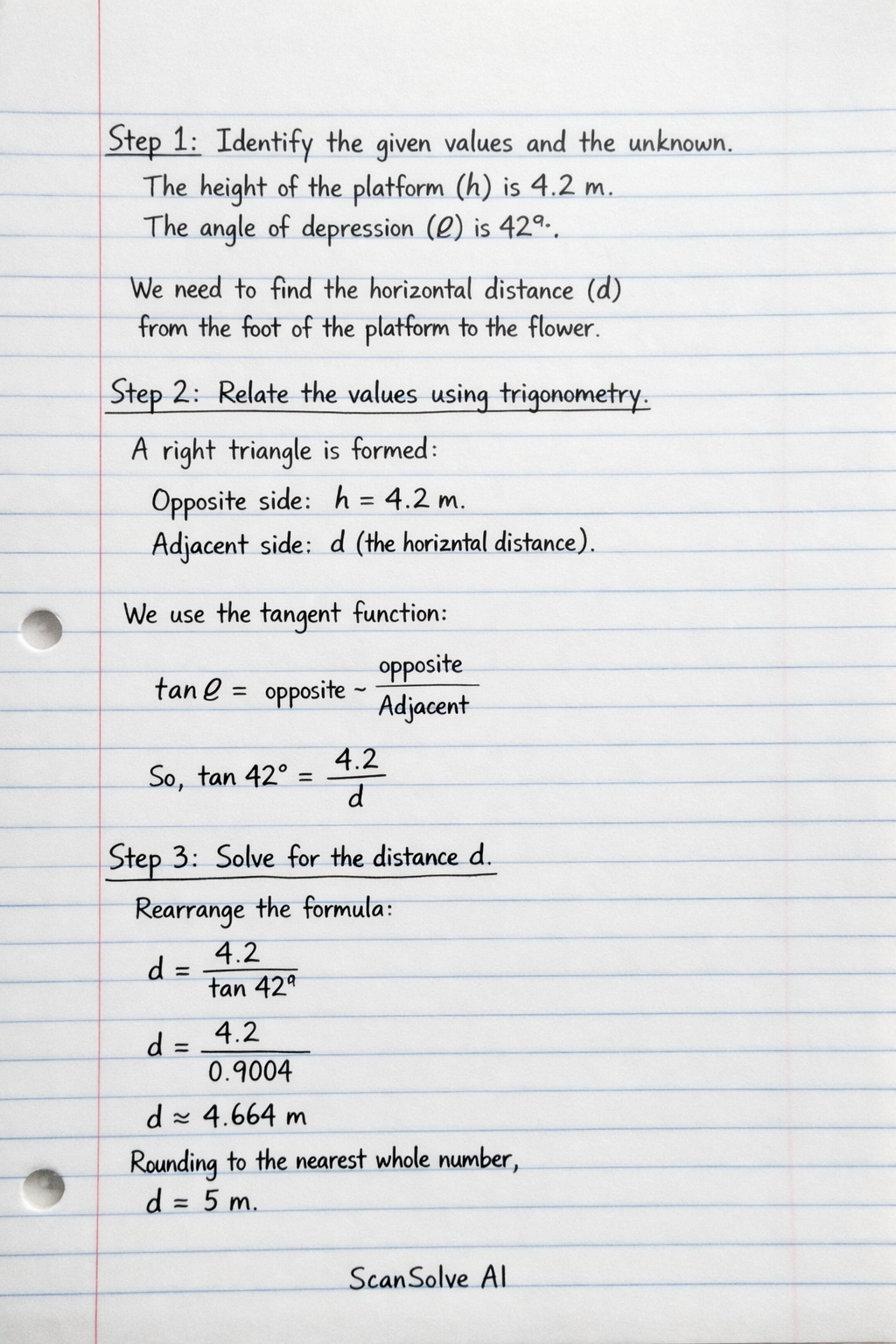
Handwritten Step-by-Step Solution
Get this as a handwritten image on WhatsApp — like a tutor wrote it for you.
Try on WhatsApp