
We read your photo as:
Gas is escaping from a spherical balloon at 45 ext m3/ extmin. How fast is the radius decreasing when r = 5 ext m?
ScanSolve AI Answer
Step-by-step solution
2 stepsHere's the solution to the next rate problem:
2. Gas is escaping from a spherical balloon at . How fast is the radius decreasing when ?
Given:
Rate of change of volume, (negative because the volume is decreasing)
Radius,
The formula for the volume of a sphere is .
Differentiate the volume formula with respect to time .
Using the chain rule, we differentiate both sides with respect to :
Substitute the given values into the derivative and solve for .
The negative sign indicates that the radius is decreasing.
The rate at which the radius is decreasing is
\boxed{\textbf{\frac{9}{20\pi} m/min}}.
Still stuck on this one?
Ask a follow-up, and the answer starts from this question.
More Mathematics Questions
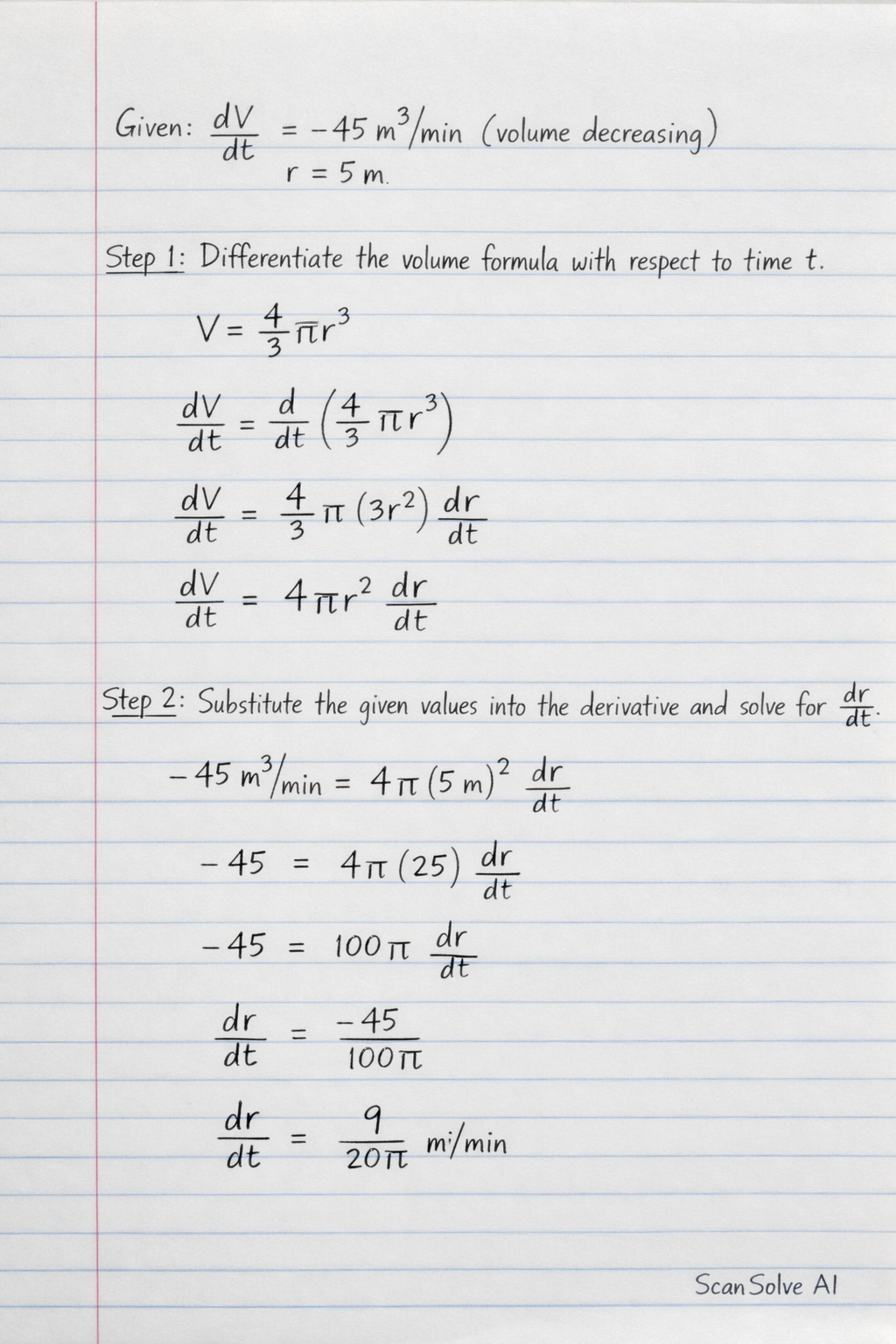
Handwritten Step-by-Step Solution
Get this as a handwritten image on WhatsApp — like a tutor wrote it for you.
Try on WhatsApp