
We read your photo as:
Describe the geometric transformations represented by the following matrices, applied to the unit square.
ScanSolve AI Answer
Step-by-step solution
8 stepsHere are the descriptions of the transformations for each matrix, using the unit square with vertices , , , and .
Part a· 2 steps
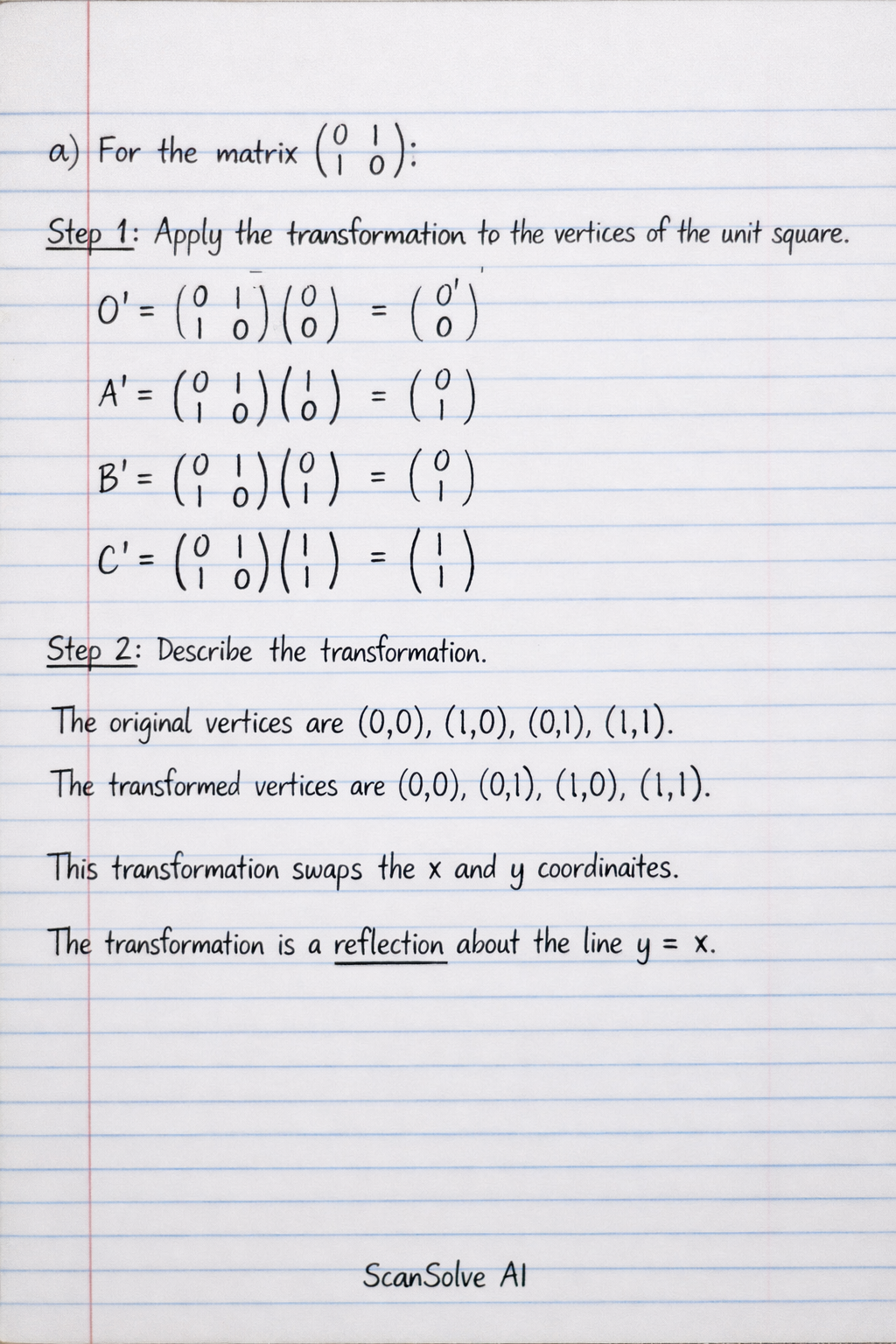
For the matrix
Apply the transformation to the vertices of the unit square.
Describe the transformation.
The original vertices are . The transformed vertices are . This transformation swaps the x and y coordinates.
The transformation is a reflection about the line .
Part b· 2 steps
For the matrix
Apply the transformation to the vertices of the unit square.
Describe the transformation.
The original vertices are . The transformed vertices are . This corresponds to rotating the x-axis to the y-axis and the y-axis to the negative x-axis.
The transformation is a rotation of counter-clockwise about the origin .
Part c· 2 steps
For the matrix
Apply the transformation to the vertices of the unit square.
Describe the transformation.
The original vertices are $(0,0), (1,0), (0,1), (1,1)$. The transformed vertices are $(0,0), (2,0), (0,2), (2,2)$. All coordinates are multiplied by 2.
The transformation is an enlargement (or dilation) with a scale factor of 2, centered at the origin $(0,0)$.
Part d· 2 steps
For the matrix
Apply the transformation to the vertices of the unit square.
Describe the transformation.
The original vertices are . The transformed vertices are . This transformation maps to .
The transformation is a reflection about the line .
Still stuck on this one?
Ask a follow-up, and the answer starts from this question.
More Mathematics Questions
Handwritten Step-by-Step Solution
Get this as a handwritten image on WhatsApp — like a tutor wrote it for you.
Try on WhatsApp