
We read your photo as:
Given 2x² + 4x + 3 = 0, we have a=2, b=4, c=3.
ScanSolve AI Answer
Answer
\text{2x^2 + 8x + 9 = 0}
Step-by-step solution
4 stepsFind the sum and product of the roots and for the given equation .
For a quadratic equation , the sum of roots is and the product of roots is .
Given , we have , , .
Sum of roots:Product of roots:
Find the sum of the new roots, which are and .
Let the new roots be and .
Sum of new roots:Substitute the value of :
Find the product of the new roots.
Product of new roots:
Substitute the values of and :
Form the new quadratic equation.
A quadratic equation with roots and is given by .
Substitute the sum and product of the new roots:To eliminate the fraction, multiply the entire equation by 2:
Comparing this with the given options, option (b) matches our result.
Try one yourself
A new problem that tests the same skill.
Still stuck on this one?
Ask a follow-up, and the answer starts from this question.
More Mathematics Questions
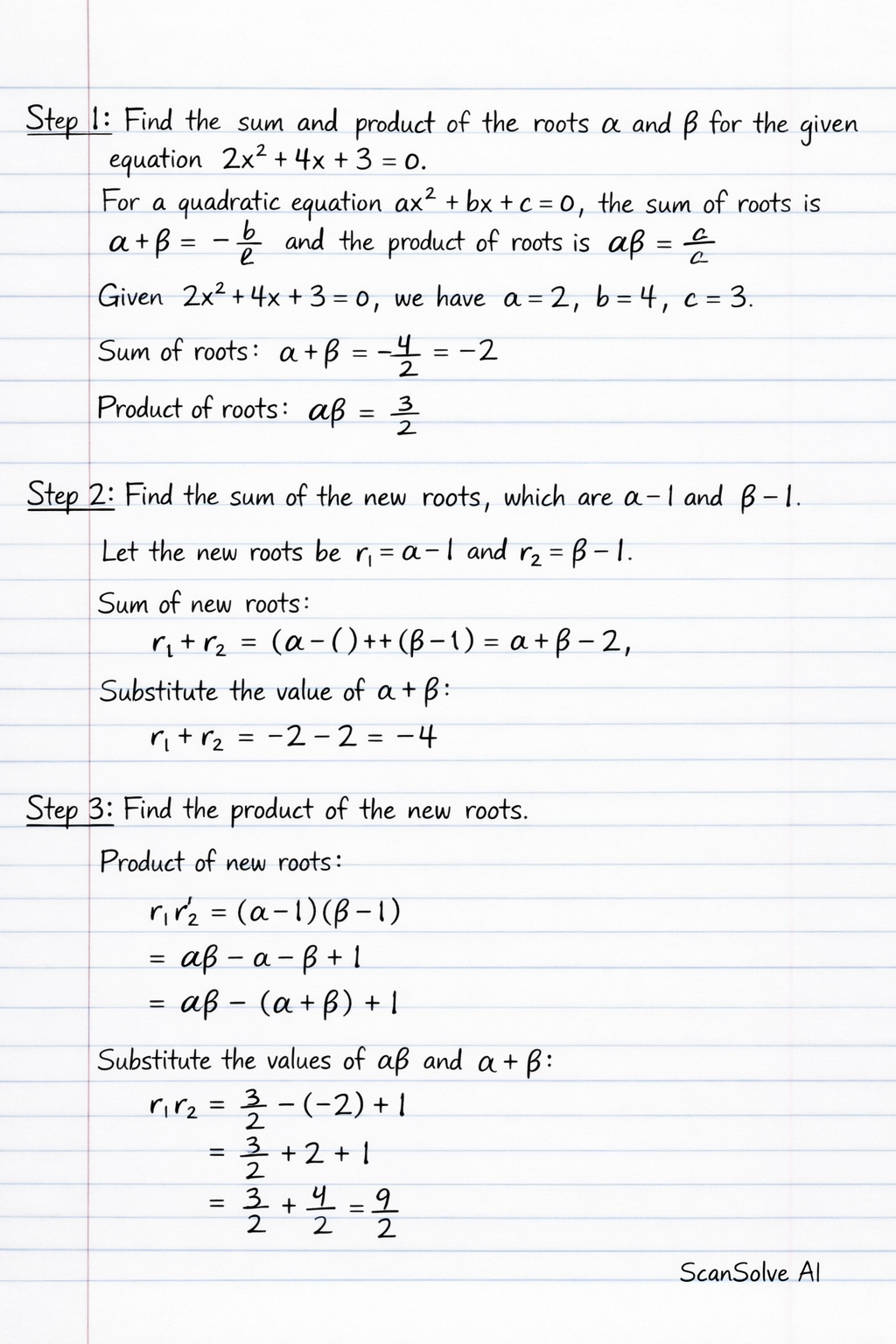
Handwritten Step-by-Step Solution
Get this as a handwritten image on WhatsApp — like a tutor wrote it for you.
Try on WhatsApp