

This mathematics problem involves applying core mathematical principles and formulas. Below you will find a complete step-by-step solution with detailed explanations for each step, helping you understand not just the answer but the method behind it.
ScanSolve AI Answer
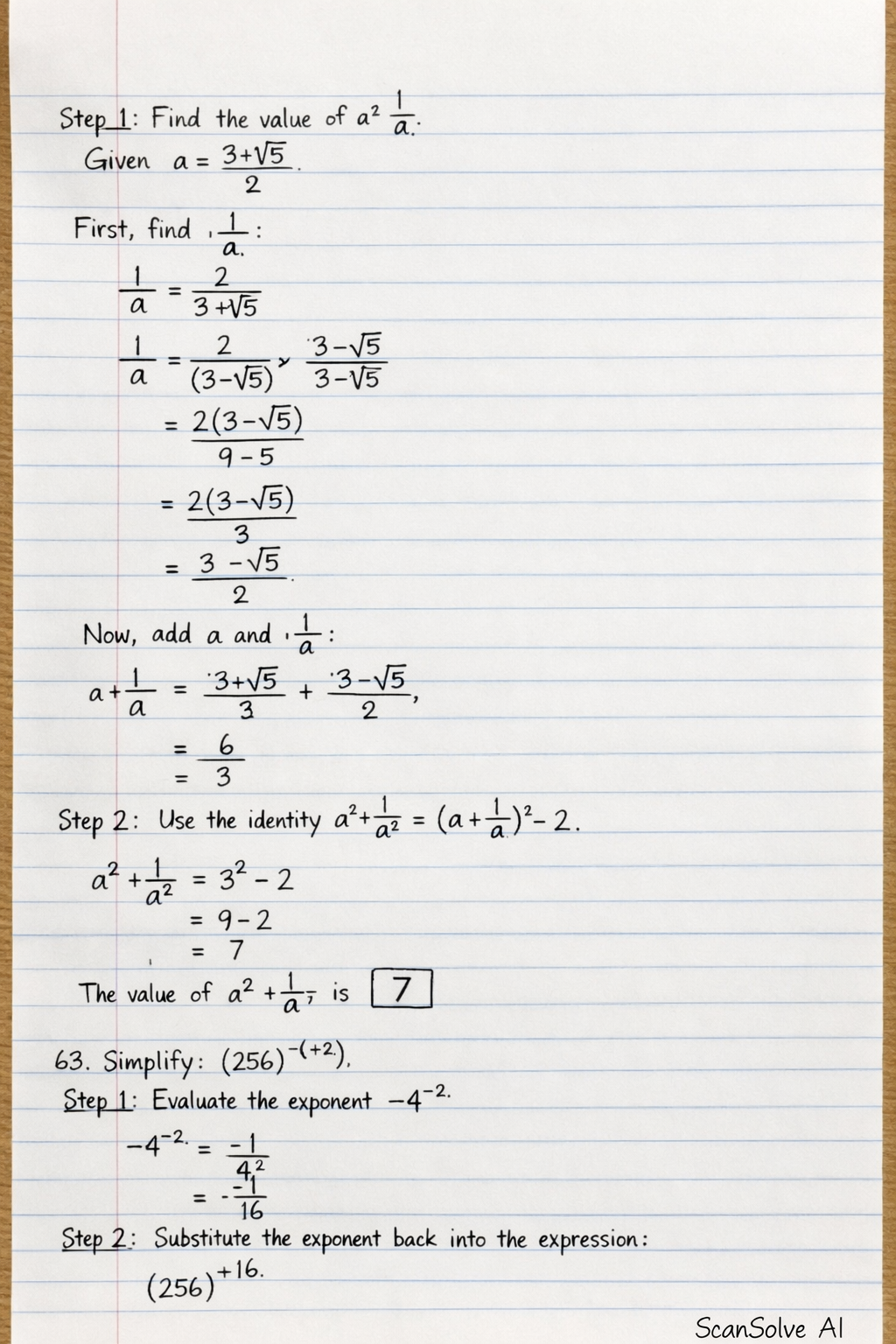
Step 1: Find the value of a + (1)/(a). Given a = 3+sqrt(5)2. First, find (1)/(a): (1)/(a) = (2)/(3+sqrt(5)) Rationalize the denominator by multiplying the numerator and denominator by the conjugate of the denominator, 3-sqrt(5): (1)/(a) = (2)/(3+sqrt(5)) × 3-sqrt(5)3-sqrt(5) = 2(3-sqrt(5))3^2 - (sqrt(5))^2 = 2(3-sqrt(5))9-5 = 2(3-sqrt(5))4 = 3-sqrt(5)2 Now, add a and (1)/(a): a + (1)/(a) = 3+sqrt(5)2 + 3-sqrt(5)2 = 3+sqrt(5)+3-sqrt(5)2 = (6)/(2) = 3 Step 2: Use the identity a^2 + (1)/(a^2) = (a + (1)/(a))^2 - 2. Substitute the value of a + (1)/(a) found in Step 1: a^2 + (1)/(a^2) = (3)^2 - 2 = 9 - 2 = 7 The value of a^2 + (1)/(a^2) is 7. 63. Simplify: (256)^(-4^-2) Step 1: Evaluate the exponent -4^-2. -4^-2 = -(1)/(4^2) = -(1)/(16) Step 2: Substitute the exponent back into the expression. (256)^(-1/16) Step 3: Express 256 as a power of a base that simplifies with the exponent. We know that 256 = 2^8. (2^8)^-1/16 = 2^8 × (-(1)/(16)) = 2^-(8)/(16) = 2^-(1)/(2) Step 4: Simplify the expression. 2^-(1)/(2) = (1)/(2^1/2) = (1)/(sqrt(2)) Rationalize the denominator: (1)/(sqrt(2)) × sqrt(2)sqrt(2) = sqrt(2)2 The simplified expression is sqrt(2)2. 64. Find the value of (4)/((216)^-2)3 + (1)/((256)^-3)4 + (2)/((243)^-1)5 Step 1: Rewrite the terms using the property (1)/(x^-n) = x^n. The expression becomes: 4 · (216)^(2)/(3) + 1 · (256)^(3)/(4) + 2 · (243)^(1)/(5) Step 2: Evaluate each term. For the first term, 4 · (216)^(2)/(3): Recognize that 216 = 6^3. 4 · (6^3)^(2)/(3) = 4 · 6^3 × (2)/(3) = 4 · 6^2 = 4 · 36 = 144 For the second term, 1 · (256)^(3)/(4): Recognize that 256 = 4^4. 1 · (4^4)^(3)/(4) = 1 · 4^4 × (3)/(4) = 1 · 4^3 = 1 · 64 = 64 For the third term, 2 · (243)^(1)/(5): Recognize that 243 = 3^5. 2 · (3^5)^(1)/(5) = 2 · 3^5 × (1)/(5) = 2 · 3^1 = 2 · 3 = 6 Step 3: Add the values of the terms. 144 + 64 + 6 = 208 + 6 = 214 The value of the expression is 214. Send me the next one 📸