
We read your photo as:
Given a circle equation, find its center and related line equations, and prove a relationship between coordinates.
ScanSolve AI Answer
This answer stops before the end.
It was cut off when it was first written. Ask ScanSolve this question again for the full working.
Step 1: Show that M is the point (for 10.1)
The equation of the circle is given as .
To find the center M, we complete the square:
From this standard form , the center M is .
Thus, M is the point .
Step 2: Determine the equation of MR (for 10.2)
M is and R is .
First, calculate the gradient of MR:
Now, use the point-slope form with R and :
The equation of MR is .
Step 3: Show that (for 10.3)
We are given that . This means the line segment MR is perpendicular to the line segment MN.
From Step 2, the gradient of MR is .
Since , the gradient of MN, , must be the negative reciprocal of :
Now, calculate using M and N:
Set this equal to :
Thus, .
Step 4: Determine the values of and (for 10.4)
N lies on the circle . Substitute into the equation:
From Step 3, we have . Substitute this into equation :
Since :
Take the square root of both sides:
Case 1: .
Substitute into : . So N is .
Case 2: .
Substitute into : . So N is .
From the diagram, N is in the fourth quadrant (positive , negative ). Therefore, the correct coordinates for N are .
The values are .
Step 5: Determine the equation of the circle having centre O and passing through N (for 10.5)
The center O is .
The circle passes through N (from Step 4).
The radius squared, , is the distance from O to N squared:
The equation of the circle with center O is :
Step 6: Calculate the area of the circle centred at M (for 10.6)
From Step 1, the equation of the circle centred at M is .
The radius squared for this circle is .
The area of a circle is given by the formula .
The area of the circle centred at M is .
Step 7: Calculate the ratio in its simplest form (for 10.7)
M is the center . R is . N is .
The tangents drawn to the circle at R and N meet at P.
We know and are radii, so (from Step 1, ).
Also, (given).
A tangent to a circle is perpendicular to the radius at the point of tangency. So, and . This means and .
Since all four angles of quadrilateral MRNP are (, , , and thus ), MRNP is a rectangle.
Because , it is a square.
In a square, all sides are equal, so .
The diagonals of a square are equal. So .
Calculate the length of RN:
Still stuck on this one?
Ask a follow-up, and the answer starts from this question.
More Mathematics Questions
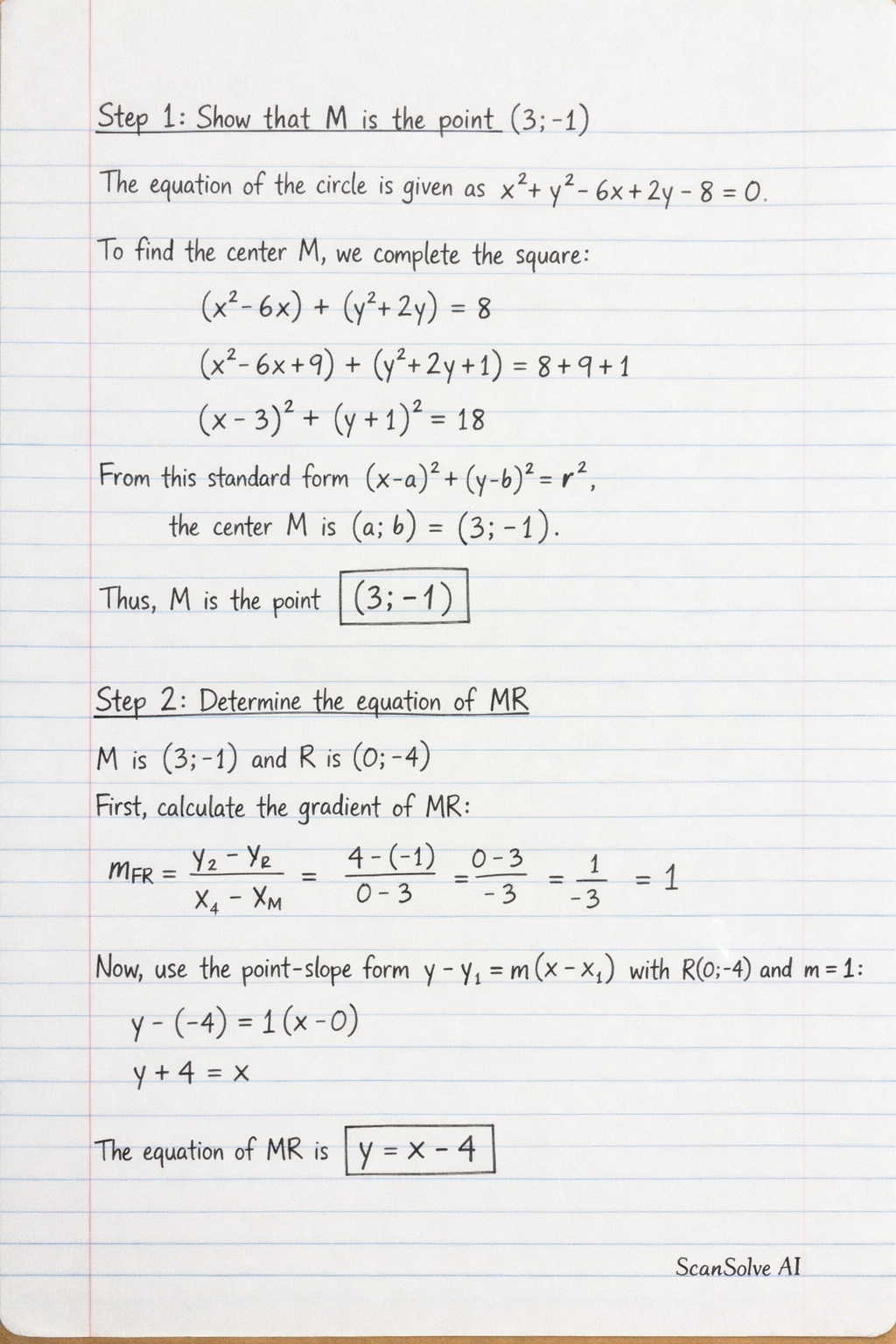
Handwritten Step-by-Step Solution
Get this as a handwritten image on WhatsApp — like a tutor wrote it for you.
Try on WhatsApp