Solve the given circle puzzles. Puzzle 7 has the numbers 27, 16, 4 and ?. Puzzle 8 has the numbers 64, 144, 4 and ?.
|Mathematics
Solve the given circle puzzles. Puzzle 7 has the numbers 27, 16, 4 and ?. Puzzle 8 has the numbers 64, 144, 4 and ?.
ScanSolve AI Answer
2 steps
Answer
D. 9
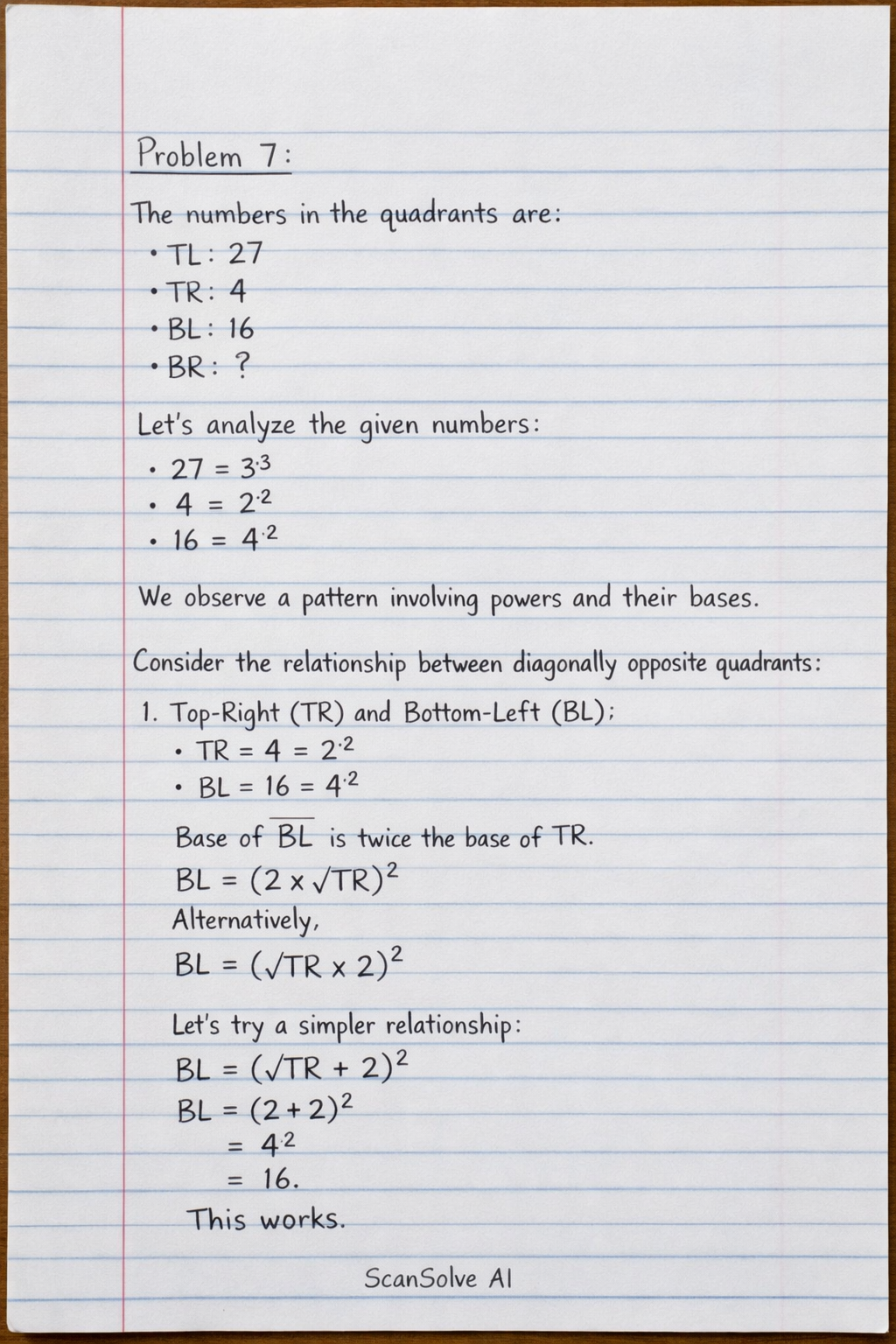
To solve these pattern problems, we need to find the mathematical relationship between the numbers in the four quadrants of each circle. Let's denote the quadrants as Top-Left (TL), Top-Right (TR), Bottom-Left (BL), and Bottom-Right (BR).
:
The numbers in the quadrants are:
TL: 27
TR: 4
BL: 16
BR: ?
Let's analyze the given numbers:
27=33
4=22
16=42
We observe a pattern involving powers and their bases.
Consider the relationship between diagonally opposite quadrants:
Top-Right (TR) and Bottom-Left (BL):
TR=4=22
BL=16=42
The base of BL (4) is twice the base of TR (2). So, BL=(2×TR)2. This is not a simple relationship.
Alternatively, BL=(TR×2)2.
Let's try a simpler relationship: BL=(TR+2)2.
BL=(2+2)2=42=16. This works.
Top-Left (TL) and Bottom-Right (BR):
TL=27=33
BR=?
If we follow a similar pattern, the base of TL is 3. Let's assume BR is related to this base.
If BR=(3+2)2=52=25. This is not among the options.
Let's try a different pattern.
Consider the relationship between the bases of the powers.
TL=33 (base 3)
TR=22 (base 2)
BL=42 (base 4)
If the pattern is that the number in the Top-Left quadrant is a cube, and the other numbers are squares:
TL=X3
TR=Y2
BL=Z2
BR=W2
From :
TL=27⟹X3=27⟹X=3.
TR=4⟹Y2=4⟹Y=2.
BL=16⟹Z2=16⟹Z=4.
Now we have the bases: X=3,Y=2,Z=4. We need to find W.
Let's look for a relationship between these bases.
Consider the diagonal relationship for the bases:
X (from TL) and Z (from BL): 3→4. This is X→X+1.
Y (from TR) and W (from BR): 2→W. If this is also Y→Y+1, then W=2+1=3.
If W=3, then BR=W2=32=9.
Let's verify this pattern for :
TL=33=27 (Base X=3)
TR=22=4 (Base Y=2)
BL=(X+1)2=(3+1)2=42=16 (Base Z=4)
BR=(Y+1)2=(2+1)2=32=9 (Base W=3)
This pattern works for . The missing number is 9.
Step 1: Identify the pattern for .
The pattern is:
Top-Left (TL) is a cube (X3).
Top-Right (TR) is a square (Y2).
Bottom-Left (BL) is the square of (base of TL + 1), i.e., (X+1)2.
Bottom-Right (BR) is the square of (base of TR + 1), i.e., (Y+1)2.
Step 2: Apply the pattern to find the missing number in .
From TL: 27=X3⟹X=3.
From TR: 4=Y2⟹Y=2.
The missing number is BR, which is (Y+1)2.
BR=(2+1)2=32=9.
Step 3: Check the options.
The options are A. 3, B. 4, C. 6, D. 9, E. 12.
The calculated value is 9, which matches option D.
The answer for is D.9.
:
The numbers in the quadrants are:
TL: 64
TR: ?
BL: 144
BR: 4
Let's apply the same pattern identified for :
TL=X3
TR=Y2
BL=(X+1)2
BR=(Y+1)2
Step 1: Use the given numbers to find the bases X and Y.
From TL: 64=X3⟹X=4.
From BR: 4=(Y+1)2⟹4=Y+1⟹2=Y+1⟹Y=1.
Step 2: Verify the pattern with BL.
BL=(X+1)2=(4+1)2=52=25.
However, the given BL is 144. This means the pattern from does not apply directly to .
Let's re-evaluate the pattern for .
Consider the numbers as powers:
TL=64=82 or 43.
BL=144=122.
BR=4=22.
Let's assume all numbers are squares, except for the missing one.
TL=64=8
BL=144=12
BR=4=2
Let the square roots be a,b,c,d in clockwise order starting from TL.
a=8, b=?, c=12, d=2.
Let's look for a relationship between these square roots.
Consider the sum of opposite square roots:
a+d=8+2=10.
b+c=?+12.
If the sum of opposite square roots is constant, then ?+12=10.
?=10−12=−2. This is not a valid base for a square in this context.
Let's try a different relationship for the square roots.
Consider the numbers in a clockwise sequence of square roots: 8→?→12→2.
8→?
?→12
12→2: This is 12−10=2.
2→8: This is 2+6=8.
This doesn't seem to be a simple arithmetic sequence.
Let's try a pattern where the numbers are related by multiplication or division.
Consider the diagonal relationship for the square roots:
TLroot=8 and BLroot=12.
TRroot=? and BRroot=2.
What if the product of the roots on one diagonal equals the product of the roots on the other diagonal?
8×2=?×1216=?×12?=1216=34. This is not an integer option.
Let's reconsider the pattern from , but with a slight modification.
TL=X3=33TR=Y2=22BL=(X+1)2=42BR=(Y+1)2=32
What if for , the powers are swapped for the diagonals?
E.g., TL is a square, BR is a cube. TR is a square, BL is a cube.
This is getting too complex.
Let's assume the pattern is simpler and involves the numbers themselves, not just their bases.
TL: 64
TR: ?
BL: 144
BR: 4
Consider the relationship between adjacent numbers.
64÷4=16.
144÷4=36.
64÷144=4/9.
What if the pattern is:
TL÷BR=XBL÷TR=X
For :
TL÷BR=64÷4=16.
So, BL÷TR=16.
144÷TR=16.
TR=16144.
Step 1: Identify the pattern.
The pattern is that the ratio of the Top-Left number to the Bottom-Right number is equal to the ratio of the Bottom-Left number to the Top-Right number.
BRTL=TRBL
Step 2: Apply the pattern to .
Given: TL=64, BR=4, BL=144, TR=?464=TR144
Step 3: Calculate the value.
16=TR144TR=16144TR=9
Step 4: Check the options.
The options are A. 3, B. 4, C. 6, D. 9, E. 12.
The calculated value is 9, which matches option D.
Let's quickly check if this pattern works for as well.
TL=27,BR=9,BL=16,TR=4.
BRTL=927=3.
TRBL=416=4.
Since 3=4, this pattern does not work for .
This implies that and have different patterns. This is unusual for problems presented together like this, but we must find a pattern that works for each individually.
Let's re-confirm the pattern for :
TL=X3, TR=Y2, BL=(X+1)2, BR=(Y+1)2.
X=3 from 27=33.
Y=2 from 4=22.
BL=(3+1)2=42=16. (Matches)
BR=(2+1)2=32=9. (Missing value)
This pattern is consistent for .
Let's re-confirm the pattern for .
The numbers are 64,?,144,4.
Consider the product of diagonally opposite numbers.
TL×BL=64×144=9216.
TR×BR=?×4.
This doesn't seem to lead to a simple integer.
Let's try the sum of adjacent numbers.
64+?=A?+144=B144+4=1484+64=68
No obvious pattern.
Let's try the square roots again for :
64=8144=124=2
Let the missing number be Z.
The sequence of square roots is 8,Z,12,2.
Consider the sum of adjacent square roots:
8+Z=AZ+12=B12+2=142+8=10
This is not a constant sum.
What if the pattern is:
TL=A2BR=B2BL=C2TR=D2
And A+B=C+D?
For :
A=64=8B=4=2C=144=12D=TR=?
So, A+B=8+2=10.
And C+D=12+TR.
If A+B=C+D, then 10=12+TR⟹TR=−2. Not possible.
What if A+C=B+D? (Sum of vertical roots = sum of horizontal roots)
8+12=2+TR20=2+TRTR=18TR=182=324. This is not among the options.
Let's try A×B=C×D. (Product of opposite roots)
8×2=12×TR16=12×TRTR=1216=34TR=(34)2=916. Not an integer option.
Let's try the pattern: TL×BR=TR×BL (product of diagonals).
For :
64×4=?×144256=?×144?=144256=9×1616×16=916. Not an integer option.
Let's try the pattern: TL+BR=TR+BL (sum of diagonals).
For :
64+4=?+14468=?+144?=68−144=−76. Not possible.
Let's try a pattern where the numbers are related by a constant difference or ratio in a specific order.
64, ?, 144, 4.
Consider the numbers in a clockwise order:
64→??→144144→4 (e.g., 144÷36=4)
4→64 (e.g., 4×16=64)
If the pattern is X×16=Y and Y÷36=Z. This is not consistent.
Let's try a pattern based on the square roots and a simple arithmetic progression.
Roots: 8,?,12,2.
If the sequence is 8,?,12,2.
What if the difference between adjacent roots is constant?
12−?=?−812−?=2−12=−10.
So 12−?=−10⟹?=22⟹?=484. Not an option.
What if the pattern is:
TL=A2TR=B2BL=C2BR=D2
And A+D=C−B?
8+2=12−TR10=12−TRTR=2TR=22=4.
This is
✂️ That answer was long and got cut off. Reply continue and I'll finish it.
Was this helpful?
Need help with your own homework?
Get instant step-by-step solutions to any question. Free to start.
This mathematics problem involves applying core mathematical principles and formulas. Below you will find a complete step-by-step solution with detailed explanations for each step, helping you understand not just the answer but the method behind it.
ScanSolve AI Answer
To solve these pattern problems, we need to find the mathematical relationship between the numbers in the four quadrants of each circle. Let's denote the quadrants as Top-Left (TL), Top-Right (TR), Bottom-Left (BL), and Bottom-Right (BR). Problem 7: The numbers in the quadrants are: TL: 27 TR: 4 BL: 16 BR: ? Let's analyze the given numbers: 27 = 3^3 4 = 2^2 16 = 4^2 We observe a pattern involving powers and their bases. Consider the relationship between diagonally opposite quadrants: 1. Top-Right (TR) and Bottom-Left (BL): TR = 4 = 2^2 BL = 16 = 4^2 The base of BL (4) is twice the base of TR (2). So, BL = (2 × sqrt(TR))^2. This is not a simple relationship. Alternatively, BL = (sqrt(TR) × 2)^2. Let's try a simpler relationship: BL = (sqrt(TR) + 2)^2. BL = (2+2)^2 = 4^2 = 16. This works. 2. Top-Left (TL) and Bottom-Right (BR): TL = 27 = 3^3 BR = ? If we follow a similar pattern, the base of TL is 3. Let's assume BR is related to this base. If BR = (3+2)^2 = 5^2 = 25. This is not among the options. Let's try a different pattern. Consider the relationship between the bases of the powers. TL = 3^3 (base 3) TR = 2^2 (base 2) BL = 4^2 (base 4) If the pattern is that the number in the Top-Left quadrant is a cube, and the other numbers are squares: TL = X^3 TR = Y^2 BL = Z^2 BR = W^2 From Problem 7: TL = 27 X^3 = 27 X = 3. TR = 4 Y^2 = 4 Y = 2. BL = 16 Z^2 = 16 Z = 4. Now we have the bases: X=3, Y=2, Z=4. We need to find W. Let's look for a relationship between these bases. Consider the diagonal relationship for the bases: X (from TL) and Z (from BL): 3 4. This is X X+1. Y (from TR) and W (from BR): 2 W. If this is also Y Y+1, then W = 2+1 = 3. If W=3, then BR = W^2 = 3^2 = 9. Let's verify this pattern for Problem 7: TL = 3^3 = 27 (Base X=3) TR = 2^2 = 4 (Base Y=2) BL = (X+1)^2 = (3+1)^2 = 4^2 = 16 (Base Z=4) BR = (Y+1)^2 = (2+1)^2 = 3^2 = 9 (Base W=3) This pattern works for Problem 7. The missing number is 9. Step 1: Identify the pattern for Problem 7. The pattern is: Top-Left (TL) is a cube (X^3). Top-Right (TR) is a square (Y^2). Bottom-Left (BL) is the square of (base of TL + 1), i.e., (X+1)^2. Bottom-Right (BR) is the square of (base of TR + 1), i.e., (Y+1)^2. Step 2: Apply the pattern to find the missing number in Problem 7. From TL: 27 = X^3 X = 3. From TR: 4 = Y^2 Y = 2. The missing number is BR, which is (Y+1)^2. BR = (2+1)^2 = 3^2 = 9. Step 3: Check the options. The options are A. 3, B. 4, C. 6, D. 9, E. 12. The calculated value is 9, which matches option D. The answer for Problem 7 is D. 9. Problem 8: The numbers in the quadrants are: TL: 64 TR: ? BL: 144 BR: 4 Let's apply the same pattern identified for Problem 7: TL = X^3 TR = Y^2 BL = (X+1)^2 BR = (Y+1)^2 Step 1: Use the given numbers to find the bases X and Y. From TL: 64 = X^3 X = 4. From BR: 4 = (Y+1)^2 sqrt(4) = Y+1 2 = Y+1 Y = 1. Step 2: Verify the pattern with BL. BL = (X+1)^2 = (4+1)^2 = 5^2 = 25. However, the given BL is 144. This means the pattern from Problem 7 does not* apply directly to Problem 8. Let's re-evaluate the pattern for Problem 8. Consider the numbers as powers: TL = 64 = 8^2 or 4^3. BL = 144 = 12^2. BR = 4 = 2^2. Let's assume all numbers are squares, except for the missing one. sqrt(TL) = sqrt(64) = 8 sqrt(BL) = sqrt(144) = 12 sqrt(BR) = sqrt(4) = 2 Let the square roots be a, b, c, d in clockwise order starting from TL. a=8, b=?, c=12, d=2. Let's look for a relationship between these square roots. Consider the sum of opposite square roots: a + d = 8 + 2 = 10. b + c = ? + 12. If the sum of opposite square roots is constant, then ? + 12 = 10. ?=10-12 = -2. This is not a valid base for a square in this context. Let's try a different relationship for the square roots. Consider the numbers in a clockwise sequence of square roots: 8 ? 12 2. 8 ? ? 12 12 2: This is 12 - 10 = 2. 2 8: This is 2 + 6 = 8. This doesn't seem to be a simple arithmetic sequence. Let's try a pattern where the numbers are related by multiplication or division. Consider the diagonal relationship for the square roots: TL_root = 8 and BL_root = 12. TR_root = ? and BR_root = 2. What if the product of the roots on one diagonal equals the product of the roots on the other diagonal? 8 × 2 = ? × 12 16 = ? × 12 ? = (16)/(12) = (4)/(3). This is not an integer option. Let's reconsider the pattern from Problem 7, but with a slight modification. Problem 7: TL = X^3 = 3^3 TR = Y^2 = 2^2 BL = (X+1)^2 = 4^2 BR = (Y+1)^2 = 3^2 What if for Problem 8, the powers are swapped for the diagonals? E.g., TL is a square, BR is a cube. TR is a square, BL is a cube. This is getting too complex. Let's assume the pattern is simpler and involves the numbers themselves, not just their bases. Problem 8: TL: 64 TR: ? BL: 144 BR: 4 Consider the relationship between adjacent numbers. 64 ÷ 4 = 16. 144 ÷ 4 = 36. 64 ÷ 144 = 4/9. What if the pattern is: TL ÷ BR = X BL ÷ TR = X For Problem 8: TL ÷ BR = 64 ÷ 4 = 16. So, BL ÷ TR = 16. 144 ÷ TR = 16. TR = (144)/(16). Step 1: Identify the pattern. The pattern is that the ratio of the Top-Left number to the Bottom-Right number is equal to the ratio of the Bottom-Left number to the Top-Right number. (TL)/(BR) = (BL)/(TR) Step 2: Apply the pattern to Problem 8. Given: TL = 64, BR = 4, BL = 144, TR = ? (64)/(4) = (144)/(TR) Step 3: Calculate the value. 16 = (144)/(TR) TR = (144)/(16) TR = 9 Step 4: Check the options. The options are A. 3, B. 4, C. 6, D. 9, E. 12. The calculated value is 9, which matches option D. Let's quickly check if this pattern works for Problem 7 as well. Problem 7: TL=27, BR=9, BL=16, TR=4. (TL)/(BR) = (27)/(9) = 3. (BL)/(TR) = (16)/(4) = 4. Since 3 ≠ 4, this pattern does not work for Problem 7. This implies that Problem 7 and Problem 8 have different patterns. This is unusual for problems presented together like this, but we must find a pattern that works for each individually. Let's re-confirm the pattern for Problem 7: TL = X^3, TR = Y^2, BL = (X+1)^2, BR = (Y+1)^2. X=3 from 27=3^3. Y=2 from 4=2^2. BL = (3+1)^2 = 4^2 = 16. (Matches) BR = (2+1)^2 = 3^2 = 9. (Missing value) This pattern is consistent for Problem 7. Let's re-confirm the pattern for Problem 8. The numbers are 64, ?, 144, 4. Consider the product of diagonally opposite numbers. TL × BL = 64 × 144 = 9216. TR × BR = ? × 4. This doesn't seem to lead to a simple integer. Let's try the sum of adjacent numbers. 64 + ? = A ? + 144 = B 144 + 4 = 148 4 + 64 = 68 No obvious pattern. Let's try the square roots again for Problem 8: sqrt(64) = 8 sqrt(144) = 12 sqrt(4) = 2 Let the missing number be Z. The sequence of square roots is 8, sqrt(Z), 12, 2. Consider the sum of adjacent square roots: 8 + sqrt(Z) = A sqrt(Z) + 12 = B 12 + 2 = 14 2 + 8 = 10 This is not a constant sum. What if the pattern is: TL = A^2 BR = B^2 BL = C^2 TR = D^2 And A+B = C+D? For Problem 8: A = sqrt(64) = 8 B = sqrt(4) = 2 C = sqrt(144) = 12 D = sqrt(TR) = ? So, A+B = 8+2 = 10. And C+D = 12 + sqrt(TR). If A+B = C+D, then 10 = 12 + sqrt(TR) sqrt(TR) = -2. Not possible. What if A+C = B+D? (Sum of vertical roots = sum of horizontal roots) 8 + 12 = 2 + sqrt(TR) 20 = 2 + sqrt(TR) sqrt(TR) = 18 TR = 18^2 = 324. This is not among the options. Let's try A × B = C × D. (Product of opposite roots) 8 × 2 = 12 × sqrt(TR) 16 = 12 × sqrt(TR) sqrt(TR) = (16)/(12) = (4)/(3) TR = ((4)/(3))^2 = (16)/(9). Not an integer option. Let's try the pattern: TL × BR = TR × BL (product of diagonals). For Problem 8: 64 × 4 = ? × 144 256 = ? × 144 ? = (256)/(144) = (16 × 16)/(9 × 16) = (16)/(9). Not an integer option. Let's try the pattern: TL + BR = TR + BL (sum of diagonals). For Problem 8: 64 + 4 = ? + 144 68 = ? + 144 ? = 68 - 144 = -76. Not possible. Let's try a pattern where the numbers are related by a constant difference or ratio in a specific order. Problem 8: 64, ?, 144, 4. Consider the numbers in a clockwise order: 64 ? ? 144 144 4 (e.g., 144 ÷ 36 = 4) 4 64 (e.g., 4 × 16 = 64) If the pattern is X × 16 = Y and Y ÷ 36 = Z. This is not consistent. Let's try a pattern based on the square roots and a simple arithmetic progression. Roots: 8, sqrt(?), 12, 2. If the sequence is 8, sqrt(?), 12, 2. What if the difference between adjacent roots is constant? 12 - sqrt(?) = sqrt(?) - 8 12 - sqrt(?) = 2 - 12 = -10. So 12 - sqrt(?) = -10 sqrt(?) = 22 ? = 484. Not an option. What if the pattern is: TL = A^2 TR = B^2 BL = C^2 BR = D^2 And A+D = C-B? 8+2 = 12 - sqrt(TR) 10 = 12 - sqrt(TR) sqrt(TR) = 2 TR = 2^2 = 4. This is ✂️ _That answer was long and got cut off. Reply continue and I'll finish it._