This mathematics problem involves applying core mathematical principles and formulas. Below you will find a complete step-by-step solution with detailed explanations for each step, helping you understand not just the answer but the method behind it.
ScanSolve AI Answer
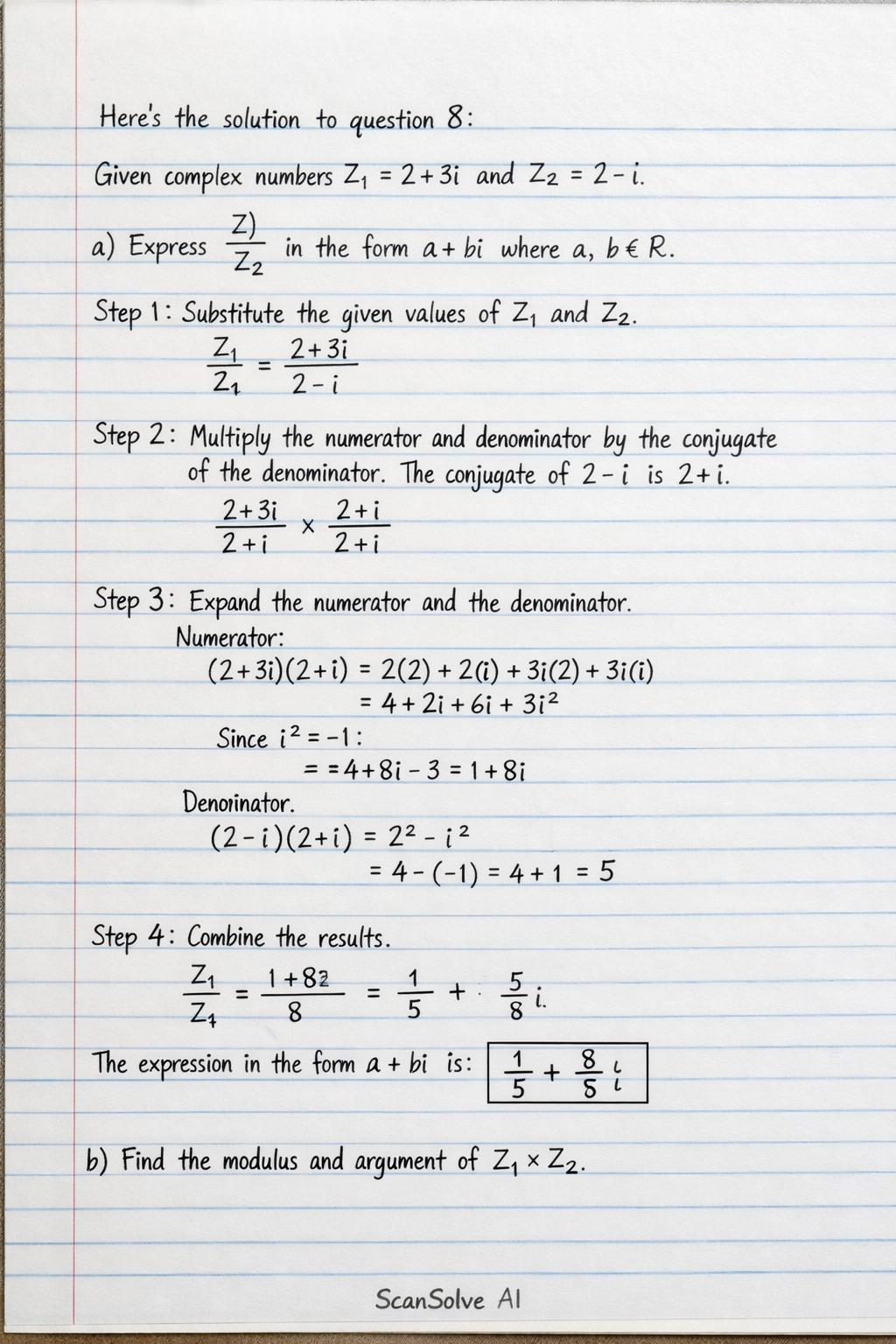
Here's the solution to question 8:
Given complex numbers $Z_1 = 2 + 3i$ and $Z_2 = 2 - i$.
a) Express $\frac{Z_1}{Z_2}$ in the form $a + bi$ where $a, b \in \mathbb{R}$.
Step 1: Substitute the given values of $Z_1$ and $Z_2$.
$$ \frac{Z_1}{Z_2} = \frac{2 + 3i}{2 - i} $$
Step 2: Multiply the numerator and denominator by the conjugate of the denominator. The conjugate of $2 - i$ is $2 + i$.
$$ \frac{2 + 3i}{2 - i} \times \frac{2 + i}{2 + i} $$
Step 3: Expand the numerator and the denominator.
Numerator:
$$ (2 + 3i)(2 + i) = 2(2) + 2(i) + 3i(2) + 3i(i) $$
$$ = 4 + 2i + 6i + 3i^2 $$
Since $i^2 = -1$:
$$ = 4 + 8i - 3 = 1 + 8i $$
Denominator:
$$ (2 - i)(2 + i) = 2^2 - i^2 $$
$$ = 4 - (-1) = 4 + 1 = 5 $$
Step 4: Combine the results.
$$ \frac{Z_1}{Z_2} = \frac{1 + 8i}{5} = \frac{1}{5} + \frac{8}{5}i $$
The expression in the form $a + bi$ is $\boxed{\frac{1}{5} + \frac{8}{5}i}$.
b) Find the modulus and argument of $Z_1 \times Z_2$.
Step 1: Calculate the product $Z_1 \times Z_2$.
$$ Z_1 \times Z_2 = (2 + 3i)(2 - i) $$
$$ = 2(2) + 2(-i) + 3i(2) + 3i(-i) $$
$$ = 4 - 2i + 6i - 3i^2 $$
Since $i^2 = -1$:
$$ = 4 + 4i - 3(-1) $$
$$ = 4 + 4i + 3 = 7 + 4i $$
Step 2: Find the modulus of $Z_1 \times Z_2$. For a complex number $x + yi$, the modulus is $\sqrt{x^2 + y^2}$.
$$ |Z_1 \times Z_2| = |7 + 4i| = \sqrt{7^2 + 4^2} $$
$$ = \sqrt{49 + 16} = \sqrt{65} $$
Step 3: Find the argument of $Z_1 \times Z_2$. For a complex number $x + yi$ in the first quadrant, the argument is $\tan^{-1}\left(\frac{y}{x}\right)$.
Since $7 + 4i$ is in the first quadrant (real part positive, imaginary part positive):
$$ \arg(Z_1 \times Z_2) = \tan^{-1}\left(\frac{4}{7}\right) $$
The modulus is $\boxed{\sqrt{65}}$ and the argument is $\boxed{\tan^{-1}\left(\frac{4}{7}\right)}$.
c) Given also that $Z_3$ is a complex number such that $|Z_3| = 5$ and $\arg(Z_3) = \frac{\pi}{3}$, express $\frac{Z_1 \times Z_2}{Z_3}$ in polar form.
Step 1: From part b), we have $Z_1 \times Z_2 = 7 + 4i$.
Its modulus is $|Z_1 \times Z_2| = \sqrt{65}$.
Its argument is $\arg(Z_1 \times Z_2) = \tan^{-1}\left(\frac{4}{7}\right)$.
Step 2: We are given $Z_3$ in polar form:
$|Z_3| = 5$
$\arg(Z_3) = \frac{\pi}{3}$
Step 3: To find the modulus of the quotient $\frac{Z_1 \times Z_2}{Z_3}$, divide their moduli.
$$ \left|\frac{Z_1 \times Z_2}{Z_3}\right| = \frac{|Z_1 \times Z_2|}{|Z_3|} = \frac{\sqrt{65}}{5} $$
Step 4: To find the argument of the quotient $\frac{Z_1 \times Z_2}{Z_3}$, subtract their arguments.
$$ \arg\left(\frac{Z_1 \times Z_2}{Z_3}\right) = \arg(Z_1 \times Z_2) - \arg(Z_3) $$
$$ = \tan^{-1}\left(\frac{4}{7}\right) - \frac{\pi}{3} $$
Step 5: Express the result in polar form, $r(\cos \theta + i \sin \theta)$.
$$ \frac{Z_1 \times Z_2}{Z_3} = \frac{\sqrt{65}}{5} \left( \cos\left(\tan^{-1}\left(\frac{4}{7}\right) - \frac{\pi}{3}\right) + i \sin\left(\tan^{-1}\left(\frac{4}{7}\right) - \frac{\pi}{3}\right) \right) $$
The expression in polar form is $\boxed{\frac{\sqrt{65}}{5} \left( \cos\left(\tan^{-1}\left(\frac{4}{7}\right) - \frac{\pi}{3}\right) + i \sin\left(\tan^{-1}\left(\frac{4}{7}\right) - \frac{\pi}{3}\right) \right)}$.
Given complex numbers Z1 = 2 + 3i and Z2 = 2 - i.
|Mathematics
Given complex numbers Z1 = 2 + 3i and Z2 = 2 - i.
ScanSolve AI Answer
Here's the solution to question 8:
Given complex numbers Z1=2+3i and Z2=2−i.
a) Express Z2Z1 in the form a+bi where a,b∈R.
Step 1: Substitute the given values of Z1 and Z2.
Z2Z1=2−i2+3i
Step 2: Multiply the numerator and denominator by the conjugate of the denominator. The conjugate of 2−i is 2+i.
2−i2+3i×2+i2+i
Step 3: Expand the numerator and the denominator.
Numerator:
(2+3i)(2+i)=2(2)+2(i)+3i(2)+3i(i)=4+2i+6i+3i2
Since i2=−1:
=4+8i−3=1+8i
Denominator:
(2−i)(2+i)=22−i2=4−(−1)=4+1=5
Step 4: Combine the results.
Z2Z1=51+8i=51+58i
The expression in the form a+bi is 51+58i.
b) Find the modulus and argument of Z1×Z2.
Step 1: Calculate the product Z1×Z2.
Z1×Z2=(2+3i)(2−i)=2(2)+2(−i)+3i(2)+3i(−i)=4−2i+6i−3i2
Since i2=−1:
=4+4i−3(−1)=4+4i+3=7+4i
Step 2: Find the modulus of Z1×Z2. For a complex number x+yi, the modulus is x2+y2.
∣Z1×Z2∣=∣7+4i∣=72+42=49+16=65
Step 3: Find the argument of Z1×Z2. For a complex number x+yi in the first quadrant, the argument is tan−1(xy).
Since 7+4i is in the first quadrant (real part positive, imaginary part positive):
arg(Z1×Z2)=tan−1(74)
The modulus is 65 and the argument is tan−1(74).
c) Given also that Z3 is a complex number such that ∣Z3∣=5 and arg(Z3)=3π, express Z3Z1×Z2 in polar form.
Step 1: From part b), we have Z1×Z2=7+4i.
Its modulus is ∣Z1×Z2∣=65.
Its argument is arg(Z1×Z2)=tan−1(74).
Step 2: We are given Z3 in polar form:
∣Z3∣=5arg(Z3)=3π
Step 3: To find the modulus of the quotient Z3Z1×Z2, divide their moduli.
Z3Z1×Z2=∣Z3∣∣Z1×Z2∣=565
Step 4: To find the argument of the quotient Z3Z1×Z2, subtract their arguments.
arg(Z3Z1×Z2)=arg(Z1×Z2)−arg(Z3)=tan−1(74)−3π
Step 5: Express the result in polar form, r(cosθ+isinθ).
Z3Z1×Z2=565(cos(tan−1(74)−3π)+isin(tan−1(74)−3π))
The expression in polar form is 565(cos(tan−1(74)−3π)+isin(tan−1(74)−3π)).
Need help with your own homework?
Get instant step-by-step solutions to any question. Free to start.