We read your photo as:

Given functions: f(x) = (2)/(3)x - 4 and g(x) = sqrt(2x). Calculate f(3), f(-2), g(-5), g(sqrt(8)). Also, calculate the images of 0 and 6 by the function f.

Mathematics

ScanSolve AI Answer

Step-by-step solution

12 steps

Given functions:
f(x)=23x−4f(x) = \frac{2}{3}x - 4
g(x)=2xg(x) = \sqrt{2x}

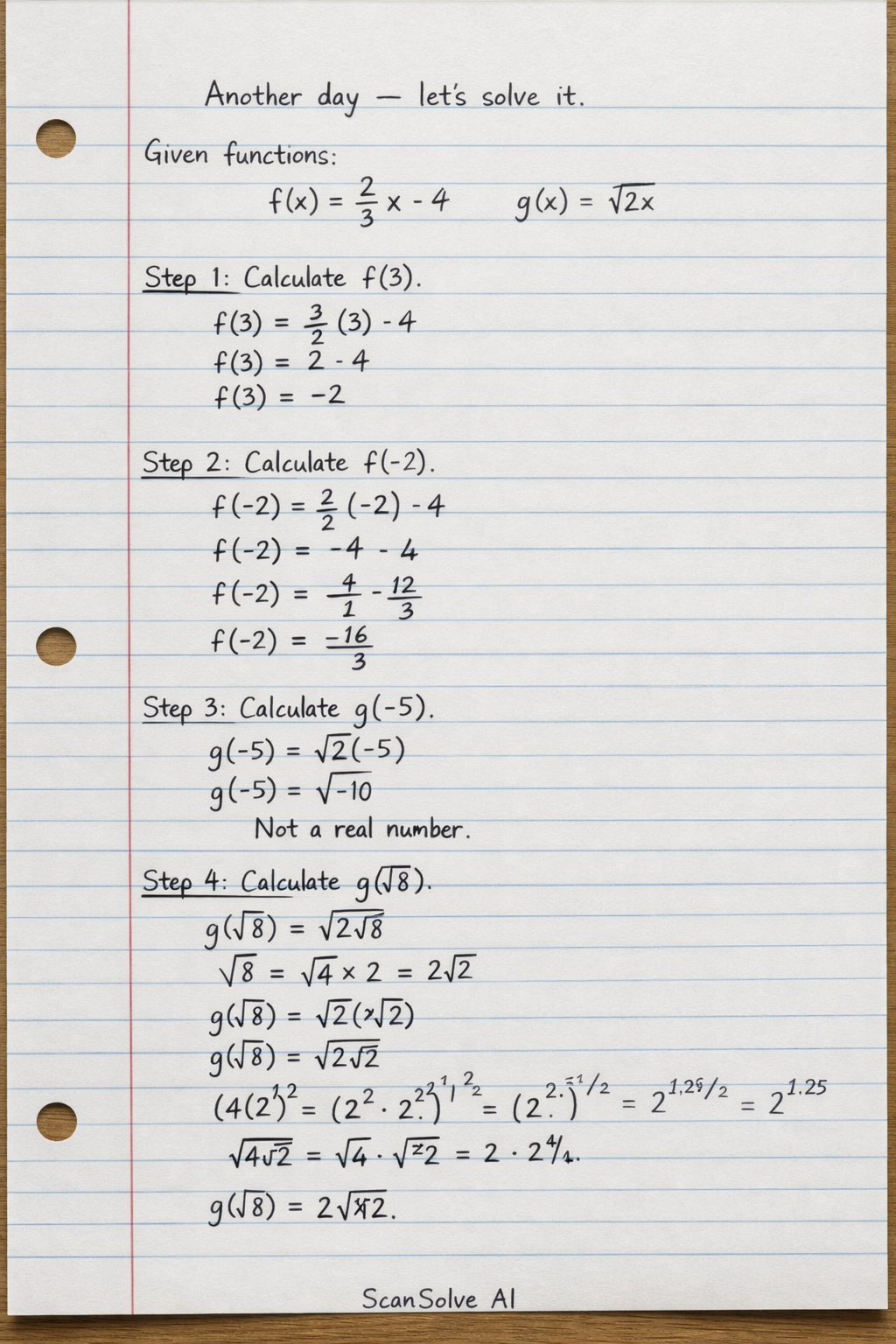
1) Calculate f(3)f(3), f(−2)f(-2), g(−5)g(-5), g(8)g(\sqrt{8}).

  1. Calculate f(3)f(3).

    Substitute x=3x=3 into f(x)f(x).

    f(3)=23(3)−4f(3) = \frac{2}{3}(3) - 4 f(3)=2−4f(3) = 2 - 4 f(3)=−2f(3) = -2
  2. Calculate f(−2)f(-2).

    Substitute x=−2x=-2 into f(x)f(x).

    f(−2)=23(−2)−4f(-2) = \frac{2}{3}(-2) - 4 f(−2)=−43−4f(-2) = -\frac{4}{3} - 4 f(−2)=−43−123f(-2) = -\frac{4}{3} - \frac{12}{3} f(−2)=−163f(-2) = -\frac{16}{3}
  3. Calculate g(−5)g(-5).

    Substitute x=−5x=-5 into g(x)g(x).

    g(−5)=2(−5)g(-5) = \sqrt{2(-5)} g(−5)=−10g(-5) = \sqrt{-10}

    The square root of a negative number is not a real number.

  4. Calculate g(8)g(\sqrt{8}).

    Substitute x=8x=\sqrt{8} into g(x)g(x).

    g(8)=28g(\sqrt{8}) = \sqrt{2\sqrt{8}}

    Simplify 8=4×2=22\sqrt{8} = \sqrt{4 \times 2} = 2\sqrt{2}.

    g(8)=2(22)g(\sqrt{8}) = \sqrt{2(2\sqrt{2})} g(8)=42g(\sqrt{8}) = \sqrt{4\sqrt{2}}

    We can write this as (42)1/2=(22⋅21/2)1/2=(22.5)1/2=21.25(4\sqrt{2})^{1/2} = (2^2 \cdot 2^{1/2})^{1/2} = (2^{2.5})^{1/2} = 2^{1.25}.
    Alternatively, 42=4⋅2=2⋅(21/2)1/2=2⋅21/4\sqrt{4\sqrt{2}} = \sqrt{4} \cdot \sqrt{\sqrt{2}} = 2 \cdot (2^{1/2})^{1/2} = 2 \cdot 2^{1/4}.

    g(8)=224g(\sqrt{8}) = 2\sqrt[4]{2}

    Summary for 1):
    f(3)=−2f(3) = \boxed{-2}
    f(−2)=−163f(-2) = \boxed{-\frac{16}{3}}
    g(−5)g(-5) is not a real number.
    g(8)=224g(\sqrt{8}) = \boxed{2\sqrt[4]{2}}

    2) Calculate the images of 0 and 6 by the function ff.

  5. Calculate f(0)f(0).

    Substitute x=0x=0 into f(x)f(x).

    f(0)=23(0)−4f(0) = \frac{2}{3}(0) - 4 f(0)=0−4f(0) = 0 - 4 f(0)=−4f(0) = -4
  6. Calculate f(6)f(6).

    Substitute x=6x=6 into f(x)f(x).

    f(6)=23(6)−4f(6) = \frac{2}{3}(6) - 4 f(6)=4−4f(6) = 4 - 4 f(6)=0f(6) = 0

    Summary for 2):
    The image of 0 by ff is −4\boxed{-4}.
    The image of 6 by ff is 0\boxed{0}.

    3) Calculate the images of 0 and −2-\sqrt{2} by the function gg.

  7. Calculate g(0)g(0).

    Substitute x=0x=0 into g(x)g(x).

    g(0)=2(0)g(0) = \sqrt{2(0)} g(0)=0g(0) = \sqrt{0} g(0)=0g(0) = 0
  8. Calculate g(−2)g(-\sqrt{2}).

    Substitute x=−2x=-\sqrt{2} into g(x)g(x).

    g(−2)=2(−2)g(-\sqrt{2}) = \sqrt{2(-\sqrt{2})} g(−2)=−22g(-\sqrt{2}) = \sqrt{-2\sqrt{2}}

    The square root of a negative number is not a real number.

    Summary for 3):
    The image of 0 by gg is 0\boxed{0}.
    The image of −2-\sqrt{2} by gg is not a real number.

    4) Calculate the number which has 2 as its image by the function ff.
    This means finding xx such that f(x)=2f(x) = 2.

    23x−4=2\frac{2}{3}x - 4 = 2
  9. Add 4 to both sides.

    23x=2+4\frac{2}{3}x = 2 + 4 23x=6\frac{2}{3}x = 6
  10. Multiply both sides by 32\frac{3}{2}.

    x=6×32x = 6 \times \frac{3}{2} x=3×3x = 3 \times 3 x=9x = 9

    The number is 9\boxed{9}.

    5) What is the antecedent of 5 by the function gg?
    This means finding xx such that g(x)=5g(x) = 5.

    2x=5\sqrt{2x} = 5
  11. Square both sides of the equation.

    (2x)2=52(\sqrt{2x})^2 = 5^2 2x=252x = 25
  12. Divide by 2.

    x=252x = \frac{25}{2}

    The antecedent is 252\boxed{\frac{25}{2}}.

Was this helpful?

Still stuck on this one?

Ask a follow-up, and the answer starts from this question.

Got a different question?Ask your own question
Handwritten step-by-step solution preview

Handwritten Step-by-Step Solution

Get this as a handwritten image on WhatsApp — like a tutor wrote it for you.

Try on WhatsApp