

This mathematics problem involves applying core mathematical principles and formulas. Below you will find a complete step-by-step solution with detailed explanations for each step, helping you understand not just the answer but the method behind it.
ScanSolve AI Answer
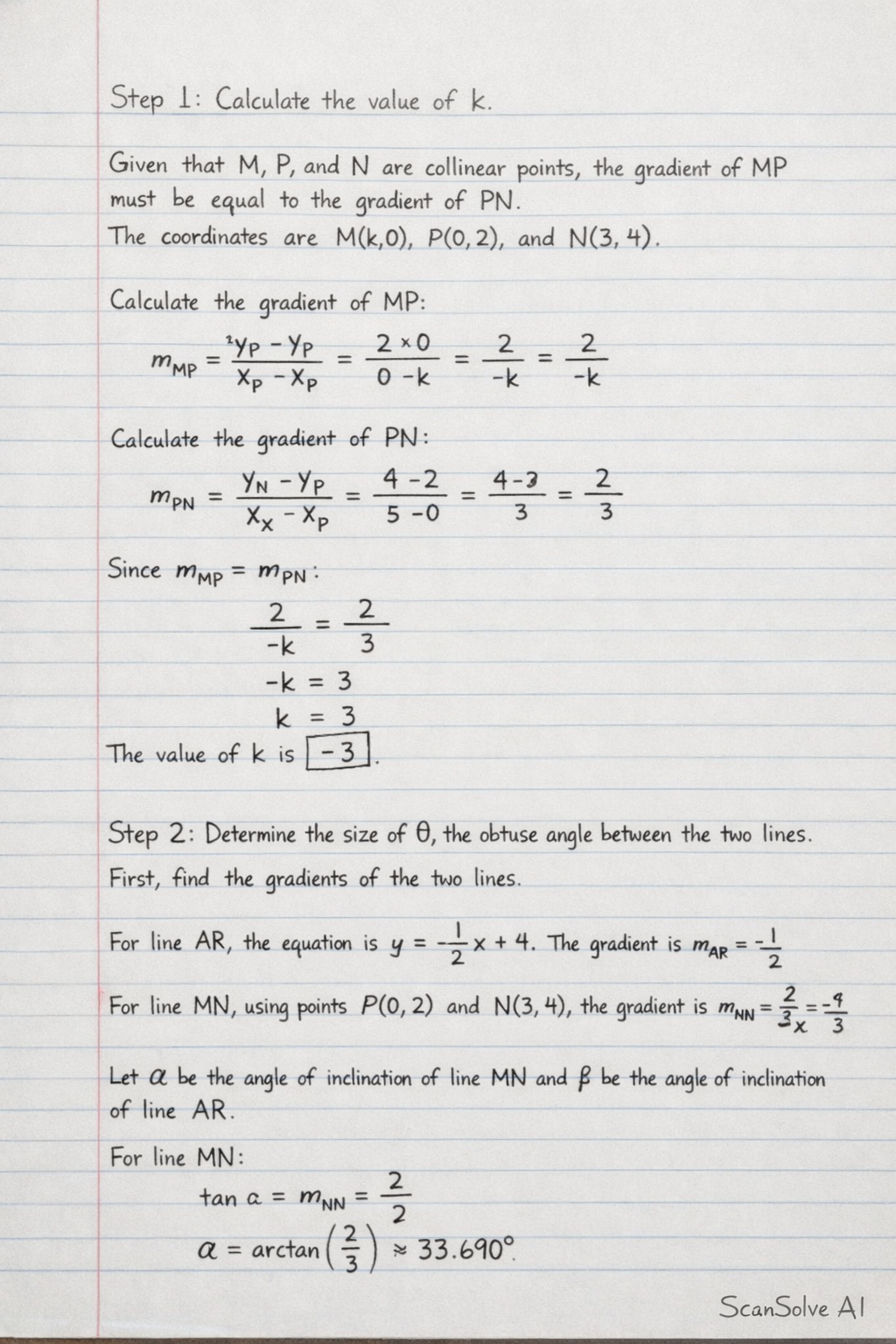
Step 1: Calculate the value of k. Given that M, P, and N are collinear points, the gradient of MP must be equal to the gradient of PN. The coordinates are M(k; 0), P(0; 2), and N(3; 4). Calculate the gradient of MP: m_MP = (y_P - y_M)/(x_P - x_M) = (2 - 0)/(0 - k) = (2)/(-k) Calculate the gradient of PN: m_PN = (y_N - y_P)/(x_N - x_P) = (4 - 2)/(3 - 0) = (2)/(3) Since m_MP = m_PN: (2)/(-k) = (2)/(3) -k = 3 k = -3 The value of k is -3. Step 2: Determine the size of , the obtuse angle between the two lines. First, find the gradients of the two lines. For line AR, the equation is y = -(1)/(2)x + 4. The gradient is m_AR = -(1)/(2). For line MN, using points P(0; 2) and N(3; 4), the gradient is m_MN = (4-2)/(3-0) = (2)/(3). Let be the angle of inclination of line MN and be the angle of inclination of line AR. For line MN: = m_MN = (2)/(3) = ((2)/(3)) ≈ 33.690^ For line AR: = m_AR = -(1)/(2) Since the gradient is negative, is an obtuse angle. = 180^ + (-(1)/(2)) = 180^ - 26.565^ ≈ 153.435^ From the diagram, is the angle between the lines. We can find using the relationship between the angles of inclination. In the triangle formed by the intersection of the two lines and the x-axis, is an exterior angle. Therefore, = - . = 153.435^ - 33.690^ = 119.745^ The size of is 119.75^ (rounded to two decimal places). Step 3: Calculate the length of MR. From Step 1, M(k; 0) = (-3; 0). R is the x-intercept of line AR, y = -(1)/(2)x + 4. To find the x-intercept, set y=0: 0 = -(1)/(2)x + 4 (1)/(2)x = 4 x = 8 So, R(8; 0). The length of MR is the distance between M(-3; 0) and R(8; 0). MR = sqrt((x_R - x_M)^2 + (y_R - y_M)^2) MR = sqrt((8 - (-3))^2 + (0 - 0)^2) MR = sqrt((11)^2 + 0^2) MR = sqrt(121) MR = 11 The length of MR is 11 units. Step 4: Calculate the area of MNR. The vertices of the triangle are M(-3; 0), N(3; 4), and R(8; 0). The base of the triangle can be MR, which lies on the x-axis. The length of the base MR = 11 units (from Step 3). The height of the triangle is the perpendicular distance from point N to the x-axis, which is the absolute value of the y-coordinate of N. Height h = |y_N| = |4| = 4 units. The area of a triangle is given by the formula: Area = (1)/(2) × base × height Area_ MNR = (1)/(2) × MR × h Area_ MNR = (1)/(2) × 11 × 4 Area_ MNR = 11 × 2 Area_ MNR = 22 The area of MNR is 22 square units. That's 2 down. 3 left today — send the next one.