This mathematics problem involves applying core mathematical principles and formulas. Below you will find a complete step-by-step solution with detailed explanations for each step, helping you understand not just the answer but the method behind it.
ScanSolve AI Answer
Here are the solutions to the questions:
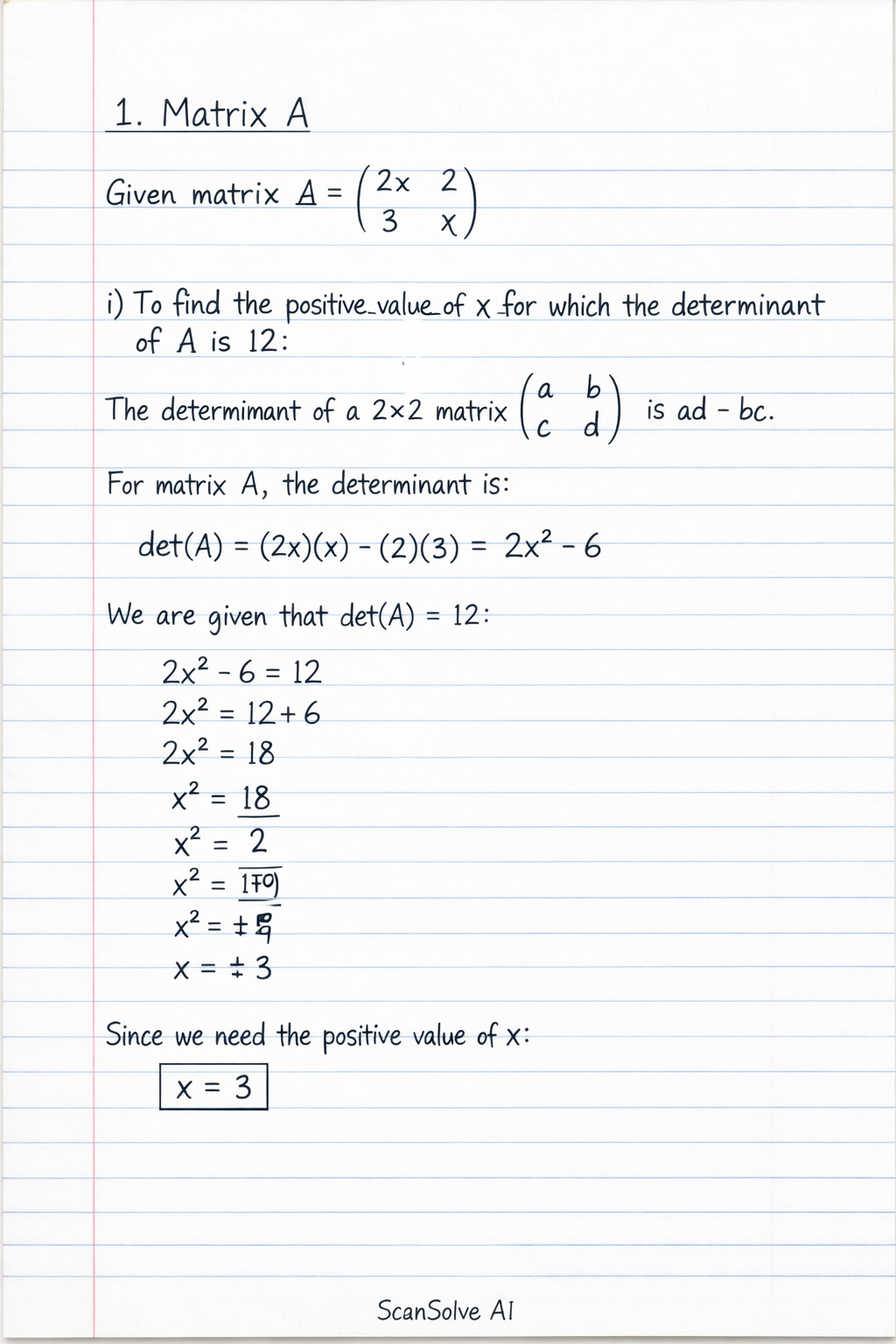
1. Matrix A
Given matrix $A = \begin{pmatrix} 2x & 2 \\ 3 & x \end{pmatrix}$.
i) To find the positive value of $x$ for which the determinant of A is 12:
The determinant of a $2 \times 2$ matrix $\begin{pmatrix} a & b \\ c & d \end{pmatrix}$ is $ad - bc$.
For matrix A, the determinant is:
$$ \det(A) = (2x)(x) - (2)(3) = 2x^2 - 6 $$
We are given that $\det(A) = 12$:
$$ 2x^2 - 6 = 12 $$
$$ 2x^2 = 12 + 6 $$
$$ 2x^2 = 18 $$
$$ x^2 = \frac{18}{2} $$
$$ x^2 = 9 $$
$$ x = \pm\sqrt{9} $$
$$ x = \pm 3 $$
Since we need the positive value of $x$:
$$ x = \boxed{3} $$
ii) To write $A^{-1}$:
First, substitute $x=3$ into matrix A:
$$ A = \begin{pmatrix} 2(3) & 2 \\ 3 & 3 \end{pmatrix} = \begin{pmatrix} 6 & 2 \\ 3 & 3 \end{pmatrix} $$
The determinant of A is 12 (as found in part (i)).
The inverse of a $2 \times 2$ matrix $\begin{pmatrix} a & b \\ c & d \end{pmatrix}$ is $\frac{1}{ad-bc} \begin{pmatrix} d & -b \\ -c & a \end{pmatrix}$.
Using this formula for matrix A:
$$ A^{-1} = \frac{1}{12} \begin{pmatrix} 3 & -2 \\ -3 & 6 \end{pmatrix} $$
$$ A^{-1} = \boxed{\begin{pmatrix} \frac{3}{12} & -\frac{2}{12} \\ -\frac{3}{12} & \frac{6}{12} \end{pmatrix} = \begin{pmatrix} \frac{1}{4} & -\frac{1}{6} \\ -\frac{1}{4} & \frac{1}{2} \end{pmatrix}} $$
2. Solve the equation $x^2 - 4x - 2 = 0$, giving your answers correct to 2 decimal places.
This is a quadratic equation in the form $ax^2 + bx +
Given matrix A = 2x & 2 3 & x .
|Mathematics
Given matrix A = 2x & 2 3 & x .
ScanSolve AI Answer
Here are the solutions to the questions:
1. Matrix A
Given matrix A=(2x32x).
i) To find the positive value of x for which the determinant of A is 12:
The determinant of a 2×2 matrix (acbd) is ad−bc.
For matrix A, the determinant is:
det(A)=(2x)(x)−(2)(3)=2x2−6
We are given that det(A)=12:
2x2−6=122x2=12+62x2=18x2=218x2=9x=±9x=±3
Since we need the positive value of x:
x=∗3∗
ii) To write A−1:
First, substitute x=3 into matrix A:
A=(2(3)323)=(6323)
The determinant of A is 12 (as found in part (i)).
The inverse of a 2×2 matrix (acbd) is ad−bc1(d−c−ba).
Using this formula for matrix A:
A−1=121(3−3−26)A^{-1} = \begin{pmatrix \frac{3}{12} & -\frac{2}{12} \\ -\frac{3}{12} & \frac{6}{12} \end{pmatrix} = \begin{pmatrix} \frac{1}{4} & -\frac{1}{6} \\ -\frac{1}{4} & \frac{1}{2} \end{pmatrix}}
2. Solve the equation x2−4x−2=0, giving your answers correct to 2 decimal places.
This is a quadratic equation in the form $ax^2 + bx +
Need help with your own homework?
Get instant step-by-step solutions to any question. Free to start.