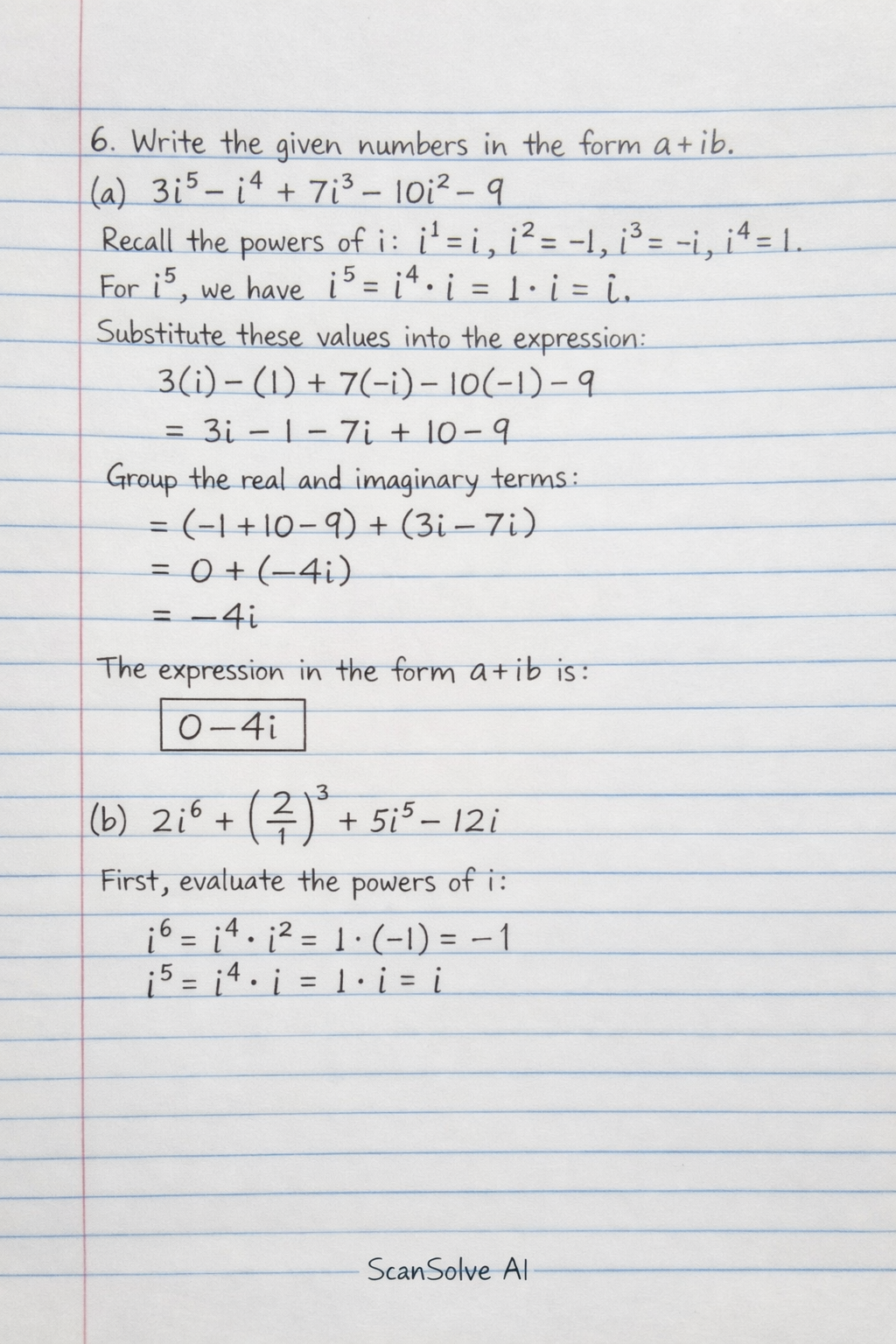
a) 3i5−i4+7i3−10i2−9
Recall the powers of i: i1=i, i2=−1, i3=−i, i4=1.
For i5, we have i5=i4⋅i=1⋅i=i.
Substitute these values into the expression:
3(i)−(1)+7(−i)−10(−1)−9=3i−1−7i+10−9
Group the real and imaginary terms:
=(−1+10−9)+(3i−7i)=(0)+(−4i)=−4i
The expression in the form a+ib is 0−4i.
b) 2i6+(−i2)3+5i5−12i
First, evaluate the powers of i:
i6=i4⋅i2=1⋅(−1)=−1i5=i4⋅i=1⋅i=i
Next, simplify the term (−i2)3:
−i2=−i2⋅ii=−i22i=−(−1)2i=12i=2i
Now, cube this result:
(2i)3=23⋅i3=8⋅(−i)=−8i
Substitute all simplified terms back into the original expression:
2(−1)+(−8i)+5(i)−12i=−2−8i+5i−12i
Group the real and imaginary terms:
=(−2)+(−8i+5i−12i)=−2+(−15i)=−2−15i
The expression in the form a+ib is −2−15i.
7. Find the polar coordinate form of the complex numbers.
The polar form of a complex number z=a+bi is z=r(cosθ+isinθ), where r=∣z∣=a2+b2 and θ=arg(z).
a) z=i
This can be written as z=0+1i.
Calculate the modulus r:
r=02+12=1=1
Calculate the argument θ:
The complex number i lies on the positive imaginary axis.
θ=2π
So, the polar coordinate form is 1(cos(2π)+isin(2π)).
b) z=3−4i
This is in the form a+bi with a=3 and b=−4.
Calculate the modulus r:
r=32+(−4)2=9+16=25=5
Calculate the argument θ:
The complex number 3−4i is in the fourth quadrant.
θ=arctan(3−4)
Using a calculator, θ≈−0.927 radians (or approximately −53.13∘).
So, the polar coordinate form is 5(cos(−0.927)+isin(−0.927)).
8. Find the values of x and y that satisfy the equation (x+y)+i(x−y)=14.8+6.2i.
For two complex numbers to be equal, their real parts must be equal and their imaginary parts must be equal.
Step 1: Equate the real parts.x+y=14.8(1)
Step 2: Equate the imaginary parts.x−y=6.2(2)
Step 3: Solve the system of linear equations.
Add equation (1) and equation (2):
(x+y)+(x−y)=14.8+6.22x=21x=221x=10.5
Substitute the value of x into equation (1):
10.5+y=14.8y=14.8−10.5y=4.3
The values are x=10.5,y=4.3.
9. Express (−1+i) in the form reiθ, where r is positive and −π<θ<π.
Let z=−1+i.
Step 1: Find the modulus r.r=∣−1+i∣=(−1)2+(1)2=1+1=2
Step 2: Find the argument θ.
The complex number −1+i corresponds to the point (−1,1) in the complex plane, which is in the second quadrant.
The reference angle α is given by tanα=−11=1.
So, α=4π.
Since the point is in the second quadrant, the argument θ is:
θ=π−α=π−4π=43π
This value of θ=43π satisfies the condition −π<θ<π.
Step 3: Write in the form reiθ.z=2ei43π
The expression is 2ei43π.
Was this helpful?
Need help with your own homework?
Get instant step-by-step solutions to any question. Free to start.
This mathematics problem involves applying core mathematical principles and formulas. Below you will find a complete step-by-step solution with detailed explanations for each step, helping you understand not just the answer but the method behind it.
ScanSolve AI Answer
6. Write the given numbers in the form a+ib. a) 3i^5 - i^4 + 7i^3 - 10i^2 - 9 Recall the powers of i: i^1=i, i^2=-1, i^3=-i, i^4=1. For i^5, we have i^5 = i^4 · i = 1 · i = i. Substitute these values into the expression: 3(i) - (1) + 7(-i) - 10(-1) - 9 = 3i - 1 - 7i + 10 - 9 Group the real and imaginary terms: = (-1 + 10 - 9) + (3i - 7i) = (0) + (-4i) = -4i The expression in the form a+ib is 0 - 4i. b) 2i^6 + ((2)/(-i))^3 + 5i^5 - 12i First, evaluate the powers of i: i^6 = i^4 · i^2 = 1 · (-1) = -1 i^5 = i^4 · i = 1 · i = i Next, simplify the term ((2)/(-i))^3: (2)/(-i) = (2)/(-i) · (i)/(i) = (2i)/(-i^2) = (2i)/(-(-1)) = (2i)/(1) = 2i Now, cube this result: (2i)^3 = 2^3 · i^3 = 8 · (-i) = -8i Substitute all simplified terms back into the original expression: 2(-1) + (-8i) + 5(i) - 12i = -2 - 8i + 5i - 12i Group the real and imaginary terms: = (-2) + (-8i + 5i - 12i) = -2 + (-15i) = -2 - 15i The expression in the form a+ib is -2 - 15i. 7. Find the polar coordinate form of the complex numbers. The polar form of a complex number z = a+bi is z = r( + i), where r = |z| = sqrt(a^2+b^2) and = (z). a) z = i This can be written as z = 0 + 1i. Calculate the modulus r: r = sqrt(0^2 + 1^2) = sqrt(1) = 1 Calculate the argument : The complex number i lies on the positive imaginary axis. = ()/(2) So, the polar coordinate form is 1((()/(2)) + i(()/(2))). b) z = 3 - 4i This is in the form a+bi with a=3 and b=-4. Calculate the modulus r: r = sqrt(3^2 + (-4)^2) = sqrt(9 + 16) = sqrt(25) = 5 Calculate the argument : The complex number 3-4i is in the fourth quadrant. = ((-4)/(3)) Using a calculator, ≈ -0.927 radians (or approximately -53.13^). So, the polar coordinate form is 5((-0.927) + i(-0.927)). 8. Find the values of x and y that satisfy the equation (x+y) + i(x-y) = 14.8 + 6.2i. For two complex numbers to be equal, their real parts must be equal and their imaginary parts must be equal. Step 1: Equate the real parts. x+y = 14.8 (1) Step 2: Equate the imaginary parts. x-y = 6.2 (2) Step 3: Solve the system of linear equations. Add equation (1) and equation (2): (x+y) + (x-y) = 14.8 + 6.2 2x = 21 x = (21)/(2) x = 10.5 Substitute the value of x into equation (1): 10.5 + y = 14.8 y = 14.8 - 10.5 y = 4.3 The values are x=10.5, y=4.3. 9. Express (-1+i) in the form re^i, where r is positive and - < < . Let z = -1+i. Step 1: Find the modulus r. r = |-1+i| = sqrt((-1)^2 + (1)^2) = sqrt(1+1) = sqrt(2) Step 2: Find the argument . The complex number -1+i corresponds to the point (-1,1) in the complex plane, which is in the second quadrant. The reference angle is given by = |(1)/(-1)| = 1. So, = ()/(4). Since the point is in the second quadrant, the argument is: = - = - ()/(4) = (3)/(4) This value of = (3)/(4) satisfies the condition - < < . Step 3: Write in the form re^i. z = sqrt(2)e^i(3)/(4) The expression is sqrt(2)e^i(3)/(4).