
We read your photo as:
Given P(X=k) = c(2k+1) for k = 0, 1, 2, 3, what is the value of the constant c?
Mathematics
ScanSolve AI Answer
Step-by-step solution
4 stepsUnderstand the properties of a discrete probability distribution.
For a discrete random variable, the sum of all possible probabilities must equal 1.
Given for .
This means .Calculate the sum of the terms for .
For , .
For , .
For , .
For , .Set up the equation for the sum of probabilities.
Evaluate the given options.
- A. is determined by because the random variable has 4 possible values. This is incorrect. Our calculation shows .
- B. can be any positive constant because the probabilities are all proportional and do not need to sum to 1. This is incorrect. Probabilities for a valid distribution must sum to 1.
- C. must satisfy ensuring the total probability equals 1. This statement correctly describes the method to find . As calculated in Step 3, , so . This matches our result.
- D. equals because the smallest positive normalization constant is always the reciprocal of the largest coefficient, here 7. This is incorrect. is the reciprocal of the sum of all coefficients, not just the largest one.
The correct statement is C.
Was this helpful?
Still stuck on this one?
Ask a follow-up, and the answer starts from this question.
Got a different question?Ask your own question
More Mathematics Questions
QFind the value of the constant k given the probability mass function P(X=x) = k(7-x)(x+1) for x = 0…QA discrete random variable X has probability density function P(X=x) = k/x for x=2, 4, 6, 8. Find…QThe probability distribution of a discrete random variable X is given by P(X = x) = { k(x + 1), x…QSolve for k: 2^k = k32QEvaluate sum_k=1ⁿ (k2 + k).
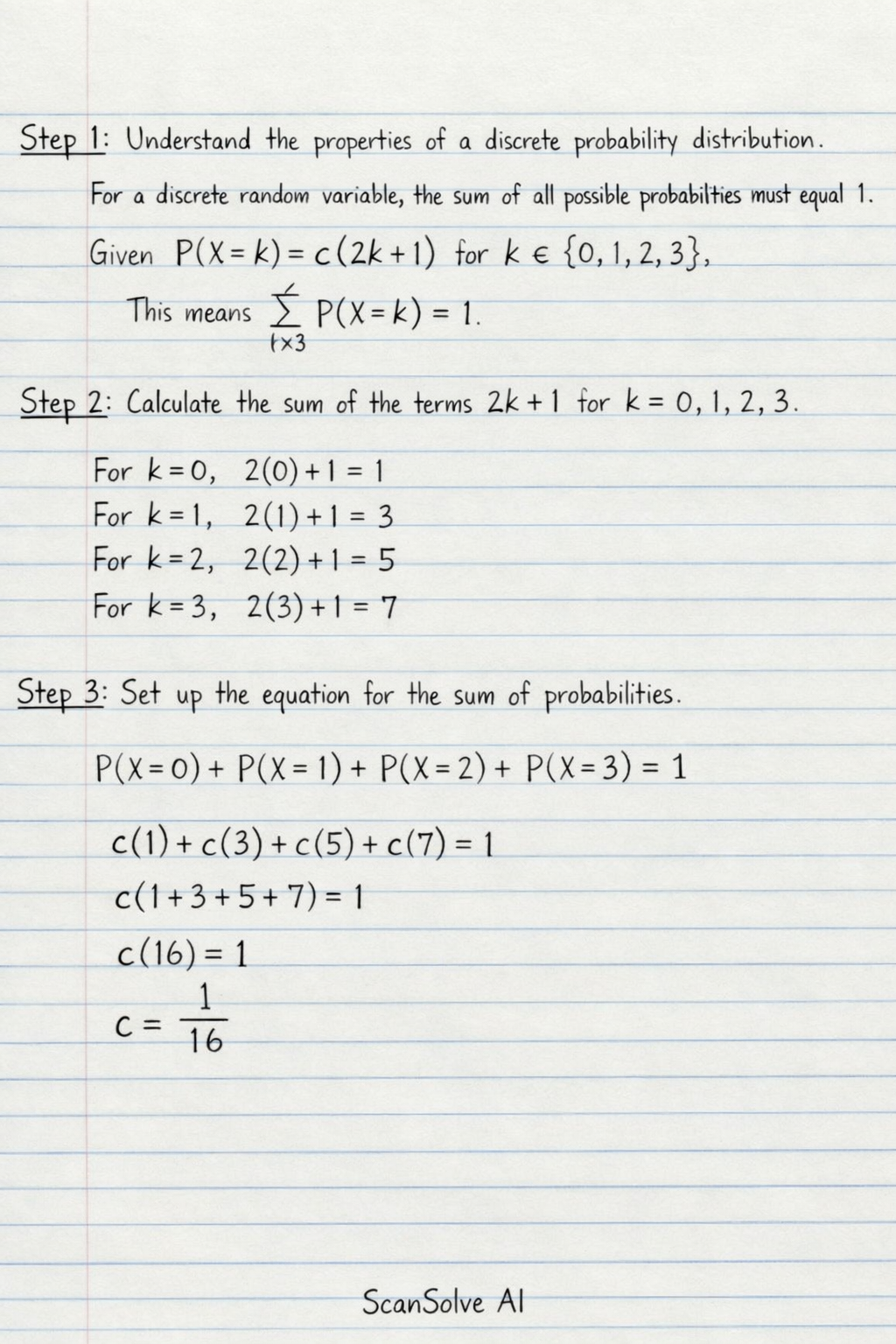
Handwritten Step-by-Step Solution
Get this as a handwritten image on WhatsApp — like a tutor wrote it for you.
Try on WhatsApp