We read your photo as:

Given points A(-2, 3), B(-6, 1), C(12, -1), and D(4, -5), show that vectors AB and CD are parallel. Also, find vector AB where A is the midpoint of M(5, 6) and N(-1, 4).

Mathematics

ScanSolve AI Answer

Answers

2 parts
b

(-30)\begin{pmatrix} \textbf{-3} \\ \textbf{0} \end{pmatrix}

c

(25)\begin{pmatrix} \textbf{2} \\ \textbf{5} \end{pmatrix}

Step-by-step solution

7 steps

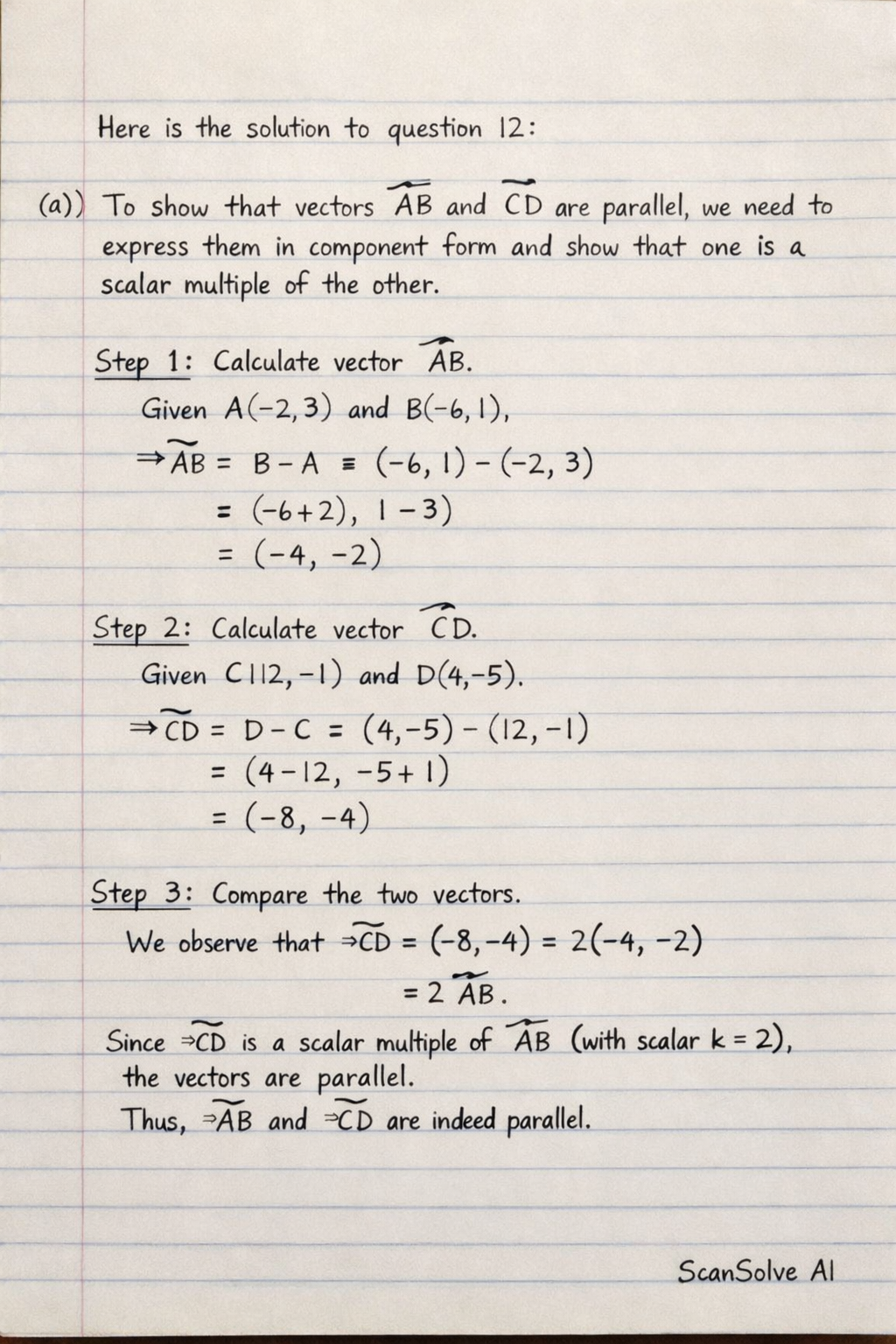
Here is the solution to question 12:

Part a· 3 steps

To show that vectors AB⃗\vec{AB} and CD⃗\vec{CD} are parallel, we need to express them in component form and show that one is a scalar multiple of the other.

  1. Calculate vector AB⃗\vec{AB}.

    Given A(−2,3)A(-2, 3) and B(−6,1)B(-6, 1).

    AB⃗=B−A=(−61)−(−23)=(−6−(−2)1−3)=(−4−2)\vec{AB} = B - A = \begin{pmatrix} -6 \\ 1 \end{pmatrix} - \begin{pmatrix} -2 \\ 3 \end{pmatrix} = \begin{pmatrix} -6 - (-2) \\ 1 - 3 \end{pmatrix} = \begin{pmatrix} -4 \\ -2 \end{pmatrix}
  2. Calculate vector CD⃗\vec{CD}.

    Given C(12,−1)C(12, -1) and D(4,−5)D(4, -5).

    CD⃗=D−C=(4−5)−(12−1)=(4−12−5−(−1))=(−8−4)\vec{CD} = D - C = \begin{pmatrix} 4 \\ -5 \end{pmatrix} - \begin{pmatrix} 12 \\ -1 \end{pmatrix} = \begin{pmatrix} 4 - 12 \\ -5 - (-1) \end{pmatrix} = \begin{pmatrix} -8 \\ -4 \end{pmatrix}
  3. Compare the two vectors.

    We observe that CD⃗=(−8−4)=2(−4−2)=2AB⃗\vec{CD} = \begin{pmatrix} -8 \\ -4 \end{pmatrix} = 2 \begin{pmatrix} -4 \\ -2 \end{pmatrix} = 2 \vec{AB}.
    Since CD⃗\vec{CD} is a scalar multiple of AB⃗\vec{AB} (with scalar k=2k=2), the vectors are parallel.
    Thus, AB⃗\vec{AB} and CD⃗\vec{CD} are indeed parallel.

Part b

(-30)\begin{pmatrix} \textbf{-3} \\ \textbf{0} \end{pmatrix}

To find AB⃗\vec{AB}, we first need to find the coordinates of point AA, which is the midpoint of MN‾\overline{MN}.

  1. Find the coordinates of point AA.

    Given M(5,6)M(5, 6) and N(−1,4)N(-1, 4). The midpoint formula is A=(x1+x22,y1+y22)A = \left( \frac{x_1+x_2}{2}, \frac{y_1+y_2}{2} \right).

    A=(5+(−1)2,6+42)=(42,102)=(2,5)A = \left( \frac{5 + (-1)}{2}, \frac{6 + 4}{2} \right) = \left( \frac{4}{2}, \frac{10}{2} \right) = (2, 5)
  2. Calculate vector AB⃗\vec{AB}.

    Given B(−1,5)B(-1, 5) and A(2,5)A(2, 5).

    AB⃗=B−A=(−15)−(25)=(−1−25−5)=(−30)\vec{AB} = B - A = \begin{pmatrix} -1 \\ 5 \end{pmatrix} - \begin{pmatrix} 2 \\ 5 \end{pmatrix} = \begin{pmatrix} -1 - 2 \\ 5 - 5 \end{pmatrix} = \begin{pmatrix} -3 \\ 0 \end{pmatrix}

    The vector AB⃗\vec{AB} is (-30)\boxed{\begin{pmatrix} \textbf{-3} \\ \textbf{0} \end{pmatrix}}.

Part c

(25)\begin{pmatrix} \textbf{2} \\ \textbf{5} \end{pmatrix}

To find the vector ff, we solve the given vector equation.

  1. Isolate the term with ff.

    2f−(37)=(13)2f - \begin{pmatrix} 3 \\ 7 \end{pmatrix} = \begin{pmatrix} 1 \\ 3 \end{pmatrix}

    Add (37)\begin{pmatrix} 3 \\ 7 \end{pmatrix} to both sides:

    2f=(13)+(37)2f = \begin{pmatrix} 1 \\ 3 \end{pmatrix} + \begin{pmatrix} 3 \\ 7 \end{pmatrix} 2f=(1+33+7)2f = \begin{pmatrix} 1+3 \\ 3+7 \end{pmatrix} 2f=(410)2f = \begin{pmatrix} 4 \\ 10 \end{pmatrix}
  2. Solve for ff.

    Divide both sides by 2:

    f=12(410)f = \frac{1}{2} \begin{pmatrix} 4 \\ 10 \end{pmatrix} f=(42102)f = \begin{pmatrix} \frac{4}{2} \\ \frac{10}{2} \end{pmatrix} f=(25)f = \begin{pmatrix} 2 \\ 5 \end{pmatrix}

    The vector ff is (25)\boxed{\begin{pmatrix} \textbf{2} \\ \textbf{5} \end{pmatrix}}.

Was this helpful?

Try one yourself

A new problem that tests the same skill.

Still stuck on this one?

Ask a follow-up, and the answer starts from this question.

Got a different question?Ask your own question
Handwritten step-by-step solution preview

Handwritten Step-by-Step Solution

Get this as a handwritten image on WhatsApp — like a tutor wrote it for you.

Try on WhatsApp