
We read your photo as:
Given points P(0, 3), Q(4, 1), R(2, -3), and S(-2, -1), show that PR = QS, determine the coordinates of N, the midpoint of QS, prove that PN ⊥ QS, and prove that P, N and R are collinear.
ScanSolve AI Answer
Answers
2 partsStep-by-step solution
10 stepsPart 1.1· 2 steps
Show that PR = QS
Given points , , , and .
Calculate the length of PR using the distance formula .
Calculate the length of QS using the distance formula.
Since and , then .
Part 1.2(1, 0)
Determine the coordinates of N, the midpoint of QS.
Use the midpoint formula for points and .
The coordinates of N are .
Part 1.3· 3 steps
Prove that PN QS.
Calculate the gradient of PN using points $P(0, 3)$ and $N(1, 0)$.
Calculate the gradient of QS using points and .
Multiply the gradients.
Since the product of their gradients is , .
Part 1.4· 2 steps
Prove that P, N and R are collinear.
Calculate the gradient of PN using points $P(0, 3)$ and $N(1, 0)$.
Calculate the gradient of NR using points and .
Since and they share a common point N, P, N, and R are collinear.
Part 1.5· 2 steps
What kind of quadrilateral is PQRS? Give a reason.
Determine properties of the diagonals.
From 1.1, , so the diagonals are equal in length.
From 1.2, N is the midpoint of QS.
From 1.4, N is also the midpoint of PR (as , which is N).
Since the diagonals bisect each other, PQRS is a parallelogram.
From 1.3, . Since N lies on PR, this means the diagonals PR and QS are perpendicular.Classify the quadrilateral based on these properties.
A parallelogram with equal diagonals is a rectangle.
A parallelogram with perpendicular diagonals is a rhombus.
A quadrilateral that is both a rectangle and a rhombus is a square.
Therefore, PQRS is a square.Reason: The diagonals PR and QS are equal in length, bisect each other, and are perpendicular.
Try one yourself
A new problem that tests the same skill.
Still stuck on this one?
Ask a follow-up, and the answer starts from this question.
More Mathematics Questions
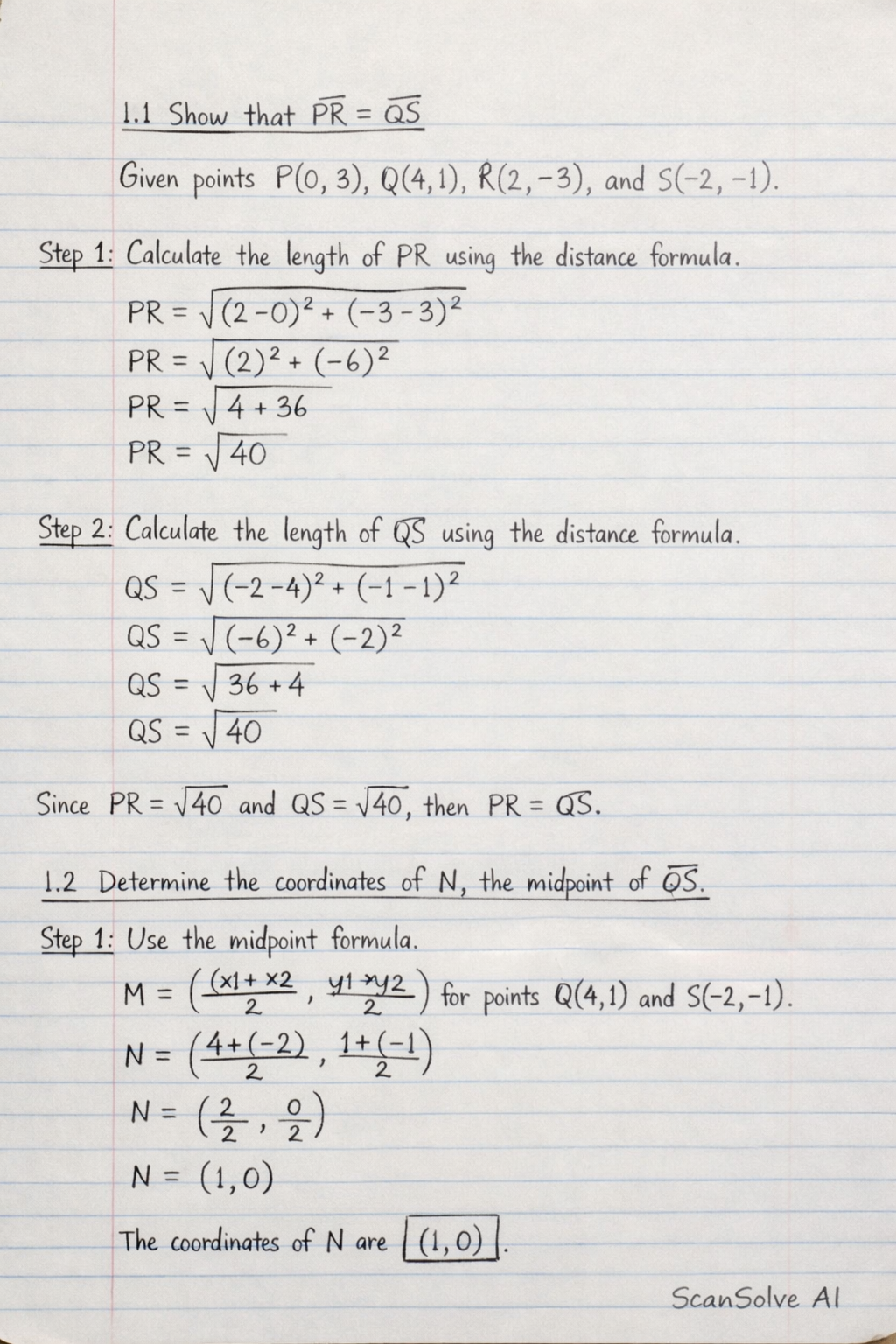
Handwritten Step-by-Step Solution
Get this as a handwritten image on WhatsApp — like a tutor wrote it for you.
Try on WhatsApp