
We read your photo as:
Given set P = 2, 4, 6. Which of the following is a subset of P? A. 2, 2, 4 B. 2, 3, 4 C. 2, 4, 6
ScanSolve AI Answer
Answer
Step-by-step solution
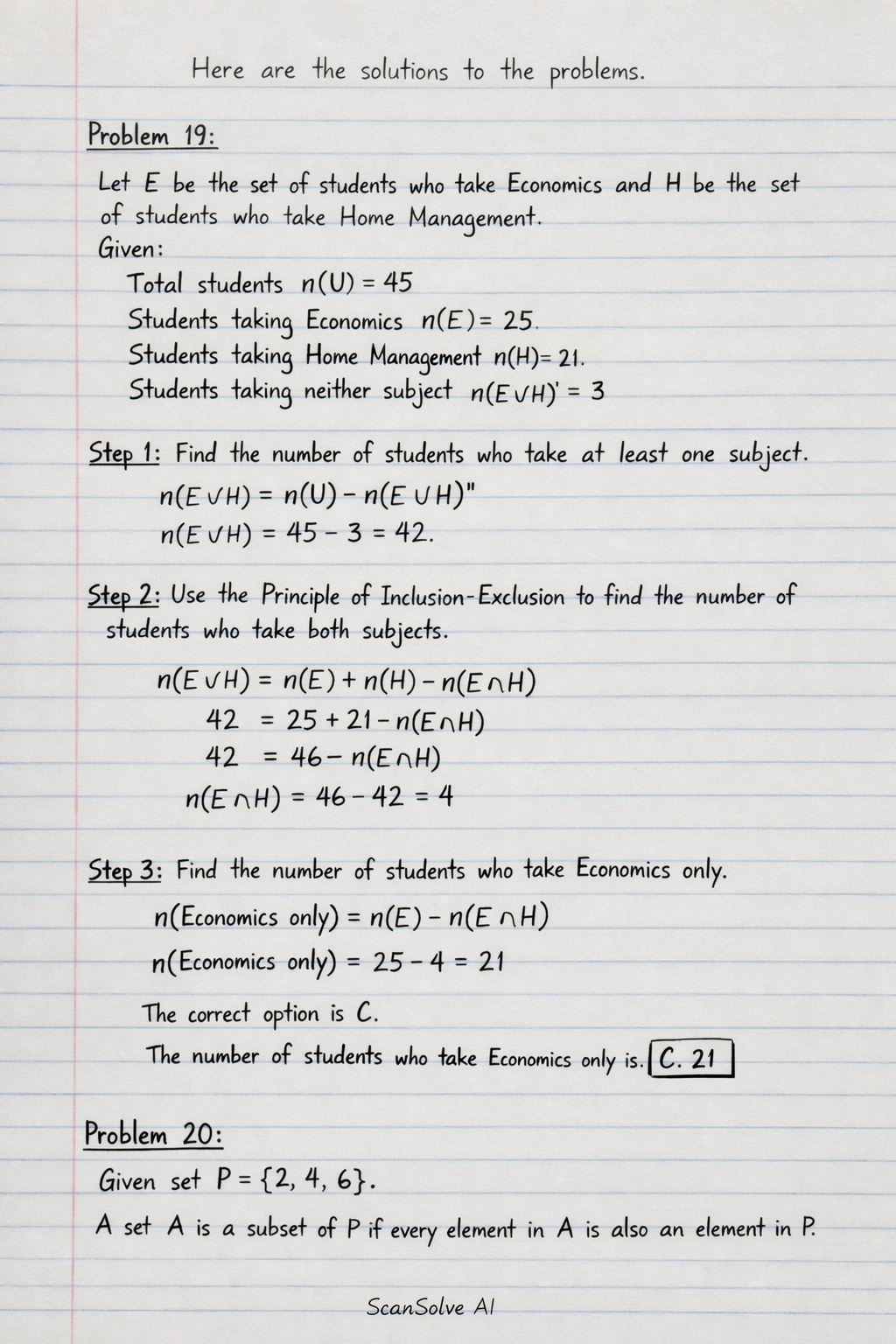
5 stepsHere are the solutions to the problems.
:
Let be the set of students who take Economics and be the set of students who take Home Management.
Given:
Total students
Students taking Economics
Students taking Home Management
Students taking neither subject
Find the number of students who take at least one subject.
Use the Principle of Inclusion-Exclusion to find the number of students who take both subjects.
Find the number of students who take Economics only.
The correct option is C.
The number of students who take Economics only is .:
Given set .
A set is a subset of if every element in is also an element in .- A. is equivalent to . Both 2 and 4 are in . So, is a subset of .
- B. . The element 3 is in this set, but 3 is not an element of . Therefore, is not a subset of .
- C. . All elements (2, 4, 6) are in . So, is a subset of .
- D. . The empty set is a subset of every set. So, is a subset of . The correct option is B. The set that is not a subset of is .
:
We need to find the equivalent expression for .
Using De Morgan's Laws, which state that and .
Also, .Apply De Morgan's Law to :
The correct option is C.
is equivalent to .:
Let be the set of teachers who teach pure Science and be the set of teachers who teach Social Science.
Given:
Total teachers
Teachers teaching pure Science
Teachers teaching Social Science
Teachers who do not teach any subjectFind the number of teachers who teach at least one subject.
Use the Principle of Inclusion-Exclusion to find the number of teachers who teach both subjects.
The correct option is D.
The number of teachers who teach both subjects is .
Try one yourself
A new problem that tests the same skill.
Still stuck on this one?
Ask a follow-up, and the answer starts from this question.
More Mathematics Questions
Handwritten Step-by-Step Solution
Get this as a handwritten image on WhatsApp — like a tutor wrote it for you.
Try on WhatsApp