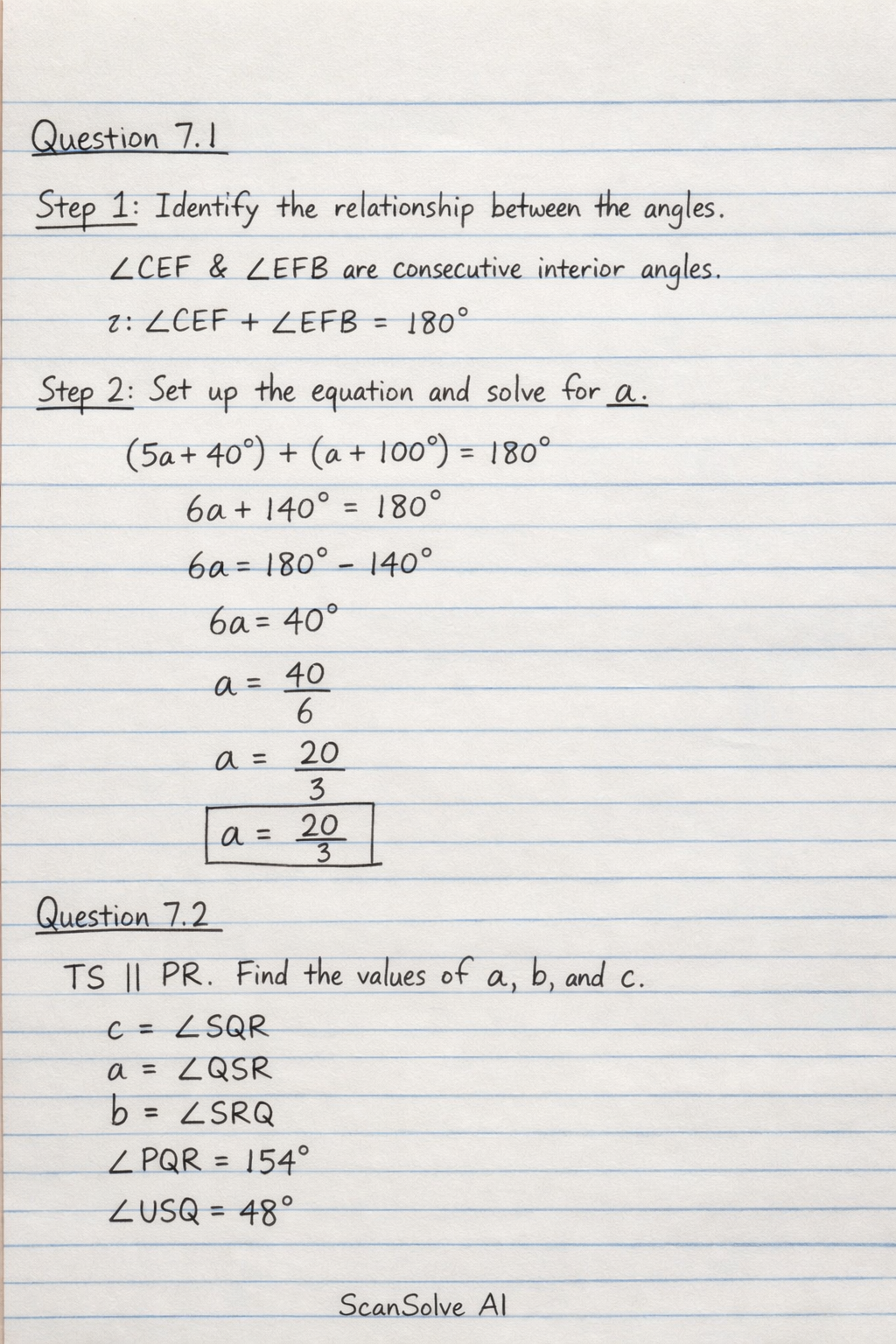
We read your photo as:

Given that AB//CD, angle CEF = 5a + 40° and EF B = a + 100°. What is the value of a? State reasons for you answer.

Mathematics

ScanSolve AI Answer

Answers

2 parts
7.1

203\frac{20}{3}

7.2

64∘64^\circ

90∘90^\circ

26∘26^\circ

Step-by-step solution

6 steps

here are the solutions to the problems.

Part 7.1· 2 steps

  1. Identify the relationship between the angles.

    Angles ∠CEF\angle CEF and ∠EFB\angle EFB are consecutive interior angles (also known as co-interior angles) because they are between the parallel lines ABAB and CDCD and on the same side of the transversal line EFEF.
    When two parallel lines are intersected by a transversal, consecutive interior angles are supplementary, meaning their sum is 180∘180^\circ.

  2. Set up the equation and solve for aa.

    ∠CEF+∠EFB=180∘\angle CEF + \angle EFB = 180^\circ (5a+40∘)+(a+100∘)=180∘(5a + 40^\circ) + (a + 100^\circ) = 180^\circ 6a+140∘=180∘6a + 140^\circ = 180^\circ 6a=180∘−140∘6a = 180^\circ - 140^\circ 6a=40∘6a = 40^\circ a=406a = \frac{40}{6} a=203a = \frac{20}{3}

    The value of aa is 203\boxed{\frac{20}{3}}.

Part 7.2

64∘64^\circ

Given TS∥PRTS \parallel PR. We need to find the values of aa, bb, and cc.
From the diagram:
c=∠SQRc = \angle SQR
a=∠QSRa = \angle QSR
b=∠SRQb = \angle SRQ
The angle 154∘154^\circ is ∠PQR\angle PQR.
The angle 48∘48^\circ is ∠USQ\angle USQ.

  1. Find the value of cc.

    Angles ∠PQR\angle PQR and ∠SQR\angle SQR are angles on a straight line PQRPQR. Therefore, their sum is 180∘180^\circ.

    ∠PQR+∠SQR=180∘\angle PQR + \angle SQR = 180^\circ 154∘+c=180∘154^\circ + c = 180^\circ c=180∘−154∘c = 180^\circ - 154^\circ c=26∘c = 26^\circ
  2. Use parallel lines to find relationships between aa and bb.

    Since TS∥PRTS \parallel PR and SQSQ is a transversal, ∠TSQ\angle TSQ and ∠SQR\angle SQR are alternate interior angles.

    ∠TSQ=∠SQR\angle TSQ = \angle SQR ∠TSQ=c\angle TSQ = c ∠TSQ=26∘\angle TSQ = 26^\circ

    Now, consider the transversal SRSR. Since TS∥PRTS \parallel PR, ∠TSR\angle TSR and ∠SRQ\angle SRQ are alternate interior angles.

    ∠TSR=∠SRQ\angle TSR = \angle SRQ

    From the diagram, ∠TSR\angle TSR is composed of ∠TSQ\angle TSQ and ∠QSR\angle QSR.

    ∠TSR=∠TSQ+∠QSR\angle TSR = \angle TSQ + \angle QSR ∠TSR=26∘+a\angle TSR = 26^\circ + a

    So, we have the equation:

    b=26∘+a(1)b = 26^\circ + a \quad (1)
  3. Use the sum of angles in △SQR\triangle SQR.

    The sum of angles in a triangle is 180∘180^\circ.

    ∠QSR+∠SRQ+∠SQR=180∘\angle QSR + \angle SRQ + \angle SQR = 180^\circ a+b+c=180∘a + b + c = 180^\circ

    Substitute the value of c=26∘c = 26^\circ:

    a+b+26∘=180∘a + b + 26^\circ = 180^\circ a+b=180∘−26∘a + b = 180^\circ - 26^\circ a+b=154∘(2)a + b = 154^\circ \quad (2)
  4. Solve the system of equations for aa and bb.

    Substitute equation (1) into equation (2):

    a+(26∘+a)=154∘a + (26^\circ + a) = 154^\circ 2a+26∘=154∘2a + 26^\circ = 154^\circ 2a=154∘−26∘2a = 154^\circ - 26^\circ 2a=128∘2a = 128^\circ a=128∘2a = \frac{128^\circ}{2} a=64∘a = 64^\circ

    Now substitute the value of aa back into equation (1) to find bb:

    b=26∘+64∘b = 26^\circ + 64^\circ b=90∘b = 90^\circ

    (Note: The angle 48∘48^\circ is extraneous information not needed to solve for a,b,ca, b, c based on the standard geometric theorems and parallel line properties.)

    The values are:
    a=64∘a = \boxed{64^\circ}
    b=90∘b = \boxed{90^\circ}
    c=26∘c = \boxed{26^\circ}

Was this helpful?

Try one yourself

A new problem that tests the same skill.

Still stuck on this one?

Ask a follow-up, and the answer starts from this question.

Got a different question?Ask your own question
Handwritten step-by-step solution preview

Handwritten Step-by-Step Solution

Get this as a handwritten image on WhatsApp — like a tutor wrote it for you.

Try on WhatsApp