We read your photo as:

Given that f(θ) = (cos θ / (1-tan θ)) + (sin θ / (1-cot θ)). (a) Prove that f(θ) ≡ cos θ + sin θ. (b) Express f(θ) in the form Rsin(θ + λ), where R > 0 and λ an acute angle. (c) Find the general solution of the equation f(θ) = 1.

Mathematics

ScanSolve AI Answer

Step-by-step solution

14 steps

Part a· 7 steps

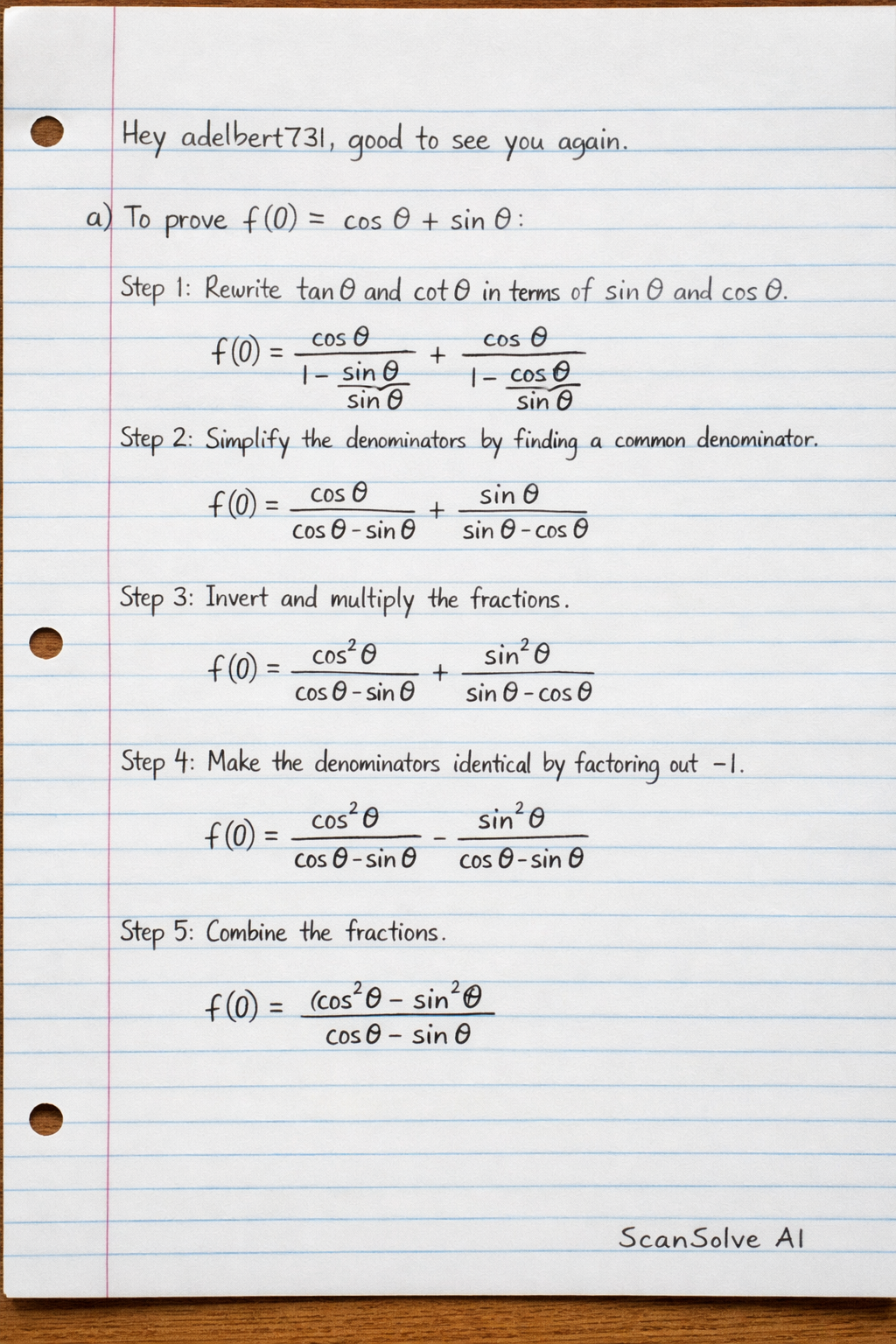
To prove f(θ)≡cos⁡θ+sin⁡θf(\theta) \equiv \cos \theta + \sin \theta

  1. Rewrite tan⁡θ\tan \theta and cot⁡θ\cot \theta in terms of sin⁡θ\sin \theta and cos⁡θ\cos \theta.

    f(θ)=cos⁡θ1−sin⁡θcos⁡θ+sin⁡θ1−cos⁡θsin⁡θf(\theta) = \frac{\cos \theta}{1-\frac{\sin \theta}{\cos \theta}} + \frac{\sin \theta}{1-\frac{\cos \theta}{\sin \theta}}
  2. Simplify the denominators by finding a common denominator.

    f(θ)=cos⁡θcos⁡θ−sin⁡θcos⁡θ+sin⁡θsin⁡θ−cos⁡θsin⁡θf(\theta) = \frac{\cos \theta}{\frac{\cos \theta - \sin \theta}{\cos \theta}} + \frac{\sin \theta}{\frac{\sin \theta - \cos \theta}{\sin \theta}}
  3. Invert and multiply the fractions.

    f(θ)=cos⁡2θcos⁡θ−sin⁡θ+sin⁡2θsin⁡θ−cos⁡θf(\theta) = \frac{\cos^2 \theta}{\cos \theta - \sin \theta} + \frac{\sin^2 \theta}{\sin \theta - \cos \theta}
  4. Make the denominators identical by factoring out −1-1 from the second denominator.

    f(θ)=cos⁡2θcos⁡θ−sin⁡θ−sin⁡2θcos⁡θ−sin⁡θf(\theta) = \frac{\cos^2 \theta}{\cos \theta - \sin \theta} - \frac{\sin^2 \theta}{\cos \theta - \sin \theta}
  5. Combine the fractions.

    f(θ)=cos⁡2θ−sin⁡2θcos⁡θ−sin⁡θf(\theta) = \frac{\cos^2 \theta - \sin^2 \theta}{\cos \theta - \sin \theta}
  6. Apply the difference of squares identity, a2−b2=(a−b)(a+b)a^2 - b^2 = (a-b)(a+b), to the numerator.

    f(θ)=(cos⁡θ−sin⁡θ)(cos⁡θ+sin⁡θ)cos⁡θ−sin⁡θf(\theta) = \frac{(\cos \theta - \sin \theta)(\cos \theta + \sin \theta)}{\cos \theta - \sin \theta}
  7. Cancel out the common term (cos⁡θ−sin⁡θ)(\cos \theta - \sin \theta).

    f(θ)=cos⁡θ+sin⁡θf(\theta) = \cos \theta + \sin \theta

    Thus, f(θ)≡cos⁡θ+sin⁡θf(\theta) \equiv \cos \theta + \sin \theta is proven.

Part b· 3 steps

To express f(θ)f(\theta) in the form Rsin⁡(θ+λ)R\sin(\theta + \lambda)

  1. We have f(θ)=cos⁡θ+sin⁡θf(\theta) = \cos \theta + \sin \theta.

    We compare this to the expansion of Rsin⁡(θ+λ)=Rsin⁡θcos⁡λ+Rcos⁡θsin⁡λR\sin(\theta + \lambda) = R\sin\theta\cos\lambda + R\cos\theta\sin\lambda.
    By comparing coefficients:
    Rcos⁡λ=1R\cos\lambda = 1 (coefficient of sin⁡θ\sin\theta)
    Rsin⁡λ=1R\sin\lambda = 1 (coefficient of cos⁡θ\cos\theta)
    To find RR, square and add the two equations:

    (Rcos⁡λ)2+(Rsin⁡λ)2=12+12(R\cos\lambda)^2 + (R\sin\lambda)^2 = 1^2 + 1^2 R2(cos⁡2λ+sin⁡2λ)=2R^2(\cos^2\lambda + \sin^2\lambda) = 2 R2(1)=2  ⟹  R=2(since R>0)R^2(1) = 2 \implies R = \sqrt{2} \quad (\text{since } R > 0)
  2. To find λ\lambda, divide the second equation by the first

    Rsin⁡λRcos⁡λ=11\frac{R\sin\lambda}{R\cos\lambda} = \frac{1}{1} tan⁡λ=1\tan\lambda = 1

    Since λ\lambda is an acute angle, λ=arctan⁡(1)=π4\lambda = \arctan(1) = \frac{\pi}{4} radians or 45∘45^\circ.

  3. Substitute the values of RR and λ\lambda into the form.

    f(θ)=2sin⁡(θ+π4)f(\theta) = \boxed{\sqrt{2}\sin\left(\theta + \frac{\pi}{4}\right)}

Part c· 4 steps

To find the general solution of the equation f(θ)=1f(\theta) = 1

  1. Use the result from part (b) for f(θ)f(\theta).

    2sin⁡(θ+π4)=1\sqrt{2}\sin\left(\theta + \frac{\pi}{4}\right) = 1
  2. Isolate the sine term.

    sin⁡(θ+π4)=12\sin\left(\theta + \frac{\pi}{4}\right) = \frac{1}{\sqrt{2}}
  3. Find the principal value for which sin⁡x=12\sin x = \frac{1}{\sqrt{2}}.

    This is x=π4x = \frac{\pi}{4}.
    The general solution for sin⁡X=sin⁡α\sin X = \sin \alpha is X=kπ+(−1)kαX = k\pi + (-1)^k \alpha, where kk is an integer.
    Let X=θ+π4X = \theta + \frac{\pi}{4} and α=π4\alpha = \frac{\pi}{4}.

    θ+π4=kπ+(−1)kπ4\theta + \frac{\pi}{4} = k\pi + (-1)^k \frac{\pi}{4}
  4. Solve for θ\theta.

    θ=kπ+(−1)kπ4−π4\theta = k\pi + (-1)^k \frac{\pi}{4} - \frac{\pi}{4}

    We consider two cases for kk:
    Case 1: kk is an even integer (e.g., k=2nk=2n for some integer nn).

    θ=2nπ+(−1)2nπ4−π4\theta = 2n\pi + (-1)^{2n} \frac{\pi}{4} - \frac{\pi}{4} θ=2nπ+π4−π4\theta = 2n\pi + \frac{\pi}{4} - \frac{\pi}{4} θ=2nπ\theta = 2n\pi

    Case 2: kk is an odd integer (e.g., k=2n+1k=2n+1 for some integer nn).

    θ=(2n+1)π+(−1)2n+1π4−π4\theta = (2n+1)\pi + (-1)^{2n+1} \frac{\pi}{4} - \frac{\pi}{4} θ=(2n+1)π−π4−π4\theta = (2n+1)\pi - \frac{\pi}{4} - \frac{\pi}{4} θ=(2n+1)π−2π4\theta = (2n+1)\pi - \frac{2\pi}{4} θ=(2n+1)π−π2\theta = (2n+1)\pi - \frac{\pi}{2} θ=2nπ+π−π2\theta = 2n\pi + \pi - \frac{\pi}{2} θ=2nπ+π2\theta = 2n\pi + \frac{\pi}{2}

    The general solution is:

    θ=2nπorθ=2nπ+π2,where n∈Z\boxed{\theta = 2n\pi \quad \text{or} \quad \theta = 2n\pi + \frac{\pi}{2}, \quad \text{where } n \in \mathbb{Z}}
Was this helpful?

Still stuck on this one?

Ask a follow-up, and the answer starts from this question.

Got a different question?Ask your own question
Handwritten step-by-step solution preview

Handwritten Step-by-Step Solution

Get this as a handwritten image on WhatsApp — like a tutor wrote it for you.

Try on WhatsApp