
We read your photo as:
Given that K = 1, 2, 3, ..., 11: (i) List the prime numbers in K. (ii) Find the probability that a number selected at random from the set K is not a prime number. 1. (b) Factorize completely: (x+y)(2m
ScanSolve AI Answer
Step-by-step solution
21 stepsHere are the solutions to the math problems:
1. (a) Given that :
- (i) List the prime numbers in : A prime number is a natural number greater than 1 that has no positive divisors other than 1 and itself.
Identify numbers in that fit the definition of a prime number.
The prime numbers in $K$ are $2, 3, 5, 7, 11$. * **Prime numbers: $\{2, 3, 5, 7, 11\}$**- (ii) Find the probability that a number selected at random from the set is not a prime number.
Determine the total number of elements in .
Total number of elements in $K = 11$.Determine the number of prime numbers in .
From (i), there are 5 prime numbers.Determine the number of non-prime numbers in .
Number of non-prime numbers = Total elements - Number of prime numbers Number of non-prime numbers = $11 - 5 = 6$.Calculate the probability.
$$ P(\text{not prime}) = \frac{\text{Number of non-prime numbers}}{\text{Total number of elements}} $$ $$ P(\text{not prime}) = \frac{6}{11} $$ * **Probability: $\boxed{\frac{6}{11}}$**1. (b) Factorize completely:
Identify the common factor in both terms.
The common factor is .
Factor out the common factor.
Simplify the expression inside the square brackets.
- Factorized expression:
1. (c) A typist charges GH¢ 68.00 for the first 8 sheets typed, and GH¢ 11.00 for each additional sheet. Calculate the amount earned if the typist typed a total of 35 sheets.
Calculate the number of additional sheets.
Additional sheets = Total sheets - First 8 sheets
Additional sheets = sheets.Calculate the cost for the additional sheets.
Cost for additional sheets = Number of additional sheets Cost per additional sheet
Cost for additional sheets = .Calculate the total amount earned.
Total amount earned = Cost for first 8 sheets + Cost for additional sheets
Total amount earned = .- Amount earned:
2. (a) The image of when translated by the vector is . Find:
- (i) ;
Let the point and its image .
Let the translation vector be .
The translation formula is .Equate the corresponding coordinates to find and .
For the x-coordinate: $-3 = 2+a \implies a = -3 - 2 \implies a = -5$. For the y-coordinate: $8 = 5+b \implies b = 8 - 5 \implies b = 3$. * **Translation vector $r$: $\boxed{\begin{pmatrix} -5 \\ 3 \end{pmatrix}}$**- (ii) the image of when translated by .
Use the translation vector found in (i) and the point .
$$ Q' = Q + r $$ $$ Q' = (-4, -6) + (-5, 3) $$Add the corresponding coordinates.
$$ Q' = (-4 + (-5), -6 + 3) $$ $$ Q' = (-4 - 5, -6 + 3) $$ $$ Q' = (-9, -3) $$ * **Image $Q'$: $\boxed{(-9, -3)}$**2. (b) Joyce and Richard contributed GH¢ 10,000.00 and GH¢ 5,000.00 respectively to start a business. They agreed that Richard will be paid one-third of the profit as a manager, and the rest of the profit will be shared in the ratio of their contributions. If the profit of GH¢ 9,000.00 was made, how much did:
- (i) Joyce receive;
- (ii) Richard receive in total?
Calculate Richard's manager's share.
Richard's manager's share = .
Calculate the remaining profit to be shared.
Remaining profit = Total profit - Richard's manager's share
Remaining profit = .Determine the ratio of their contributions.
Joyce's contribution : Richard's contribution = GH¢ 10,000.00 : GH¢ 5,000.00
Ratio = .
Sum of ratios = .Calculate Joyce's share from the remaining profit.
Joyce's share = .
- (i) Joyce receive:
Calculate Richard's share from the remaining profit.
Richard's share = .
Calculate Richard's total receipt.
Richard's total receipt = Richard's manager's share + Richard's share from remaining profit
Richard's total receipt = .- (ii) Richard receive in total:
Still stuck on this one?
Ask a follow-up, and the answer starts from this question.
More Mathematics Questions
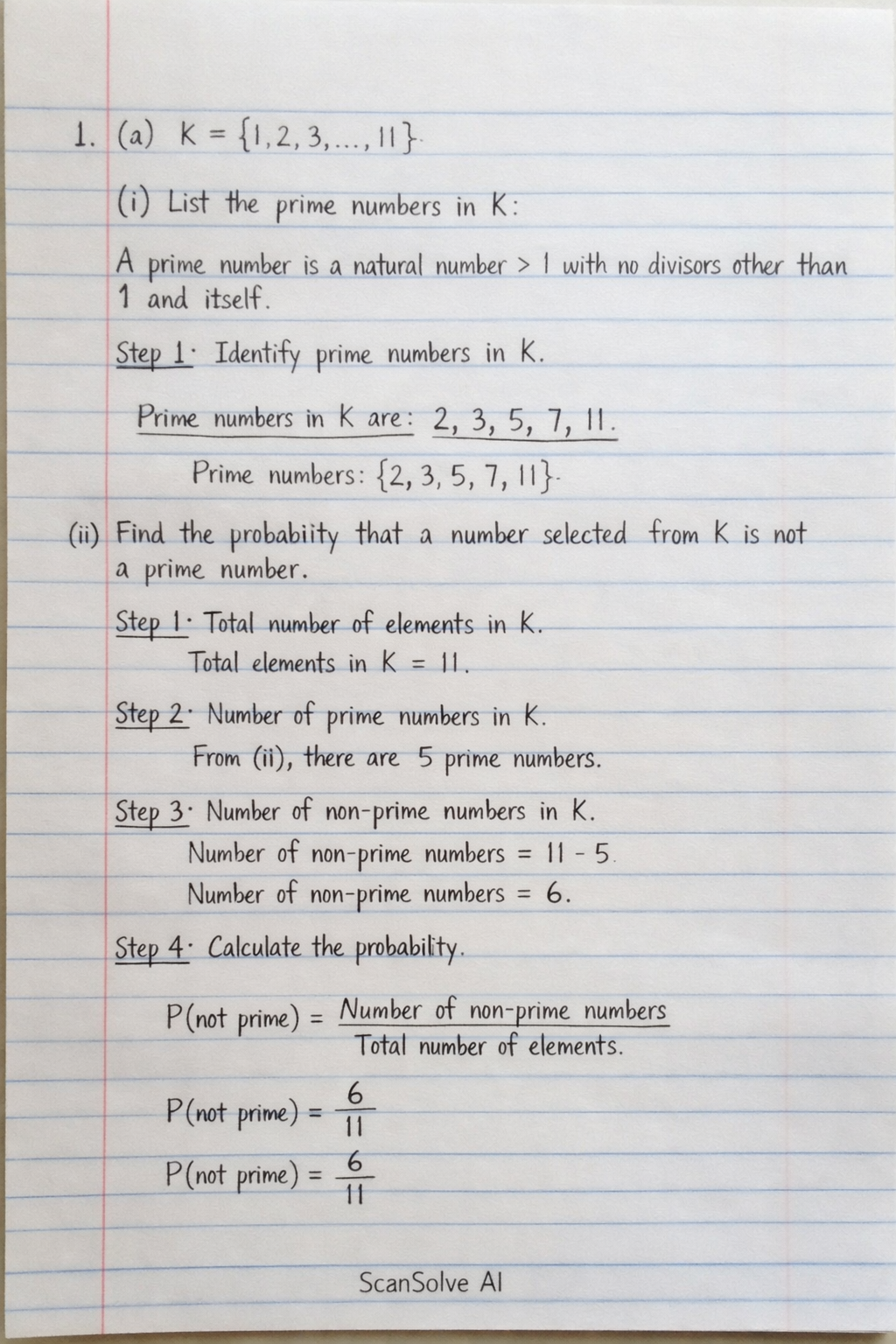
Handwritten Step-by-Step Solution
Get this as a handwritten image on WhatsApp — like a tutor wrote it for you.
Try on WhatsApp