
We read your photo as:
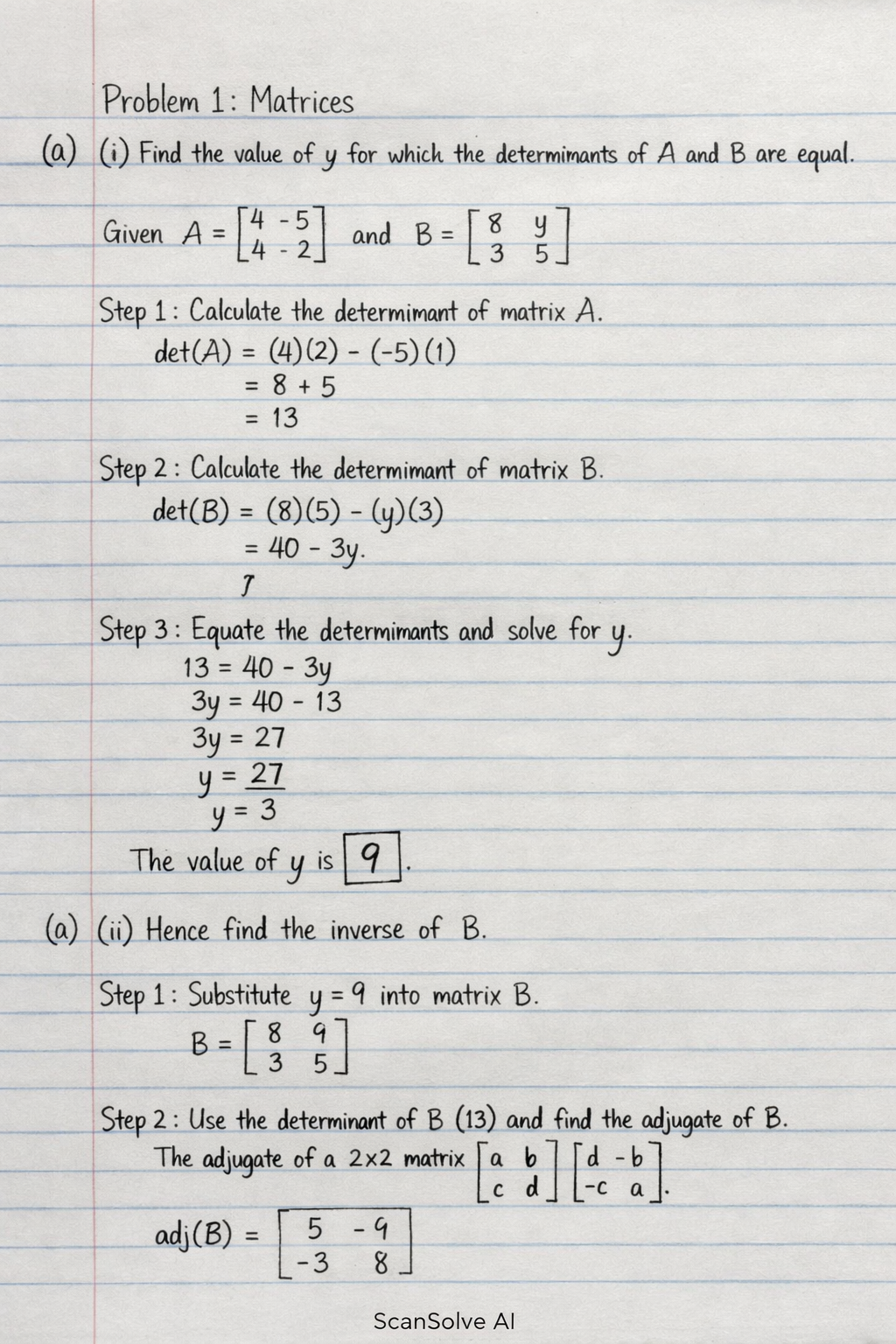
Given that matrix A = (4 −5 / 1 2) and B = (8 y / 3 5), find the value of y for which the determinants of A and B are equal, and hence find the inverse of B.
ScanSolve AI Answer
Step-by-step solution
31 stepsHere are the solutions to the problems from the image.
: Matrices
a) (i) Find the value of for which the determinants of A and B are equal.
Given and .
Calculate the determinant of matrix A.
Calculate the determinant of matrix B.
Equate the determinants and solve for .
The value of is .
a) (ii) Hence find the inverse of B.
Substitute into matrix B.
Use the determinant of B (calculated as 13 in part (i)) and find the adjugate of B.
The adjugate of a matrix is .
Calculate the inverse of B using the formula .
The inverse of B is .
: Probability
A bag contains 6 black pens and 9 green pens, making a total of pens. Two pens are taken without replacement.
a) (i) Calculate the probability that both pens are black.
Probability of the first pen being black.
Probability of the second pen being black, given the first was black (14 pens remaining, 5 black).
Multiply the probabilities to find the probability of both being black.
The probability that both pens are black is .
a) (ii) Calculate the probability that both pens are of different colours.
This means (Black then Green) OR (Green then Black).Probability of picking a black pen then a green pen.
Probability of picking a green pen then a black pen.
Add the probabilities for the two mutually exclusive events.
The probability that both pens are of different colours is .
: Quadratic Equation
Solve the equation , giving your answers correct to 2 decimal places.
Identify coefficients for the quadratic formula .
Here, , , .
Substitute the values into the quadratic formula.
Calculate the two possible values for and round to 2 decimal places.
The solutions are .
: Venn Diagram (Set Theory)
Total students = 20.
Subjects: Mathematics (M), Chemistry (C), Physics (P).
Given:- All who study Chemistry also study Mathematics ().
- 3 students study all three subjects ().
- 4 students study Mathematics only ().
- 8 students study Chemistry ().
- 14 students study Mathematics ().
Determine the number of students in each region of the Venn diagram.
Since :
- Students studying Chemistry and Mathematics but not Physics: .
- Students studying Mathematics and Physics but not Chemistry: .
- Students studying Physics only: Total students = .
a) (i) Draw a Venn diagram to illustrate this information.
(As an AI, I cannot draw diagrams. Here is a description of the regions):- A large circle for Mathematics (M).
- A smaller circle for Chemistry (C) completely inside the M circle.
- A third circle for Physics (P) that overlaps with M (and thus C).
- The region where M, C, and P overlap (center) has 3 students.
- The part of C that is not in P has 5 students.
- The part of M that is not in C and not in P has 4 students.
- The part of M that is in P but not in C has 2 students.
- The part of P that is not in M (and thus not in C) has 6 students. (All other regions are 0).
a) (ii) How many students study
(a) Physics only,
From our calculations, students studying Physics only = .(b) two subjects only,
This includes students in () + () + ().
Since , () = 0.
So, students.(c) Mathematics and Physics but not Chemistry?
This is the region (), which is students.: Definite Integral
Evaluate .
Find the antiderivative of the function.
Evaluate the antiderivative at the upper and lower limits and subtract.
Combine the fractions.
The value of the integral is .
: Equation of the Normal to a Curve
Find the equation of the normal to the curve at the point where .
Find the y-coordinate of the point.
Substitute into the equation of the curve:
The point is .
Find the derivative of the curve to get the gradient of the tangent.
Rewrite .
Calculate the gradient of the tangent at .
Calculate the gradient of the normal.
The gradient of the normal () is the negative reciprocal of the gradient of the tangent.
Use the point-slope form to find the equation of the normal.
Using point and :
Multiply by 3:
Rearrange into the form :
The equation of the normal is .
: Geometry Construction
This problem requires physical construction and measurement, which cannot be performed by an AI.
a) (i) Construct a triangle XYZ in which XY = 9 cm, YZ = 7 cm and angle XYZ = 38°.
a) (ii) Measure and write the length of XZ.
b) On your diagram, within triangle XYZ, construct the locus of points which are (i) 6 cm from Y, (ii) equidistant from XZ and XY.
c) Mark clearly with the letter P, within triangle XYZ, a point which is 6 cm from Y and equidistant from XZ and XY.
d) A point T, within triangle XYZ, is such that its distance from Y is less than or equal to 6 cm and it is nearer to XZ than XY. Indicate clearly, by shading, the region in which T must lie.
To solve this, you would:
- Draw a line segment XY of 9 cm.
- At point Y, use a protractor to draw an angle of 38°.
- Along the line forming the 38° angle, measure 7 cm from Y and mark point Z.
- Connect X to Z to complete the triangle.
- Measure the length of XZ with a ruler.
- For the locus 6 cm from Y, draw an arc of a circle with center Y and radius 6 cm.
- For the locus equidistant from XZ and XY, construct the angle bisector of .
- Point P is the intersection of the arc from Y and the angle bisector of .
- The region for T is the area within the triangle that is inside or on the arc of radius 6 cm from Y, and on the side of the angle bisector of that is closer to side XZ. This region should be shaded.
: Algebra and Geometric Progression
a) Simplify .
Factor the denominator using the difference of squares formula ().
Rewrite the numerator as .
Cancel out the common term .
The simplified expression is .
b) The first three terms of a geometric progression are and where is a positive constant.
b) (i) Find k.
Use the property that the ratio of consecutive terms in a geometric progression is constant.
Cross-multiply to form a quadratic equation.
Rearrange the equation and solve for .
Factor the quadratic equation:
This gives or . Since is a positive constant, we choose .
The value of is .b) (ii) List the first three terms of the progression.
Substitute into the expressions for the terms.
First term: .
Second term: .
Third term: .
The first three terms of the progression are .
Still stuck on this one?
Ask a follow-up, and the answer starts from this question.
More Mathematics Questions
Handwritten Step-by-Step Solution
Get this as a handwritten image on WhatsApp — like a tutor wrote it for you.
Try on WhatsApp