

This mathematics problem involves applying core mathematical principles and formulas. Below you will find a complete step-by-step solution with detailed explanations for each step, helping you understand not just the answer but the method behind it.
ScanSolve AI Answer
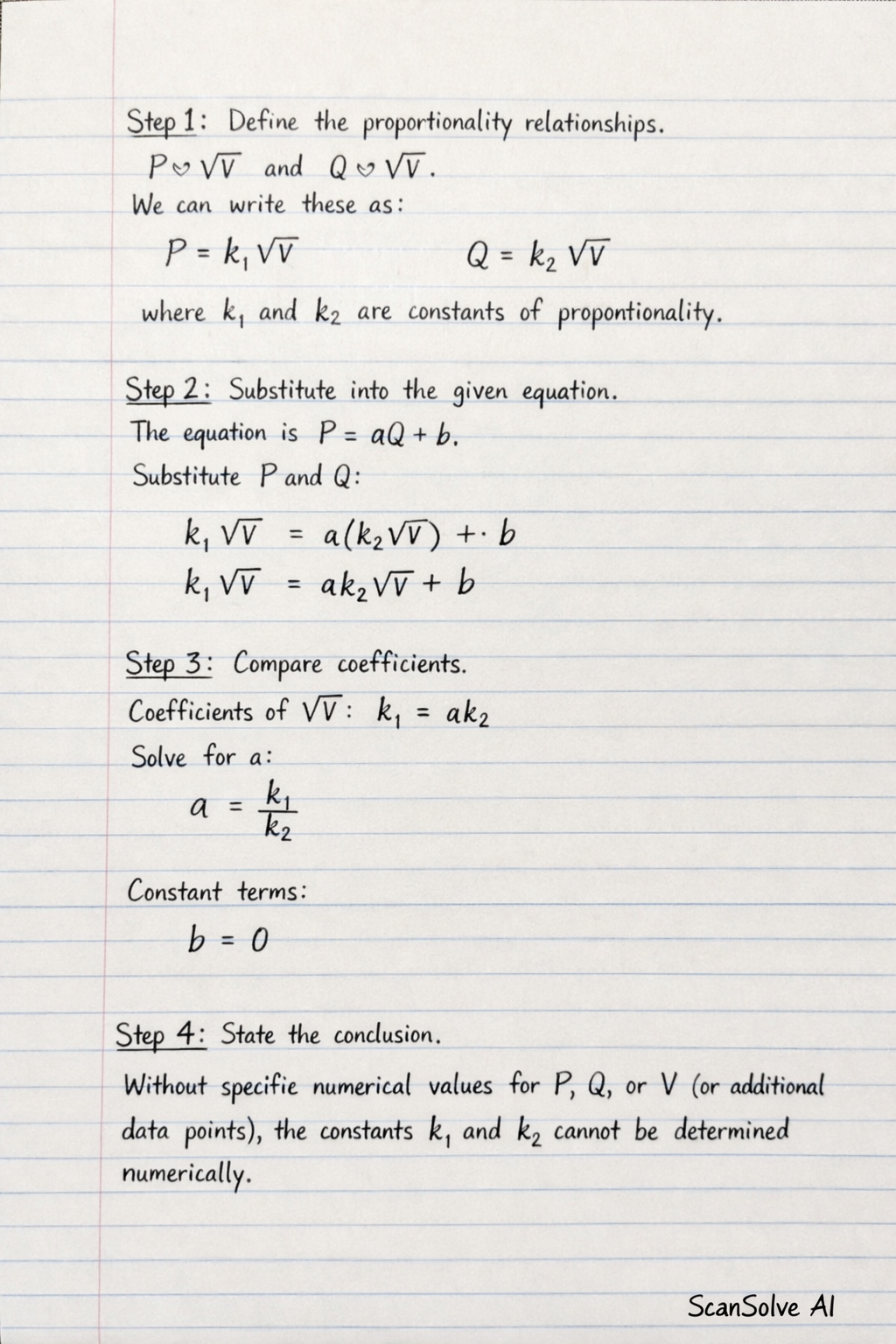
Step 1: Define the proportionality relationships. Given that P sqrt(V) and Q sqrt(V), we can write these as: P = k_1 sqrt(V) Q = k_2 sqrt(V) where k_1 and k_2 are constants of proportionality. Step 2: Substitute these relationships into the given linear equation. The given equation is P = aQ + b. Substitute the expressions for P and Q: k_1 sqrt(V) = a(k_2 sqrt(V)) + b k_1 sqrt(V) = ak_2 sqrt(V) + b Step 3: Compare coefficients. For this equation to hold true for all values of V, the coefficients of sqrt(V) on both sides must be equal, and the constant terms must be equal. Comparing the coefficients of sqrt(V): k_1 = ak_2 Solving for a: a = (k_1)/(k_2) Comparing the constant terms: b = 0 Step 4: State the conclusion. Without specific numerical values for P, Q, or V (or additional data points), the constants k_1 and k_2 cannot be determined numerically. Therefore,