

This mathematics problem involves applying core mathematical principles and formulas. Below you will find a complete step-by-step solution with detailed explanations for each step, helping you understand not just the answer but the method behind it.
ScanSolve AI Answer
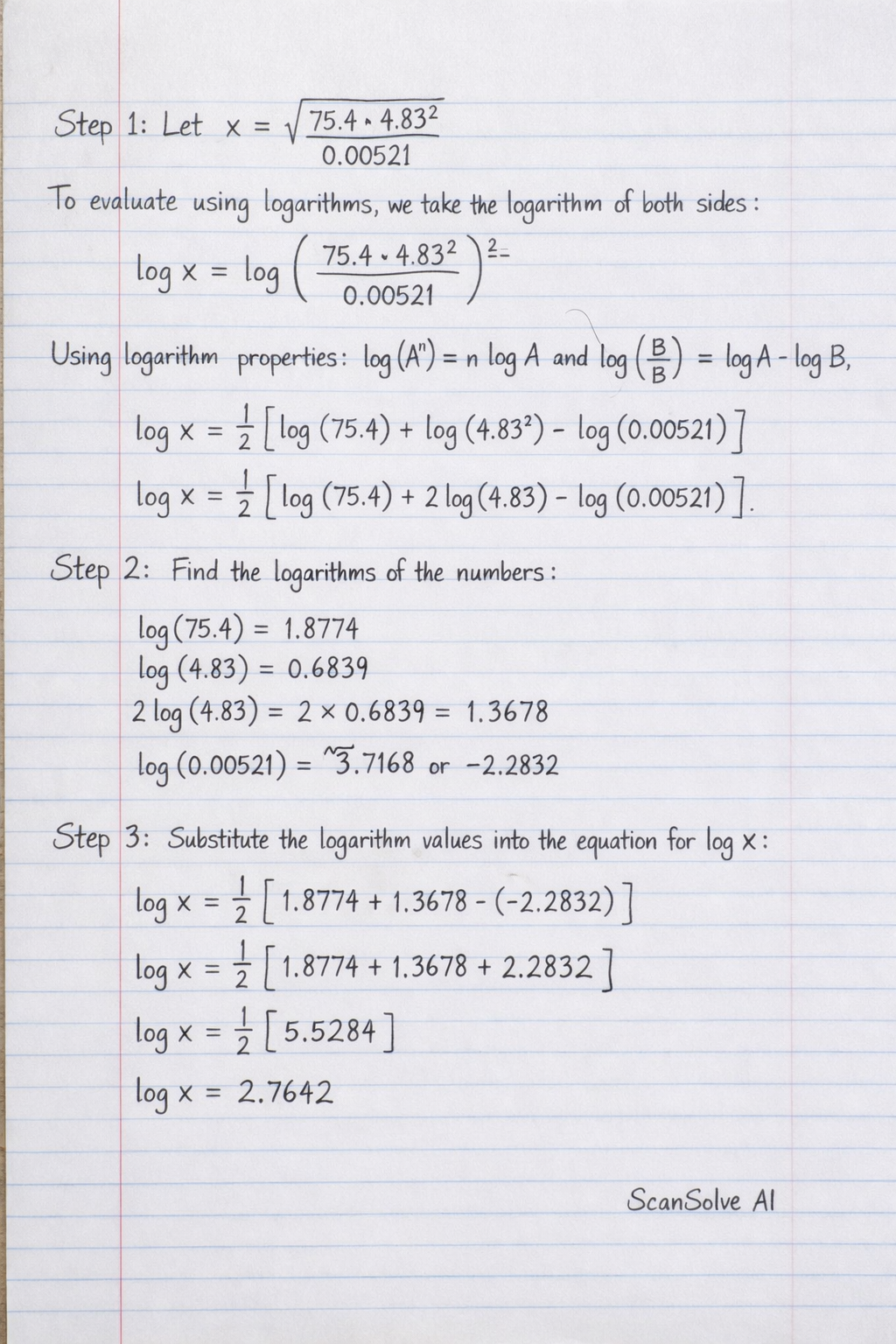
Step 1: Let x = sqrt((75.4 × 4.83^2)/(0.00521)). To evaluate using logarithms, we take the logarithm of both sides: x = ( (75.4 × 4.83^2)/(0.00521) )^(1)/(2) Using logarithm properties, (A^n) = n A and ((A)/(B)) = A - B: x = (1)/(2) [ (75.4) + (4.83^2) - (0.00521) ] Using (A^n) = n A: x = (1)/(2) [ (75.4) + 2(4.83) - (0.00521) ] Step 2: Find the logarithms of the numbers (using a logarithm table or calculator for precision). (75.4) = 1.8774 (4.83) = 0.6839 2(4.83) = 2 × 0.6839 = 1.3678 (0.00521) = 3.7168 or -2.2832 Step 3: Substitute the logarithm values into the equation for x. x = (1)/(2) [ 1.8774 + 1.3678 - (-2.2832) ] x = (1)/(2) [ 1.8774 + 1.3678 + 2.2832 ] x = (1)/(2) [ 5.5284 ] x = 2.7642 Step 4: Find the antilogarithm of 2.7642. x = antilog(2.7642) x = 10^2.7642 x ≈ 580.0 The value is 580.0. --- Step 1: Start with the given formula: a = (bd)/(Nb^2 - d) Step 2: Multiply both sides by (Nb^2 - d) to eliminate the denominator: a(Nb^2 - d) = bd Step 3: Expand the left side: aNb^2 - ad = bd Step 4: Rearrange the terms to group all terms involving b on one side and the constant term on the other. This forms a quadratic equation in b: aNb^2 - bd - ad = 0 aNb^2 - db - ad = 0 This is a quadratic equation of the form Ax^2 + Bx + C = 0, where x=b, A=aN, B=-d, and C=-ad. Step 5: Use the quadratic formula b = -B ± sqrt(B^2 - 4AC)2A to solve for b: b = -(-d) ± sqrt((-d)^2 - 4(aN)(-ad))2(aN) b = d ± sqrt(d^2 + 4a^2Nd)2aN The formula with b as the subject is b = d ± sqrt(d^2 + 4a^2Nd)2aN. --- Step 1: Find the center of the circle. The line PQ is the diameter, so the center of the circle is the midpoint of PQ. Given coordinates P(-2, 2) and Q(-2, -6). The midpoint formula is ( (x_1+x_2)/(2), (y_1+y_2)/(2) ). Center (h, k) = ( (-2+(-2))/(2), (2+(-6))/(2) ) (h, k) = ( (-4)/(2), (-4)/(2) ) (h, k) = (-2, -2) Step 2: Find the radius of the circle. The radius is half the length of the diameter PQ. The distance formula for the diameter is D = sqrt((x_2-x_1)^2 + (y_2-y_1)^2). D = sqrt((-2 - (-2))^2 + (-6 - 2)^2) D = sqrt((0)^2 + (-8)^2) D = sqrt(0 + 64) D = sqrt(64) D = 8 The radius r = (D)/(2) = (8)/(2) = 4. Step 3: Write the equation of the circle in standard form $(x-h)^2