
We read your photo as:
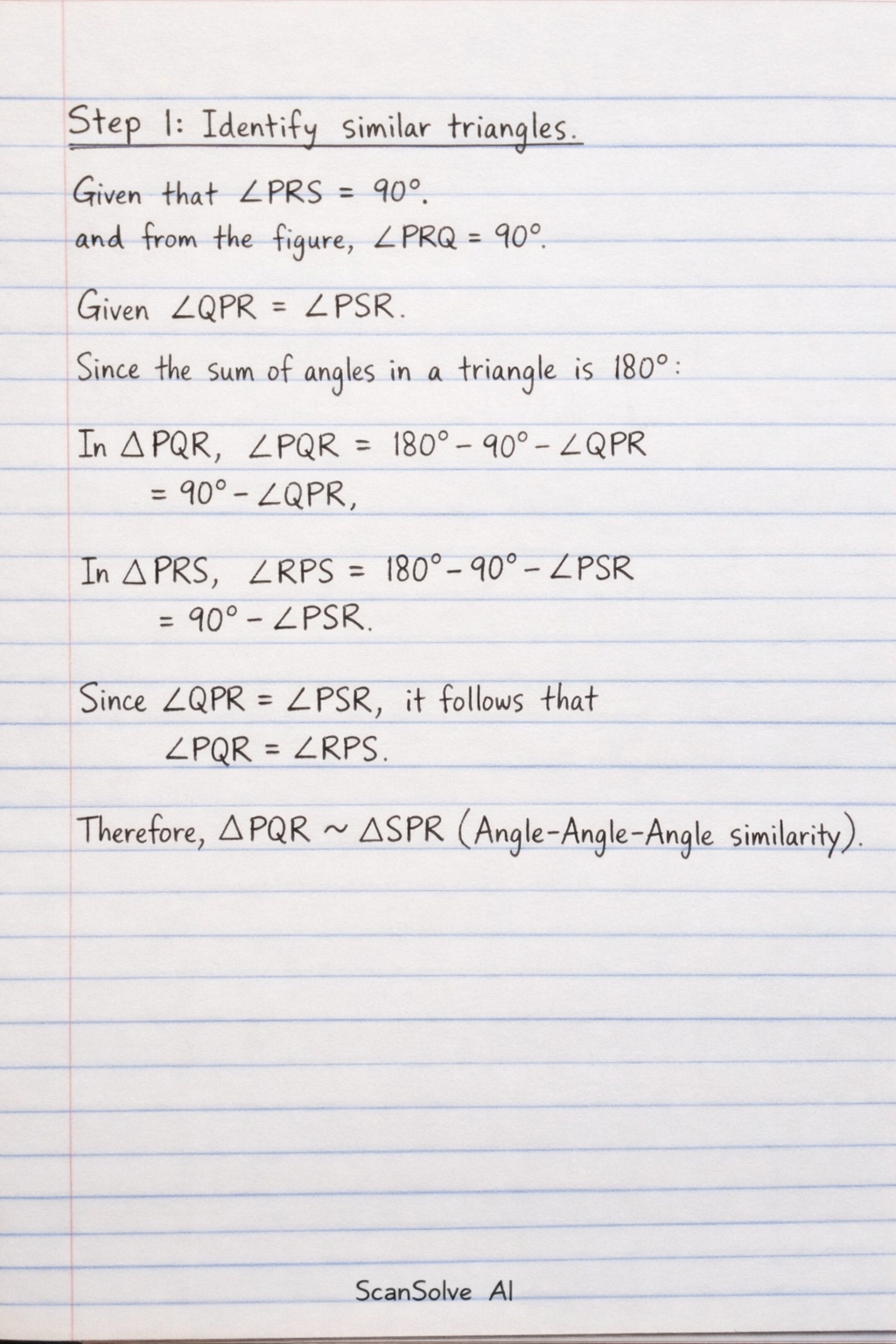
Given that PRS = 90^, and from the figure, PRQ = 90^.
ScanSolve AI Answer
Answer
Step-by-step solution
6 stepshere are the solutions:
5. In the figure below angles QPR and PSR are equal. Angle PRS is a right angle. The ratio of PR:QR = 4:3. Given that the area of triangle PQR is , find the area of triangle PRS.
Identify similar triangles.
Given that , and from the figure, .
Given .
Since the sum of angles in a triangle is :
In , .
In , .
Since , it follows that .
Therefore, is similar to (Angle-Angle-Angle similarity).Use the given area of and the ratio PR:QR to find the lengths of PR and QR.
Let and for some constant .
The area of .So, and .
Use the property of similar triangles that the ratio of their areas is equal to the square of the ratio of their corresponding sides.
Since , the ratio of their areas is:
Using the sides and :
Solve for the area of .
The area of triangle PRS is .
6. A suit whose marked price is sh. 8,000 is sold to customer after allowing him a discount of 13%. If the trader makes a profit of 20%, find how much the trader paid for the suit.
Calculate the selling price (SP) after the discount.
Marked Price (MP) = Sh. 8,000.
Discount = 13%.
Discount amount = of .
Selling Price (SP) = MP - Discount amount = .
Alternatively, .Calculate the cost price (CP) using the profit percentage.
Profit = 20%.
The selling price (SP) is the cost price plus the profit.
.The trader paid for the suit.
**7. Evans is a salesperson with Ajab Millers. He is paid on monthly basis as the agreement; basic pay of Ksh. 20,000, a commission
Try one yourself
A new problem that tests the same skill.
Still stuck on this one?
Ask a follow-up, and the answer starts from this question.
More Mathematics Questions
Handwritten Step-by-Step Solution
Get this as a handwritten image on WhatsApp — like a tutor wrote it for you.
Try on WhatsApp