We read your photo as:

Given that sin 2x = 1/2, then the value of sin 3x is

Mathematics

ScanSolve AI Answer

Step-by-step solution

39 steps

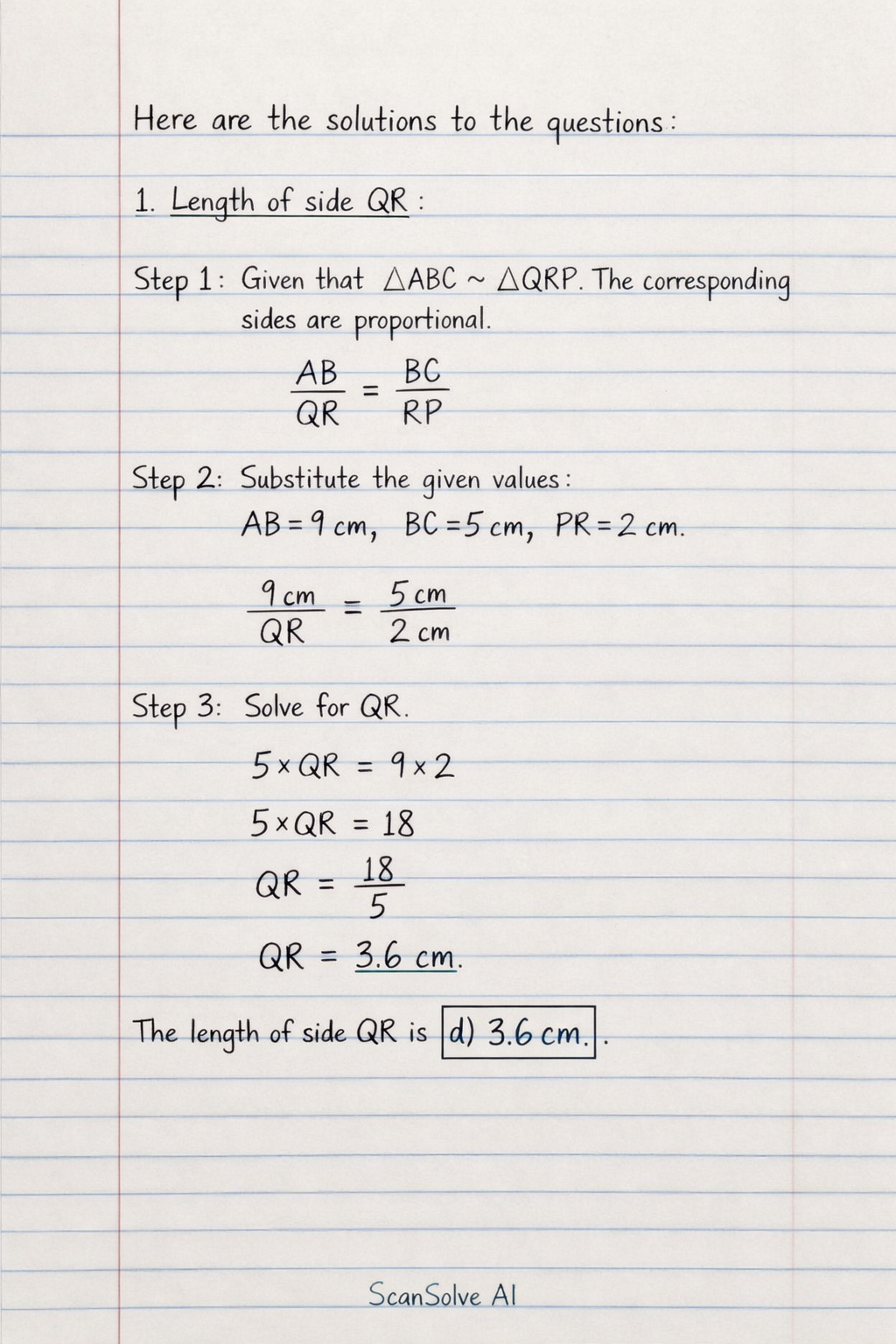
Here are the solutions to the questions:

1. Length of side QR:

  1. Given that △ABC∼△QRP\triangle ABC \sim \triangle QRP.

    The corresponding sides are proportional.

    ABQR=BCRP\frac{AB}{QR} = \frac{BC}{RP}
  2. Substitute the given values

    AB=9 cmAB = 9 \text{ cm}, BC=5 cmBC = 5 \text{ cm}, PR=2 cmPR = 2 \text{ cm}.

    9 cmQR=5 cm2 cm\frac{9 \text{ cm}}{QR} = \frac{5 \text{ cm}}{2 \text{ cm}}
  3. Solve for QRQR.

    5×QR=9×25 \times QR = 9 \times 2 5×QR=185 \times QR = 18 QR=185=3.6 cmQR = \frac{18}{5} = 3.6 \text{ cm}

    The length of side QR is d) *3.6 cm\boxed{\text{d) *3.6 cm}}.

    2. Length of tangent PQ:

  4. In the given figure, PQ is a tangent to the circle with center O and radius OQ=3 cmOQ = 3 \text{ cm}.

    The line segment OP bisects ∠QPR\angle QPR.
    Given ∠QPR=60∘\angle QPR = 60^\circ, so ∠QPO=12×60∘=30∘\angle QPO = \frac{1}{2} \times 60^\circ = 30^\circ.

  5. The radius OQ is perpendicular to the tangent PQ at the point of contact Q, so ∠OQP=90∘\angle OQP = 90^\circ.

    In the right-angled triangle △OQP\triangle OQP:

    tan⁡(∠QPO)=OppositeAdjacent=OQPQ\tan(\angle QPO) = \frac{\text{Opposite}}{\text{Adjacent}} = \frac{OQ}{PQ}
  6. Substitute the values and solve for PQ.

    tan⁡(30∘)=3 cmPQ\tan(30^\circ) = \frac{3 \text{ cm}}{PQ} 13=3 cmPQ\frac{1}{\sqrt{3}} = \frac{3 \text{ cm}}{PQ} PQ=33 cmPQ = 3\sqrt{3} \text{ cm}

    The length of the tangent is \boxed{\text{a) *3\sqrt{3} cm}}.

    3. Value of tan⁡245∘−cos⁡260∘\tan^2 45^\circ - \cos^2 60^\circ:

  7. Recall the trigonometric values

    tan⁡45∘=1\tan 45^\circ = 1 and cos⁡60∘=12\cos 60^\circ = \frac{1}{2}.

  8. Substitute the values into the expression.

    tan⁡245∘−cos⁡260∘=(1)2−(12)2\tan^2 45^\circ - \cos^2 60^\circ = (1)^2 - \left(\frac{1}{2}\right)^2 =1−14= 1 - \frac{1}{4} =44−14=34= \frac{4}{4} - \frac{1}{4} = \frac{3}{4}

    The value is \boxed{\text{c) *\frac{3}{4}}}.

    4. Value of sin⁡3x\sin 3x:

  9. Given sin⁡2x=32\sin 2x = \frac{\sqrt{3}}{2}.

    We know that sin⁡60∘=32\sin 60^\circ = \frac{\sqrt{3}}{2}.

  10. Equate the angles to find xx.

    2x=60∘2x = 60^\circ x=30∘x = 30^\circ
  11. Calculate sin⁡3x\sin 3x.

    sin⁡3x=sin⁡(3×30∘)=sin⁡90∘\sin 3x = \sin (3 \times 30^\circ) = \sin 90^\circ sin⁡90∘=1\sin 90^\circ = 1

    The value of sin⁡3x\sin 3x is d) *1\boxed{\text{d) *1}}.

    5. Altitude of the sun:

  12. Let the height of the tower be hh and the length of its shadow be ss.

    Given s=3hs = \sqrt{3}h.

  13. Let the altitude of the sun be θ\theta.

    In the right-angled triangle formed by the tower and its shadow, the tangent of the angle of elevation is the ratio of the height to the shadow length.

    tan⁡θ=hs\tan \theta = \frac{h}{s}
  14. Substitute s=3hs = \sqrt{3}h and solve for θ\theta.

    tan⁡θ=h3h=13\tan \theta = \frac{h}{\sqrt{3}h} = \frac{1}{\sqrt{3}}

    We know that tan⁡30∘=13\tan 30^\circ = \frac{1}{\sqrt{3}}.

    θ=30∘\theta = 30^\circ

    The altitude of the sun is \boxed{\text{b) *30^\circ}}.

    6. Definition of figures with same shape but not necessarily same size:
    Figures having the same shape and not necessarily the same size are called similar figures.
    The correct option is c) *similar figures\boxed{\text{c) *similar figures}}.

    7. Value of x:

  15. Given MN || QR in △PQR\triangle PQR.

    By the Basic Proportionality Theorem (Thales's Theorem), the line divides the sides proportionally.

    PMMQ=PNNR\frac{PM}{MQ} = \frac{PN}{NR}
  16. Substitute the given values

    PM=xPM = x, MQ=10 cmMQ = 10 \text{ cm}, PN=(x−2) cmPN = (x-2) \text{ cm}, NR=6 cmNR = 6 \text{ cm}.

    x10=x−26\frac{x}{10} = \frac{x-2}{6}
  17. Solve for xx.

    6x=10(x−2)6x = 10(x-2) 6x=10x−206x = 10x - 20 20=10x−6x20 = 10x - 6x 20=4x20 = 4x x=204=5 cmx = \frac{20}{4} = 5 \text{ cm}

    The value of x is b) *5 cm\boxed{\text{b) *5 cm}}.

    8. Type of triangle formed by the points (-4,0), (4,0), and (0,3):

  18. Let the points be A(-4,0), B(4,0), and C(0,3).

    Calculate the length of each side using the distance formula d=(x2−x1)2+(y2−y1)2d = \sqrt{(x_2 - x_1)^2 + (y_2 - y_1)^2}.
    Length of AB:

    AB=(4−(−4))2+(0−0)2=(8)2+02=64=8 unitsAB = \sqrt{(4 - (-4))^2 + (0 - 0)^2} = \sqrt{(8)^2 + 0^2} = \sqrt{64} = 8 \text{ units}

    Length of BC:

    BC=(0−4)2+(3−0)2=(−4)2+32=16+9=25=5 unitsBC = \sqrt{(0 - 4)^2 + (3 - 0)^2} = \sqrt{(-4)^2 + 3^2} = \sqrt{16 + 9} = \sqrt{25} = 5 \text{ units}

    Length of AC:

    AC=(0−(−4))2+(3−0)2=(4)2+32=16+9=25=5 unitsAC = \sqrt{(0 - (-4))^2 + (3 - 0)^2} = \sqrt{(4)^2 + 3^2} = \sqrt{16 + 9} = \sqrt{25} = 5 \text{ units}
  19. Compare the side lengths.

    Since BC=AC=5BC = AC = 5 units, two sides of the triangle are equal.
    Therefore, the triangle is an isosceles triangle.
    The triangle is a/an b) *isosceles triangle\boxed{\text{b) *isosceles triangle}}.

    9. Value of p:

  20. Given the distance between points (4,p) and (1,0) is 5 units.

    Use the distance formula d=(x2−x1)2+(y2−y1)2d = \sqrt{(x_2 - x_1)^2 + (y_2 - y_1)^2}.

    5=(1−4)2+(0−p)25 = \sqrt{(1 - 4)^2 + (0 - p)^2} 5=(−3)2+(−p)25 = \sqrt{(-3)^2 + (-p)^2} 5=9+p25 = \sqrt{9 + p^2}
  21. Square both sides of the equation.

    52=9+p25^2 = 9 + p^2 25=9+p225 = 9 + p^2 p2=25−9p^2 = 25 - 9 p2=16p^2 = 16
  22. Solve for p.

    p=±16p = \pm \sqrt{16} p=±4p = \pm 4

    The value of p is b) *\pm4 only\boxed{\text{b) *\pm 4 only}}.

    10. Value of a:

  23. The question has a typo as 'a' is not present in the given points Q(-6,5) and R(-2,3).

    Assuming the question intended for the x-coordinate of Q to be 'a', i.e., Q(a,5), and P(3,4) is the midpoint of QR.

  24. Use the midpoint formula for the x-coordinate

    Px=Qx+Rx2P_x = \frac{Q_x + R_x}{2}.

    3=a+(−2)23 = \frac{a + (-2)}{2}
  25. Solve for a.

    3×2=a−23 \times 2 = a - 2 6=a−26 = a - 2 a=6+2a = 6 + 2 a=8a = 8

    The value of a is c) *8\boxed{\text{c) *8}}.

    11. Value of 9sec⁡2A−9tan⁡2A9\sec^2 A - 9\tan^2 A:

  26. Factor out 9 from the expression.

    9sec⁡2A−9tan⁡2A=9(sec⁡2A−tan⁡2A)9\sec^2 A - 9\tan^2 A = 9(\sec^2 A - \tan^2 A)
  27. Use the trigonometric identity sec⁡2A−tan⁡2A=1\sec^2 A - \tan^2 A = 1.

    9(sec⁡2A−tan⁡2A)=9(1)=99(\sec^2 A - \tan^2 A) = 9(1) = 9

    The value is b) *9\boxed{\text{b) *9}}.

    12. Value of 1−tan⁡245∘1+tan⁡245∘\frac{1-\tan^2 45^\circ}{1+\tan^2 45^\circ}:

  28. Recall the trigonometric value tan⁡45∘=1\tan 45^\circ = 1.

  29. Substitute the value into the expression.

    1−tan⁡245∘1+tan⁡245∘=1−(1)21+(1)2\frac{1-\tan^2 45^\circ}{1+\tan^2 45^\circ} = \frac{1 - (1)^2}{1 + (1)^2} =1−11+1= \frac{1 - 1}{1 + 1} =02=0= \frac{0}{2} = 0

    The value is d) *0\boxed{\text{d) *0}}.

    13. Sun's altitude when shadow length equals height:

  30. Let the height of the tower be hh and the length of its shadow be ss.

    Given s=hs = h.

  31. Let the altitude of the sun be θ\theta.

    In the right-angled triangle formed by the tower and its shadow:

    tan⁡θ=hs\tan \theta = \frac{h}{s}
  32. Substitute s=hs = h and solve for θ\theta.

    tan⁡θ=hh=1\tan \theta = \frac{h}{h} = 1

    We know that tan⁡45∘=1\tan 45^\circ = 1.

    θ=45∘\theta = 45^\circ

    The sun's altitude is \boxed{\text{d) *45^\circ}}.

    14. Value of ∠POA\angle POA:

  33. Given that tangents PA and PB from point P to a circle with centre O are inclined at ∠APB=80∘\angle APB = 80^\circ.

    The line segment OP bisects the angle between the tangents, so ∠APO=12∠APB=12×80∘=40∘\angle APO = \frac{1}{2} \angle APB = \frac{1}{2} \times 80^\circ = 40^\circ.

  34. The radius OA is perpendicular to the tangent PA at the point of contact A, so ∠OAP=90∘\angle OAP = 90^\circ.

  35. In △OAP\triangle OAP, the sum of angles is 180∘180^\circ.

    ∠POA+∠OAP+∠APO=180∘\angle POA + \angle OAP + \angle APO = 180^\circ ∠POA+90∘+40∘=180∘\angle POA + 90^\circ + 40^\circ = 180^\circ ∠POA+130∘=180∘\angle POA + 130^\circ = 180^\circ ∠POA=180∘−130∘=50∘\angle POA = 180^\circ - 130^\circ = 50^\circ

    The value of ∠POA\angle POA is \boxed{\text{a) *50^\circ}}.

    15. Common point of a tangent and a circle:
    The common point of a tangent to a circle and the circle is called the point of contact.
    The correct option is c) *point of contact\boxed{\text{c) *point of contact}}.

    16. Area of sector of angle P (in degrees) of a circle with radius R:
    The formula for the area of a sector with angle θ\theta (in degrees) and radius R is θ360∘πR2\frac{\theta}{360^\circ} \pi R^2.
    Given the angle is P, the area is P360∘πR2\frac{P}{360^\circ} \pi R^2.
    Option d) is P720∘×2πR2=P×2πR2720∘=PπR2360∘\frac{P}{720^\circ} \times 2\pi R^2 = \frac{P \times 2\pi R^2}{720^\circ} = \frac{P \pi R^2}{360^\circ}.
    This matches the formula.
    The area of the sector is \boxed{\text{d) *\frac{P}{720^\circ} \times 2\pi R^2}}.

    17. Relationship between height and radius of a cylinder:

  36. Given that the curved surface area (CSA) of a solid right circular cylinder is one third of its total surface area (TSA).

    CSA=13TSACSA = \frac{1}{3} TSA
  37. Recall the formulas for CSA and TSA of a cylinder with height hh and radius rr.

    CSA=2πrhCSA = 2\pi rh TSA=2πrh+2πr2=2πr(h+r)TSA = 2\pi rh + 2\pi r^2 = 2\pi r(h+r)
  38. Substitute these into the given equation.

    2πrh=13[2πr(h+r)]2\pi rh = \frac{1}{3} [2\pi r(h+r)]
  39. Simplify the equation.

    Divide both sides by 2πr2\pi r.

    h=13(h+r)h = \frac{1}{3}(h+r) 3h=h+r3h = h+r 3h−h=r3h - h = r 2h=r2h = r

    The relationship is r = 2h\boxed{\text{r = 2h}}.

Was this helpful?

Still stuck on this one?

Ask a follow-up, and the answer starts from this question.

Got a different question?Ask your own question
Handwritten step-by-step solution preview

Handwritten Step-by-Step Solution

Get this as a handwritten image on WhatsApp — like a tutor wrote it for you.

Try on WhatsApp