
Solve the equation sin2x = cotx
ScanSolve AI Answer
Step-by-step solution
7 stepsRewrite the trigonometric functions in terms of and .
We know that and .
Substitute these into the given equation:Note that for to be defined, . This means for any integer .
Rearrange the equation to solve for .
Multiply both sides by (which is non-zero based on the restriction):
Move all terms to one side:
Factor out the common term .
Set each factor equal to zero and solve for .
This gives two separate cases:
Case 1:
Case 2:Solve Case 1.
If , then is an odd multiple of .
where is an integer.
Solve Case 2.
If , then:
We can use the identity .
So, .
Therefore, the equation becomes , or .
If , then is an odd multiple of .Divide by 2:
where is an integer.
Verify solutions against the restriction .
For , , which is not zero. These solutions are valid.
For , , which is not zero. These solutions are valid.The general solutions are the union of the solutions from Case 1 and Case 2.
The solutions are:where .
The final answer is .
Still stuck on this one?
Ask a follow-up, and the answer starts from this question.
More Mathematics Questions
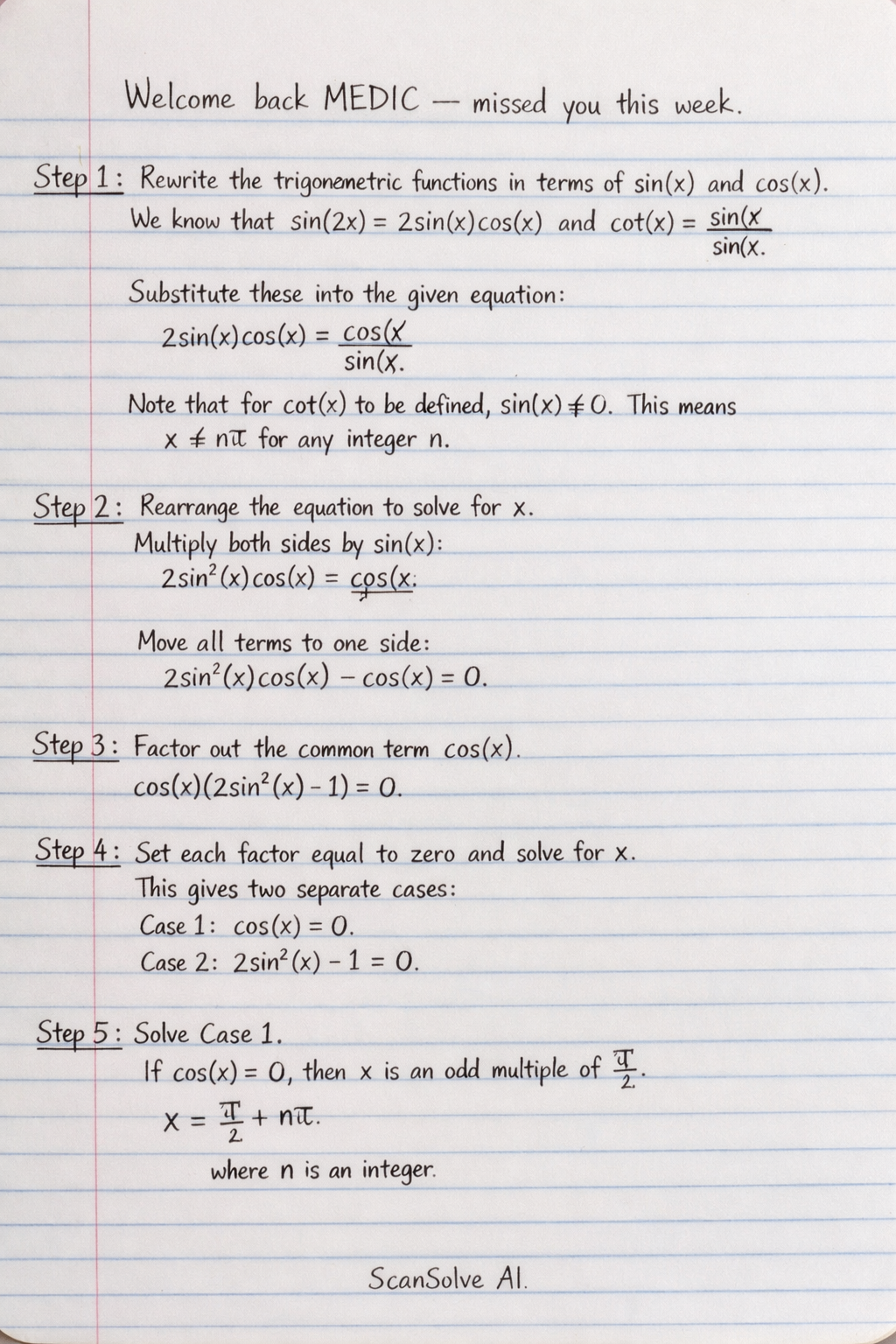
Handwritten Step-by-Step Solution
Get this as a handwritten image on WhatsApp — like a tutor wrote it for you.
Try on WhatsApp