We read your photo as:

Given that sum from r=1 to 30 of (5a + 4r) = 3960, where a is a constant. Find the value of a. Using the value of a found in (a), find an expression in terms of n for sum from r=5 to n of (5a + 4r). Sketch the graphs of y = Sin x and y = pi/2 - 2x for 0 <= x <= pi/2 on the same axis.

Mathematics

ScanSolve AI Answer

Answers

2 parts
a
14
b

2n2+72n−3202n^2 + 72n - 320

Step-by-step solution

7 steps

Part a· 3 steps

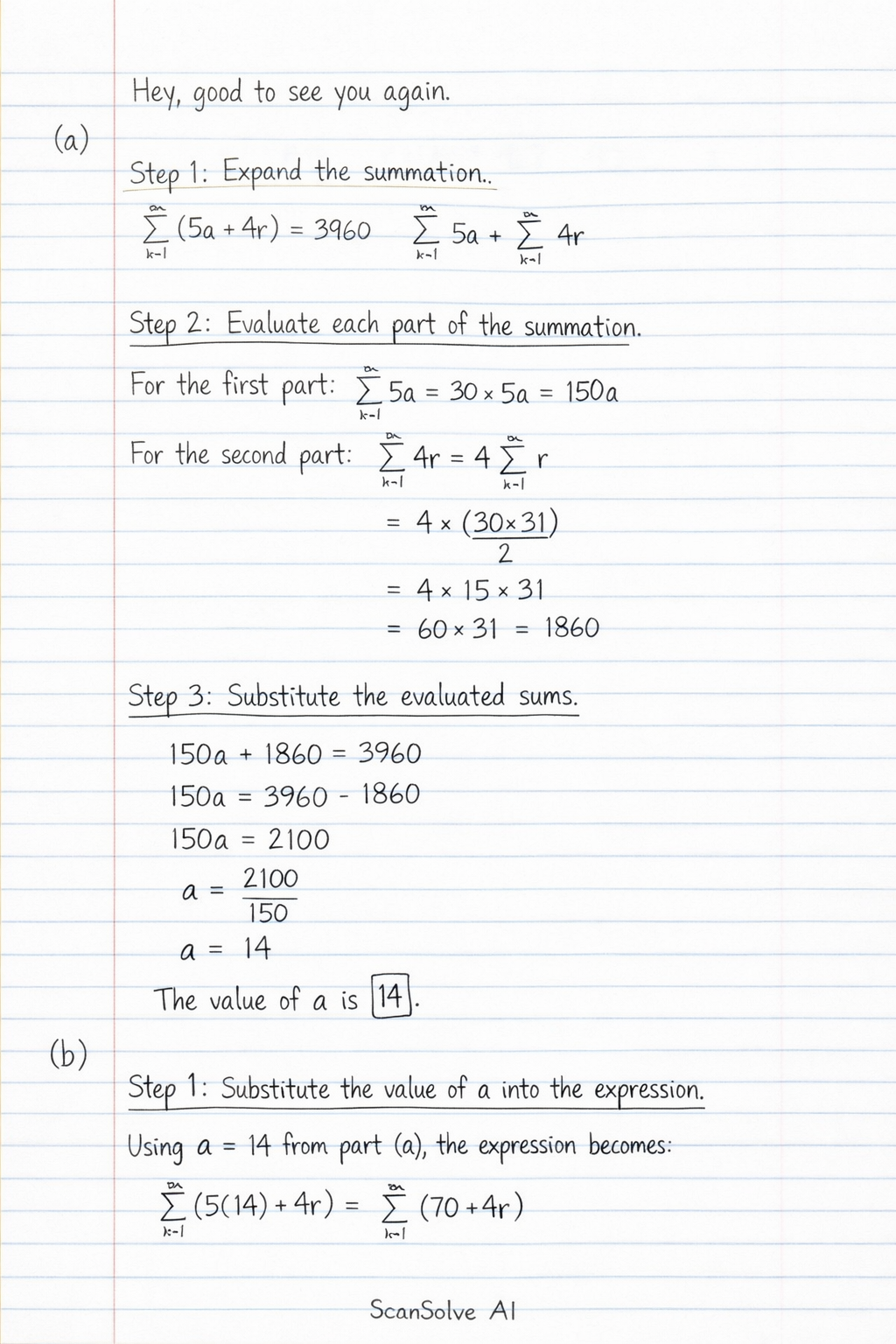
  1. Expand the summation.

    The given equation is ∑r=130(5a+4r)=3960\sum_{r=1}^{30} (5a + 4r) = 3960. We can split the summation into two parts:

    ∑r=130(5a+4r)=∑r=1305a+∑r=1304r\sum_{r=1}^{30} (5a + 4r) = \sum_{r=1}^{30} 5a + \sum_{r=1}^{30} 4r
  2. Evaluate each part of the summation.

    For the first part, 5a5a is a constant with respect to rr, so:

    ∑r=1305a=30×5a=150a\sum_{r=1}^{30} 5a = 30 \times 5a = 150a

    For the second part, we use the formula for the sum of the first NN natural numbers, ∑r=1Nr=N(N+1)2\sum_{r=1}^{N} r = \frac{N(N+1)}{2}:

    ∑r=1304r=4∑r=130r=4×30(30+1)2=4×30×312=4×15×31=60×31=1860\sum_{r=1}^{30} 4r = 4 \sum_{r=1}^{30} r = 4 \times \frac{30(30+1)}{2} = 4 \times \frac{30 \times 31}{2} = 4 \times 15 \times 31 = 60 \times 31 = 1860
  3. Substitute the evaluated sums back into the original equation and solve for aa.

    150a+1860=3960150a + 1860 = 3960 150a=3960−1860150a = 3960 - 1860 150a=2100150a = 2100 a=2100150a = \frac{2100}{150} a=14a = 14

    The value of aa is 14\boxed{14}.

Part b

2n2+72n−3202n^2 + 72n - 320

  1. Substitute the value of aa into the expression.

    Using a=14a=14 from part (a), the expression becomes:

    ∑r=5n(5(14)+4r)=∑r=5n(70+4r)\sum_{r=5}^{n} (5(14) + 4r) = \sum_{r=5}^{n} (70 + 4r)
  2. Identify the terms of the arithmetic series.

    This is an arithmetic series with the first term (when r=5r=5) T5=70+4(5)=70+20=90T_5 = 70 + 4(5) = 70 + 20 = 90.
    The last term (when r=nr=n) is Tn=70+4nT_n = 70 + 4n.
    The number of terms in the series is k=n−5+1=n−4k = n - 5 + 1 = n - 4.

  3. Use the formula for the sum of an arithmetic series.

    The sum of an arithmetic series is given by Sk=k2(first term+last term)S_k = \frac{k}{2}(\text{first term} + \text{last term}).

    Sn−4=n−42(90+(70+4n))S_{n-4} = \frac{n-4}{2} (90 + (70 + 4n)) Sn−4=n−42(160+4n)S_{n-4} = \frac{n-4}{2} (160 + 4n)
  4. Simplify the expression.

    Factor out 2 from (160+4n)(160 + 4n):

    Sn−4=n−42×2(80+2n)S_{n-4} = \frac{n-4}{2} \times 2(80 + 2n) Sn−4=(n−4)(80+2n)S_{n-4} = (n-4)(80 + 2n)

    Expand the product:

    Sn−4=n(80)+n(2n)−4(80)−4(2n)S_{n-4} = n(80) + n(2n) - 4(80) - 4(2n) Sn−4=80n+2n2−320−8nS_{n-4} = 80n + 2n^2 - 320 - 8n

    Combine like terms:

    Sn−4=2n2+(80n−8n)−320S_{n-4} = 2n^2 + (80n - 8n) - 320 Sn−4=2n2+72n−320S_{n-4} = 2n^2 + 72n - 320

    The expression in terms of nn is 2n2+72n−320\boxed{2n^2 + 72n - 320}.

Was this helpful?

Try one yourself

A new problem that tests the same skill.

Still stuck on this one?

Ask a follow-up, and the answer starts from this question.

Got a different question?Ask your own question
Handwritten step-by-step solution preview

Handwritten Step-by-Step Solution

Get this as a handwritten image on WhatsApp — like a tutor wrote it for you.

Try on WhatsApp