
We read your photo as:
Given that theta = (5)/(13), and theta is acute, find the value of ( theta + theta)/( theta).
Mathematics
ScanSolve AI Answer
Step-by-step solution
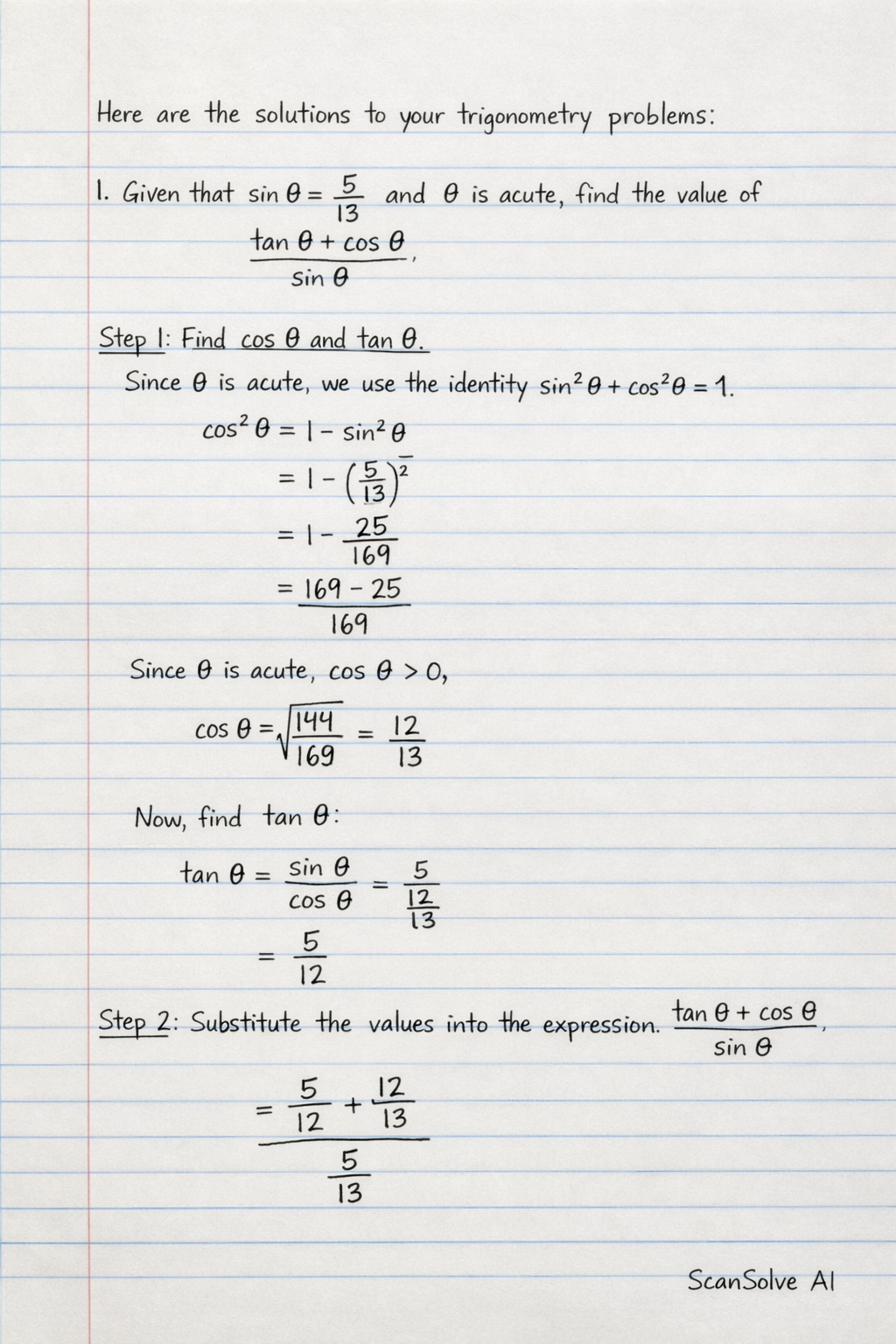
12 stepsHere are the solutions to your trigonometry problems:
- Given that , and is acute, find the value of .
Find and .
Since $\theta$ is acute, we use the identity $\sin^2 \theta + \cos^2 \theta = 1$. $$ \cos^2 \theta = 1 - \sin^2 \theta = 1 - \left(\frac{5}{13}\right)^2 = 1 - \frac{25}{169} = \frac{169 - 25}{169} = \frac{144}{169} $$ Since $\theta$ is acute, $\cos \theta > 0$. $$ \cos \theta = \sqrt{\frac{144}{169}} = \frac{12}{13} $$ Now, find $\tan \theta$: $$ \tan \theta = \frac{\sin \theta}{\cos \theta} = \frac{5/13}{12/13} = \frac{5}{12} $$Substitute the values into the expression .
$$ \frac{\frac{5}{12} + \frac{12}{13}}{\frac{5}{13}} $$Simplify the expression.
First, simplify the numerator: $$ \frac{5}{12} + \frac{12}{13} = \frac{5 \times 13 + 12 \times 12}{12 \times 13} = \frac{65 + 144}{156} = \frac{209}{156} $$ Now, divide by $\sin \theta$: $$ \frac{\frac{209}{156}}{\frac{5}{13}} = \frac{209}{156} \times \frac{13}{5} $$ Since $156 = 12 \times 13$: $$ \frac{209}{12 \times 13} \times \frac{13}{5} = \frac{209}{12 \times 5} = \frac{209}{60} $$ $$ \boxed{\frac{209}{60}} $$2. Find if .
Use the complementary angle identity .
$$ \sin 5x = \sin (90^\circ - 4x) $$Equate the angles.
$$ 5x = 90^\circ - 4x $$Solve for .
$$ 5x + 4x = 90^\circ $$ $$ 9x = 90^\circ $$ $$ x = \frac{90^\circ}{9} $$ $$ x = 10^\circ $$ $$ \boxed{10^\circ} $$3. Determine the value of if .
Use the complementary angle identity .
$$ \cos (30^\circ + \theta) = \sin (90^\circ - (30^\circ + \theta)) $$ $$ \cos (30^\circ + \theta) = \sin (90^\circ - 30^\circ - \theta) $$ $$ \cos (30^\circ + \theta) = \sin (60^\circ - \theta) $$Equate the angles.
$$ \sin (20^\circ + \theta) = \sin (60^\circ - \theta) $$ $$ 20^\circ + \theta = 60^\circ - \theta $$Solve for .
$$ \theta + \theta = 60^\circ - 20^\circ $$ $$ 2\theta = 40^\circ $$ $$ \theta = \frac{40^\circ}{2} $$ $$ \theta = 20^\circ $$ $$ \boxed{20^\circ} $$4. Given that , and is acute, find the value of .
Find , , and .
Since $\theta$ is acute, we use the identity $\sin^2 \theta + \cos^2 \theta = 1$. $$ \cos^2 \theta = 1 - \sin^2 \theta = 1 - \left(\frac{3}{5}\right)^2 = 1 - \frac{9}{25} = \frac{25 - 9}{25} = \frac{16}{25} $$ Since $\theta$ is acute, $\cos \theta > 0$. $$ \cos \theta = \sqrt{\frac{16}{25}} = \frac{4}{5} $$ Now, find $\sec \theta$: $$ \sec \theta = \frac{1}{\cos \theta} = \frac{1}{4/5} = \frac{5}{4} $$ Next, find $\tan \theta$: $$ \tan \theta = \frac{\sin \theta}{\cos \theta} = \frac{3/5}{4/5} = \frac{3}{4} $$ Then, find $\cot \theta$: $$ \cot \theta = \frac{1}{\tan \theta} = \frac{1}{3/4} = \frac{4}{3} $$Substitute the values into the expression .
$$ \frac{5}{4} + \frac{4}{3} $$Simplify the expression.
$$
\frac{5}{4} + \frac{4}{3} = \frac{5 \times 3 + 4 \times 4}{4 \times 3} = \frac{15 + 16}{12} = \frac{31}{12}
$$
$$
\boxed{\frac{31}{12}}
$$
Was this helpful?
Still stuck on this one?
Ask a follow-up, and the answer starts from this question.
Got a different question?Ask your own question
More Mathematics Questions
QIf theta = (4)/(5) and theta is an acute angle, what is the value of theta?QGiven theta = −(5)/(13) where 180^ < theta < 360^, find the values of 2 theta and (theta - 135^).QGiven theta = (9)/(5), find the value of theta.QThe problem states that theta = (4)/(5).QIf sin θ = 3/5 and θ is acute, find cos θ.
Handwritten Step-by-Step Solution
Get this as a handwritten image on WhatsApp — like a tutor wrote it for you.
Try on WhatsApp