
We read your photo as:
Given that triangle ABC is congruent to triangle PQR, BAC = QPR, then side BC is equal to side ______ in triangle PQR.
ScanSolve AI Answer
Step-by-step solution
3 stepsSolve Question 1.
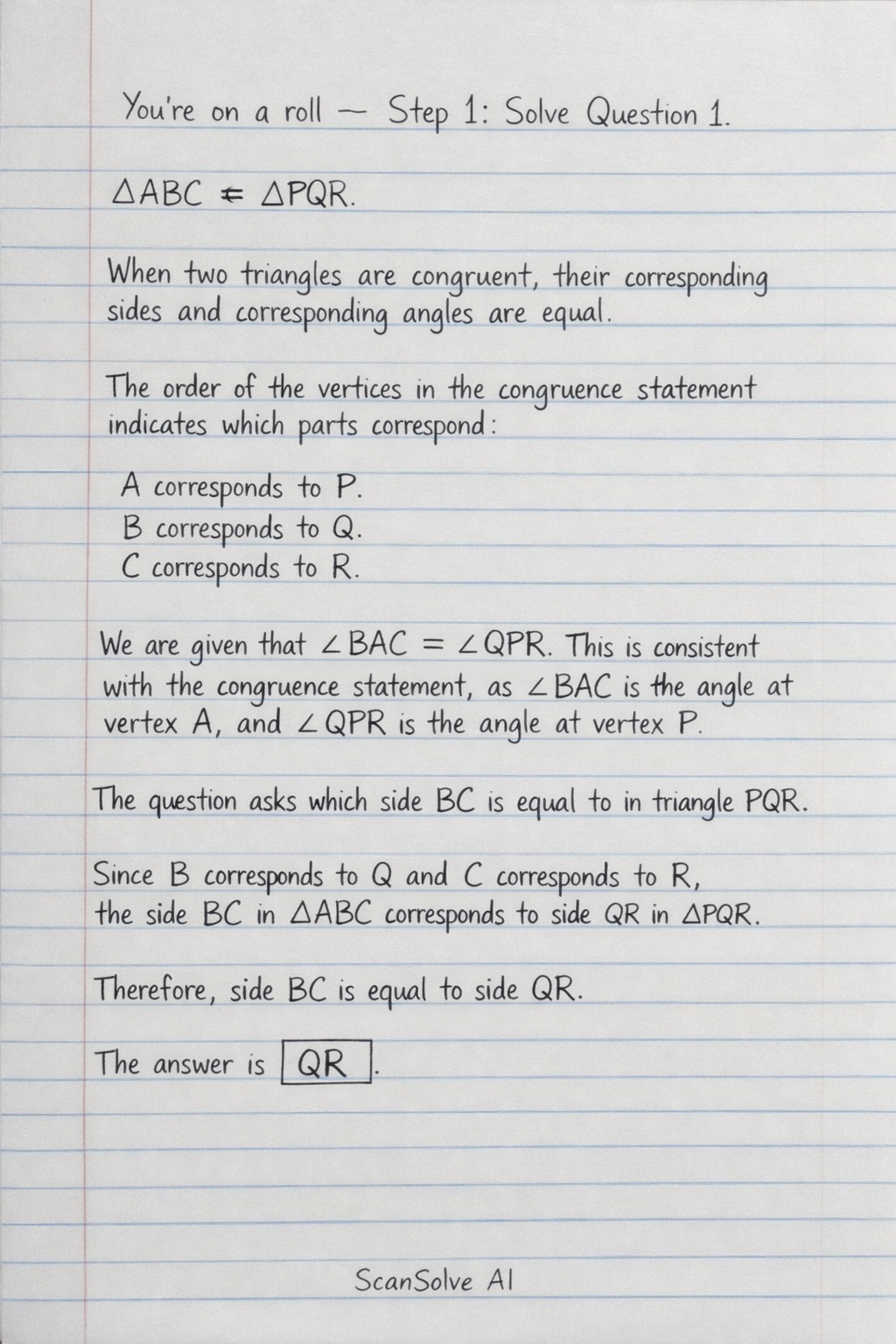
The question states that triangle ABC is congruent to triangle PQR ().
When two triangles are congruent, their corresponding sides and corresponding angles are equal.
The order of the vertices in the congruence statement indicates which parts correspond.
A corresponds to P.
B corresponds to Q.
C corresponds to R.We are given that . This is consistent with the congruence statement, as is the angle at vertex A, and is the angle at vertex P.
The question asks which side BC is equal to in triangle PQR.
Since B corresponds to Q and C corresponds to R, the side BC in corresponds to side QR in .
Therefore, side BC is equal to side QR.
The answer is .Solve Question 2.
The image shows two triangles, and . We need to show that they are congruent.
Let's examine the markings on the triangles:
In :- Side PQ has two tick marks.
- Side PR has one tick mark.
- Angle Q is marked with a right angle symbol ().
In :
- Side TU has two tick marks.
- Side TV has one tick mark.
- Angle U is marked with a right angle symbol ().
Comparing the corresponding parts:
- Side PQ has two tick marks, and side TU has two tick marks. So, .
- Angle Q is a right angle, and angle U is a right angle. So, .
- Side PR has one tick mark, and side TV has one tick mark. So, .
We have two sides and a non-included angle (SSA). However, for right-angled triangles, if the hypotenuse and one leg are equal, the triangles are congruent by the Hypotenuse-Leg (HL) congruence theorem.
In , PR is the hypotenuse (opposite the right angle Q). PQ is a leg.
In , TV is the hypotenuse (opposite the right angle U). TU is a leg.We have:
- Hypotenuse (both have one tick mark).
- Leg (both have two tick marks).
- Both triangles are right-angled at Q and U respectively.
Therefore, by the Hypotenuse-Leg (HL) congruence theorem.
The answer is .Solve Question 3.
The question states that is congruent to ().
We are given the following lengths:
AE = 5 cm
EB = 3 cm
AB = 7 cmWe need to find the measure of side BC.
Since the triangles are congruent, their corresponding sides are equal.
From the congruence statement :- Side AB corresponds to side BD. So, .
- Side BE corresponds to side DC. So, .
- Side AE corresponds to side BC. So, .
We are given cm.
Since , then cm.
The measure of side BC is .
Still stuck on this one?
Ask a follow-up, and the answer starts from this question.
More Mathematics Questions
Handwritten Step-by-Step Solution
Get this as a handwritten image on WhatsApp — like a tutor wrote it for you.
Try on WhatsApp