
![Given that xn = (1)/([3]N) is an approximation of the cube root of N. Use Newton-Raphson method to show that a better approximation is given by: xn+1 = (1)/(3) (2xn + (N)/(xn2)).](/_next/image?url=https%3A%2F%2Fohijasnjvprzodcmxltt.supabase.co%2Fstorage%2Fv1%2Fobject%2Fpublic%2Fwhatsapp-images%2F1774290119452-5ae3e6916ce43a64.png&w=3840&q=75)
This mathematics problem involves applying core mathematical principles and formulas. Below you will find a complete step-by-step solution with detailed explanations for each step, helping you understand not just the answer but the method behind it.
ScanSolve AI Answer
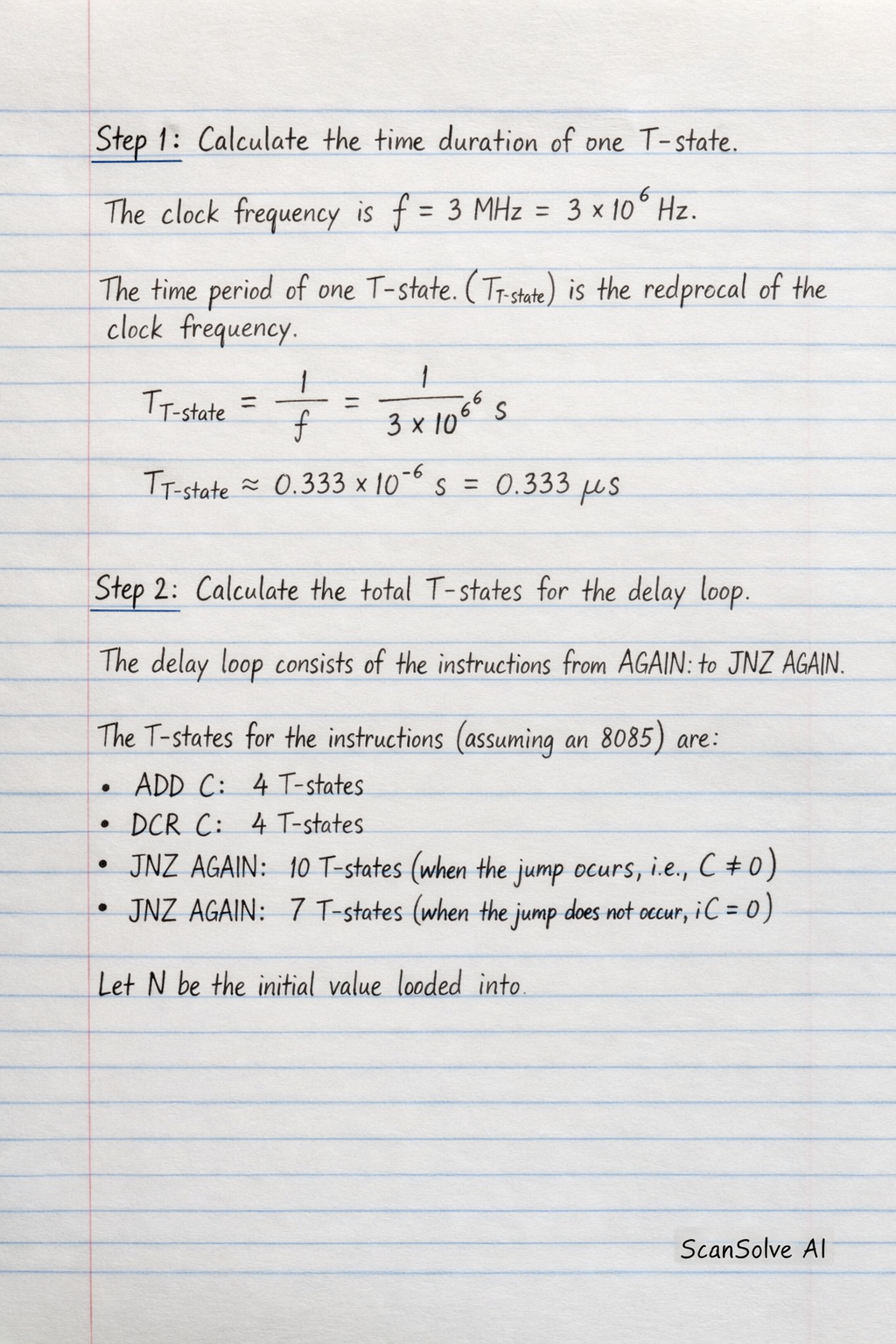
Step 1: Calculate the time duration of one T-state. The clock frequency is f = 3\, MHz = 3 × 10^6\, Hz. The time period of one T-state (T_T-state) is the reciprocal of the clock frequency. T_T-state = (1)/(f) = (1)/(3 × 10^6)\, s T_T-state ≈ 0.333 × 10^-6\, s = 0.333\, Step 2: Calculate the total T-states for the delay loop. The delay loop consists of the instructions from AGAIN: to JNZ AGAIN. The T-states for the instructions (assuming an 8085 microprocessor) are: • ADD C: 4 T-states • DCR C: 4 T-states • JNZ AGAIN: 10 T-states (when the jump occurs, i.e., C is not zero) • JNZ AGAIN: 7 T-states (when the jump does not occur, i.e., C is zero) Let N be the initial value loaded into