
We read your photo as:
Given the following vectors d = 4i + 5j + 7k and b = 2i + 5j + 4k, find (i) d x b (ii) b.b (iii) the angle between them.
Mathematics
ScanSolve AI Answer
Answers
3 partsStep-by-step solution
11 stepslet's tackle these vector calculations.
Given the vectors:
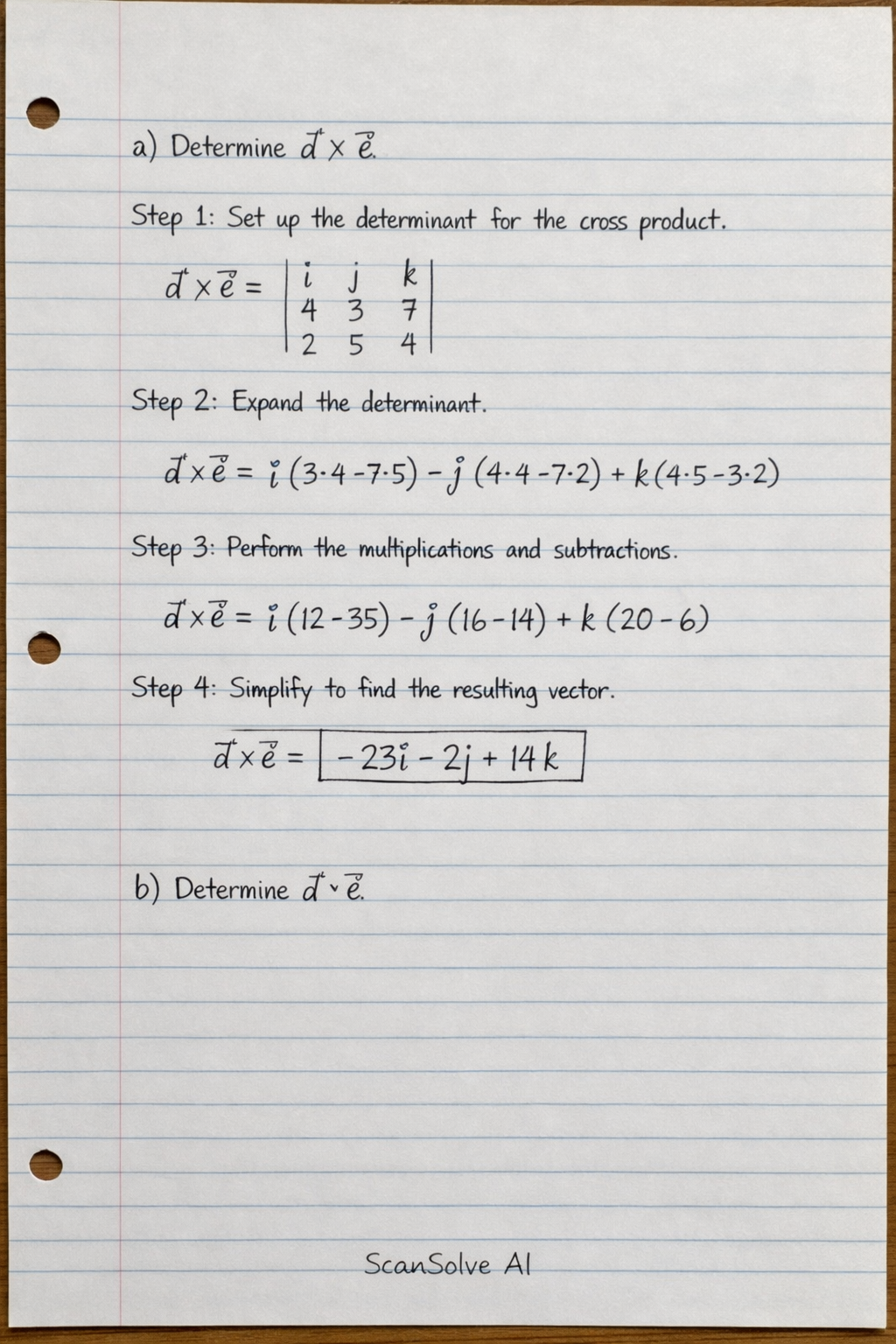
Part a· 4 steps
Determine
Set up the determinant for the cross product.
Expand the determinant.
Perform the multiplications and subtractions.
Simplify to find the resulting vector.
Part b51
Determine
Use the dot product formula .
Perform the multiplications.
Sum the values.
Part c
Determine the angle between them
Calculate the magnitudes of vectors and .
Use the dot product formula to find .
Calculate the product of the square roots and simplify.
Find the angle by taking the inverse cosine.
Was this helpful?
Still stuck on this one?
Ask a follow-up, and the answer starts from this question.
Got a different question?Ask your own question
More Mathematics Questions
QGiven vectors a = 2i + 5j − k and b = 3i − 2j + 4k, find a x b, b x a, and (a + b) x (a − b).QIf a = 2i + 3j + 4k and b = 3i − 2j + 1k, determine (a) a + b, (b) a − b, (c) a + 2b.QGiven B = 2i − 3j + 6k, find: i) the magnitude of B, ii) the unit vector of B.QFind a magnitude and the unit vector of the following given that: a) a = 3i − 4j, b) b = i + 2j − k…QGiven vectors a = 2i + j − 3k, b = 4i − j + 2k, and c = i + 3j − k, find the vector AB x AC and the…
Browse by topic:Linear Algebra
Handwritten Step-by-Step Solution
Get this as a handwritten image on WhatsApp — like a tutor wrote it for you.
Try on WhatsApp