
We read your photo as:
Given the quadratic equation 3x2 − 11x + 4 = 0, with roots alpha and beta. Find the equation whose roots are X1 = alpha2 + (1)/(beta) and X2 = (1)/(alpha) + beta2.
ScanSolve AI Answer
Answer
Step-by-step solution
3 stepsHere is the solution to Question 9.
Question 9:
Given the quadratic equation , with roots and .
From the properties of quadratic equations, for :
Sum of roots:
Product of roots:
For :
We need to find the equation whose roots are and .
A quadratic equation with roots and is given by .
Calculate the sum of the new roots, .
We know that .
And .First, calculate :
Next, calculate :
Now, substitute these values back into the expression for :
To add these fractions, find a common denominator, which is 36.
Calculate the product of the new roots, .
Expand the product:
Rearrange the terms:
Substitute the values of and :
To add these fractions, find a common denominator, which is 36.
Form the new quadratic equation .
Substitute the calculated values of and :
Multiply the entire equation by 36 to eliminate the denominators:
Try one yourself
A new problem that tests the same skill.
Still stuck on this one?
Ask a follow-up, and the answer starts from this question.
More Mathematics Questions
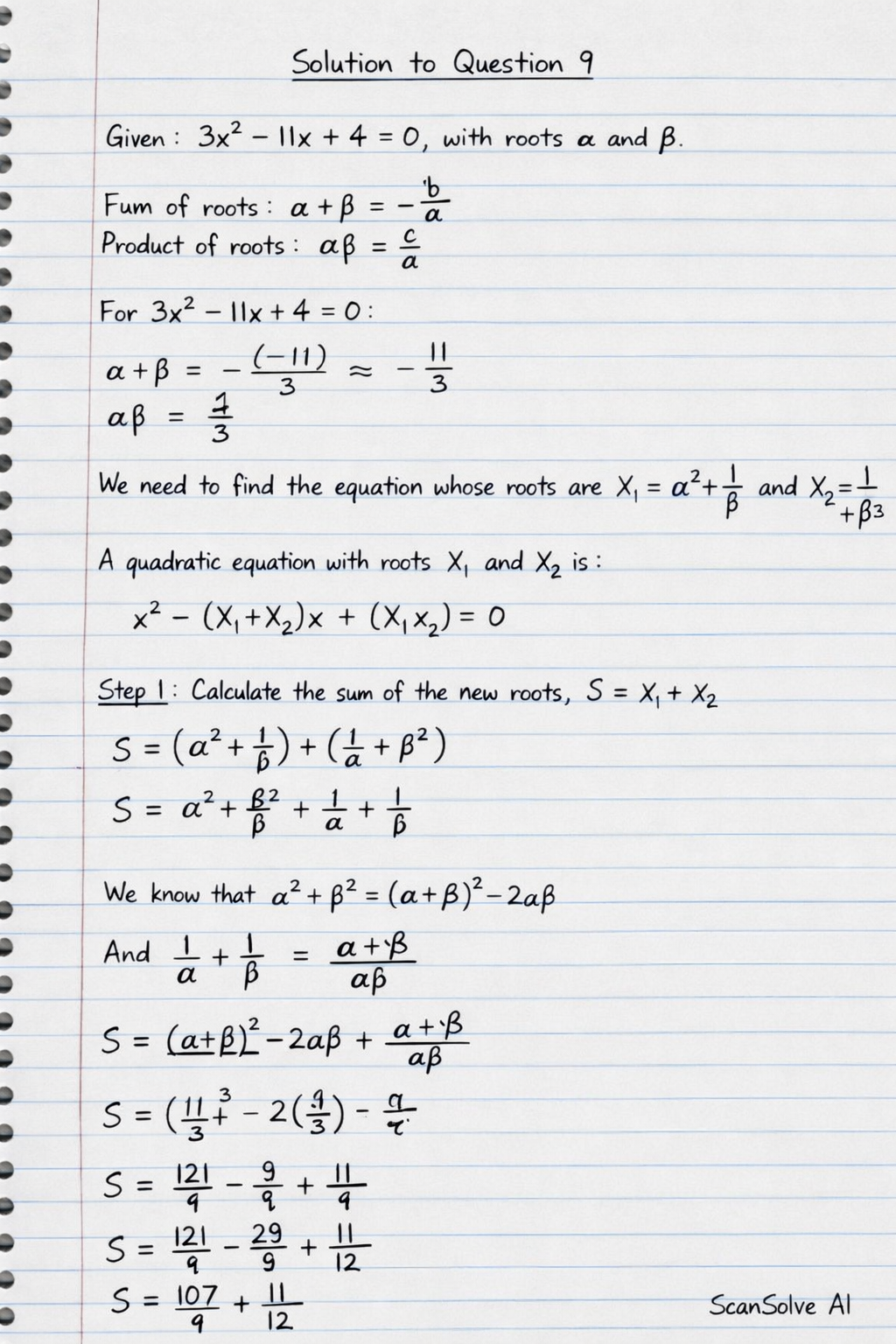
Handwritten Step-by-Step Solution
Get this as a handwritten image on WhatsApp — like a tutor wrote it for you.
Try on WhatsApp