
We read your photo as:
Given the sum of the first n terms of an arithmetic progression (A.P.) is S_n = n2 − 8n.
ScanSolve AI Answer
Answer
Step-by-step solution
6 stepsFind the formula for the sum, .
Given the sum of the first terms of an arithmetic progression (A.P.) is .
To find , substitute for :Expand and simplify .
Expand the expression:
Find the formula for the term, .
The term of an A.P. can be found using the formula .
Substitute the expressions for and :Set up the inequality based on the problem statement.
The problem states that the term of the sequence is greater than 130.
Substitute the expression for :
Solve the inequality for .
Add 9 to both sides:
Divide by 2:
Determine the least possible integer value of .
Since represents the term number, it must be an integer. The least integer value of that is greater than 69.5 is 70.
The least possible value of is .
Try one yourself
A new problem that tests the same skill.
Still stuck on this one?
Ask a follow-up, and the answer starts from this question.
More Mathematics Questions
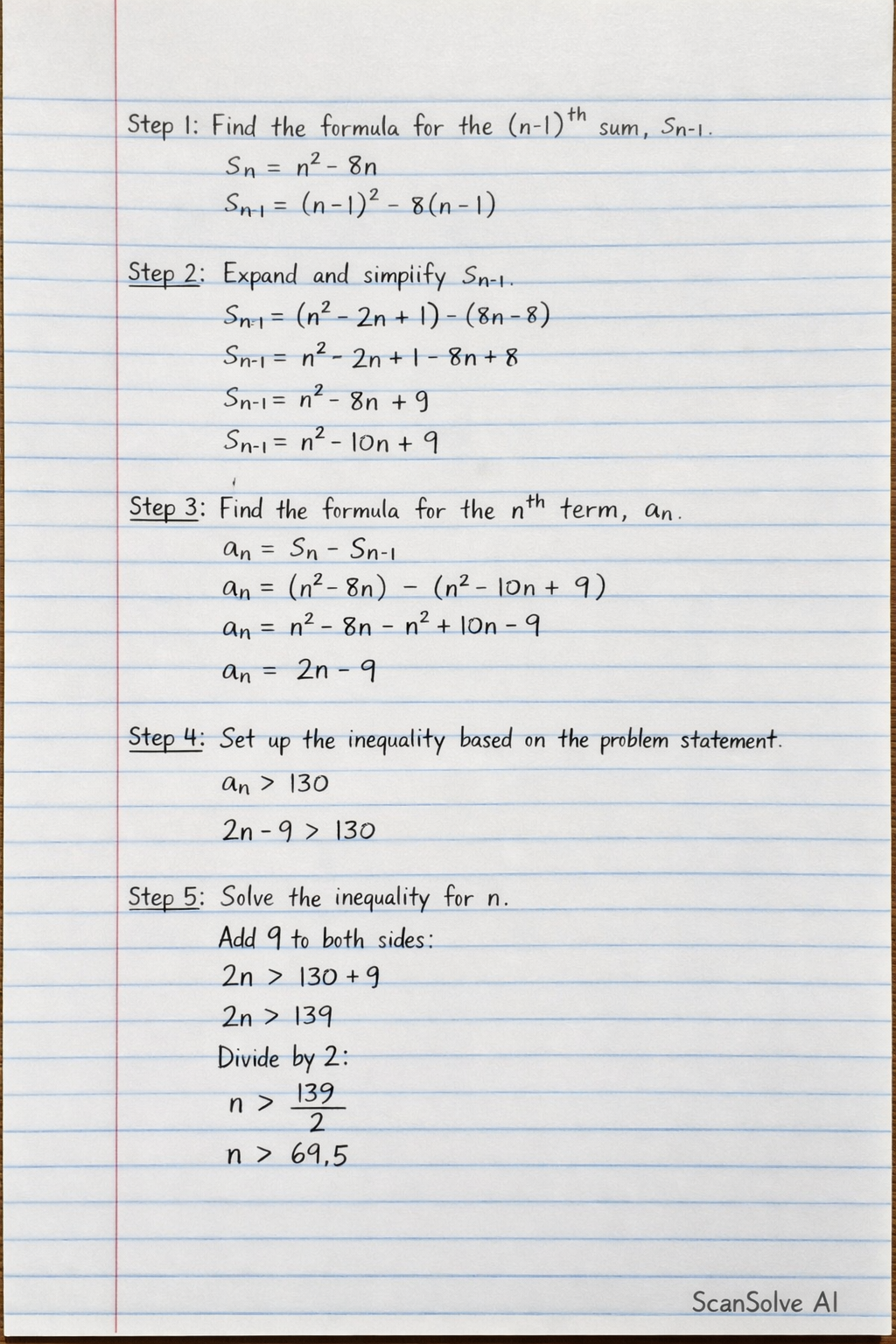
Handwritten Step-by-Step Solution
Get this as a handwritten image on WhatsApp — like a tutor wrote it for you.
Try on WhatsApp