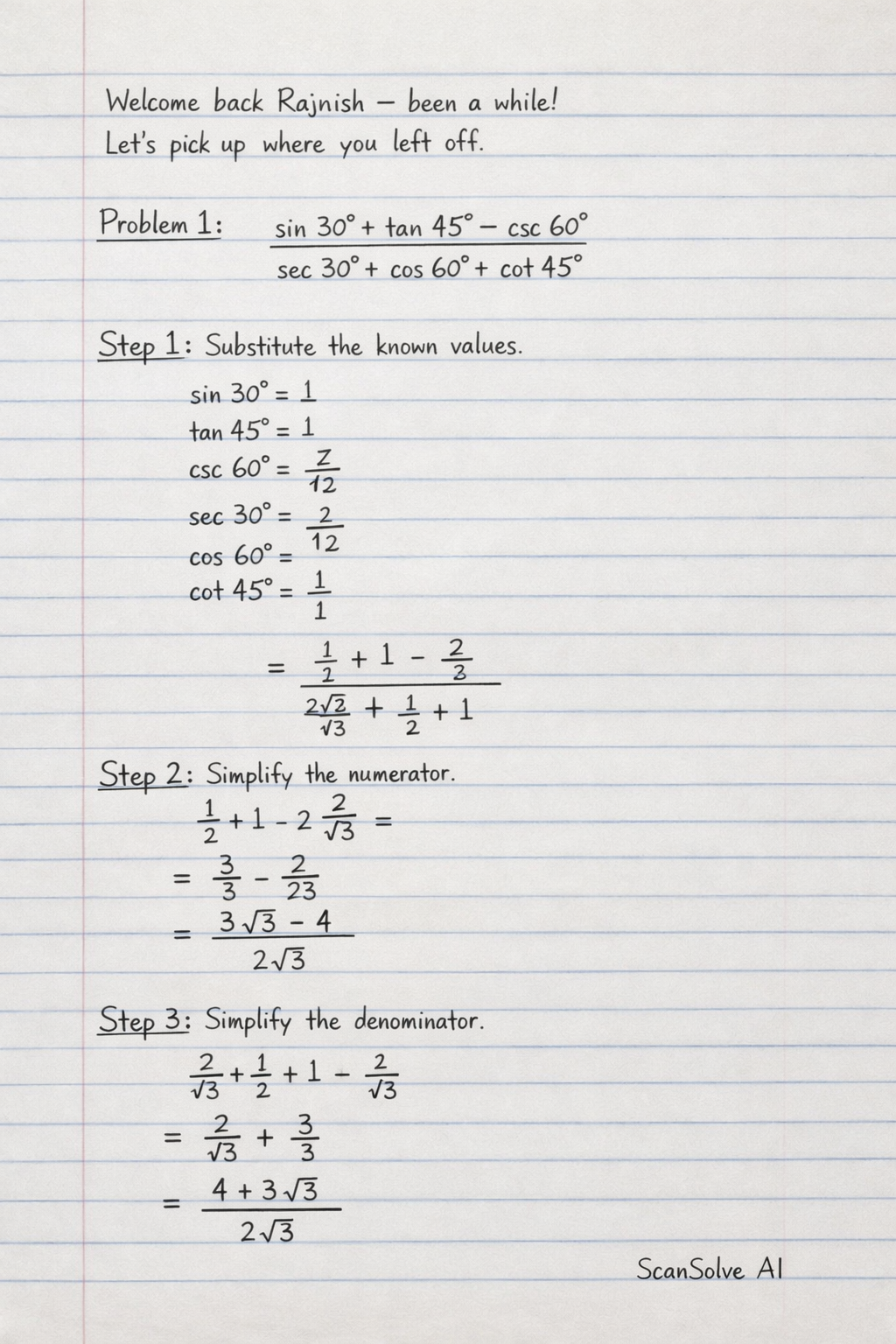
Step 1: Substitute the known trigonometric values.
We know:
sin30∘=21tan45∘=1csc60∘=32sec30∘=32cos60∘=21cot45∘=1
Substituting these values into the expression:
32+21+121+1−32
Step 2: Simplify the numerator.
21+1−32=23−32=2333−4
Step 3: Simplify the denominator.
32+21+1=32+23=234+33
Step 4: Divide the simplified numerator by the simplified denominator.
234+332333−4=4+3333−4
Step 5: Rationalize the denominator.
Multiply the numerator and denominator by the conjugate of the denominator, which is 33−4.
33+433−4×33−433−4=(33)2−42(33−4)2=27−16(33)2−2(33)(4)+42=1127−243+16=1143−243
The final answer is 1143−243.
Step 1: Substitute the known trigonometric values.
We know:
cos60∘=21sec30∘=32tan45∘=1
And by the Pythagorean identity, sin2θ+cos2θ=1, so sin230∘+cos230∘=1.
Step 2: Substitute these values into the expression.
15(21)2+4(32)2−(1)2
Step 3: Calculate the squared terms.
15(41)+4(34)−1
Step 4: Perform the multiplications in the numerator.
145+316−1
Step 5: Simplify the numerator by finding a common denominator.
The common denominator for 4 and 3 is 12.
14×35×3+3×416×4−1×121×12=11215+1264−1212=1215+64−12=1279−12=1267
The final answer is 1267.
Send me the next one 📸
Was this helpful?
Need help with your own homework?
Get instant step-by-step solutions to any question. Free to start.
This mathematics problem involves applying core mathematical principles and formulas. Below you will find a complete step-by-step solution with detailed explanations for each step, helping you understand not just the answer but the method behind it.
ScanSolve AI Answer
Welcome back Rajnish — been a while! Let's pick up where you left off. Here are the evaluations for the given trigonometric expressions. Problem 1: Evaluate ( 30^ + 45^ - 60^)/( 30^ + 60^ + 45^) Step 1: Substitute the known trigonometric values. We know: 30^ = (1)/(2) 45^ = 1 60^ = (2)/(sqrt(3)) 30^ = (2)/(sqrt(3)) 60^ = (1)/(2) 45^ = 1 Substituting these values into the expression: (1)/(2) + 1 - (2)/(sqrt(3))(2)/(sqrt(3)) + (1)/(2) + 1 Step 2: Simplify the numerator. (1)/(2) + 1 - (2)/(sqrt(3)) = (3)/(2) - (2)/(sqrt(3)) = 3sqrt(3) - 42sqrt(3) Step 3: Simplify the denominator. (2)/(sqrt(3)) + (1)/(2) + 1 = (2)/(sqrt(3)) + (3)/(2) = 4 + 3sqrt(3)2sqrt(3) Step 4: Divide the simplified numerator by the simplified denominator. 3sqrt(3) - 42sqrt(3)4 + 3sqrt(3)2sqrt(3) = 3sqrt(3) - 44 + 3sqrt(3) Step 5: Rationalize the denominator. Multiply the numerator and denominator by the conjugate of the denominator, which is 3sqrt(3) - 4. 3sqrt(3) - 43sqrt(3) + 4 × 3sqrt(3) - 43sqrt(3) - 4 = (3sqrt(3) - 4)^2(3sqrt(3))^2 - 4^2 = (3sqrt(3))^2 - 2(3sqrt(3))(4) + 4^227 - 16 = 27 - 24sqrt(3) + 1611 = 43 - 24sqrt(3)11 The final answer is 43 - 24sqrt(3)11. Problem 2: Evaluate (5 ^2 60^ + 4 ^2 30^ - ^2 45^)/(^2 30^ + ^2 30^) Step 1: Substitute the known trigonometric values. We know: 60^ = (1)/(2) 30^ = (2)/(sqrt(3)) 45^ = 1 And by the Pythagorean identity, ^2 + ^2 = 1, so ^2 30^ + ^2 30^ = 1. Step 2: Substitute these values into the expression. (5 (1)/(2))^2 + 4 ((2)/(sqrt(3)))^2 - (1)^21 Step 3: Calculate the squared terms. (5 (1)/(4)) + 4 ((4)/(3)) - 11 Step 4: Perform the multiplications in the numerator. (5)/(4) + (16)/(3) - 11 Step 5: Simplify the numerator by finding a common denominator. The common denominator for 4 and 3 is 12. (5 × 3)/(4 × 3) + (16 × 4)/(3 × 4) - (1 × 12)/(1 × 12)1 = (15)/(12) + (64)/(12) - (12)/(12)1 = (15 + 64 - 12)/(12) = (79 - 12)/(12) = (67)/(12) The final answer is (67)/(12). Send me the next one 📸