Given vectors a and b, find the unit vector in the direction of a and the angle between a and b.
|Mathematics
Given vectors a and b, find the unit vector in the direction of a and the angle between a and b.
ScanSolve AI Answer
Answer
1032i−522j+22k
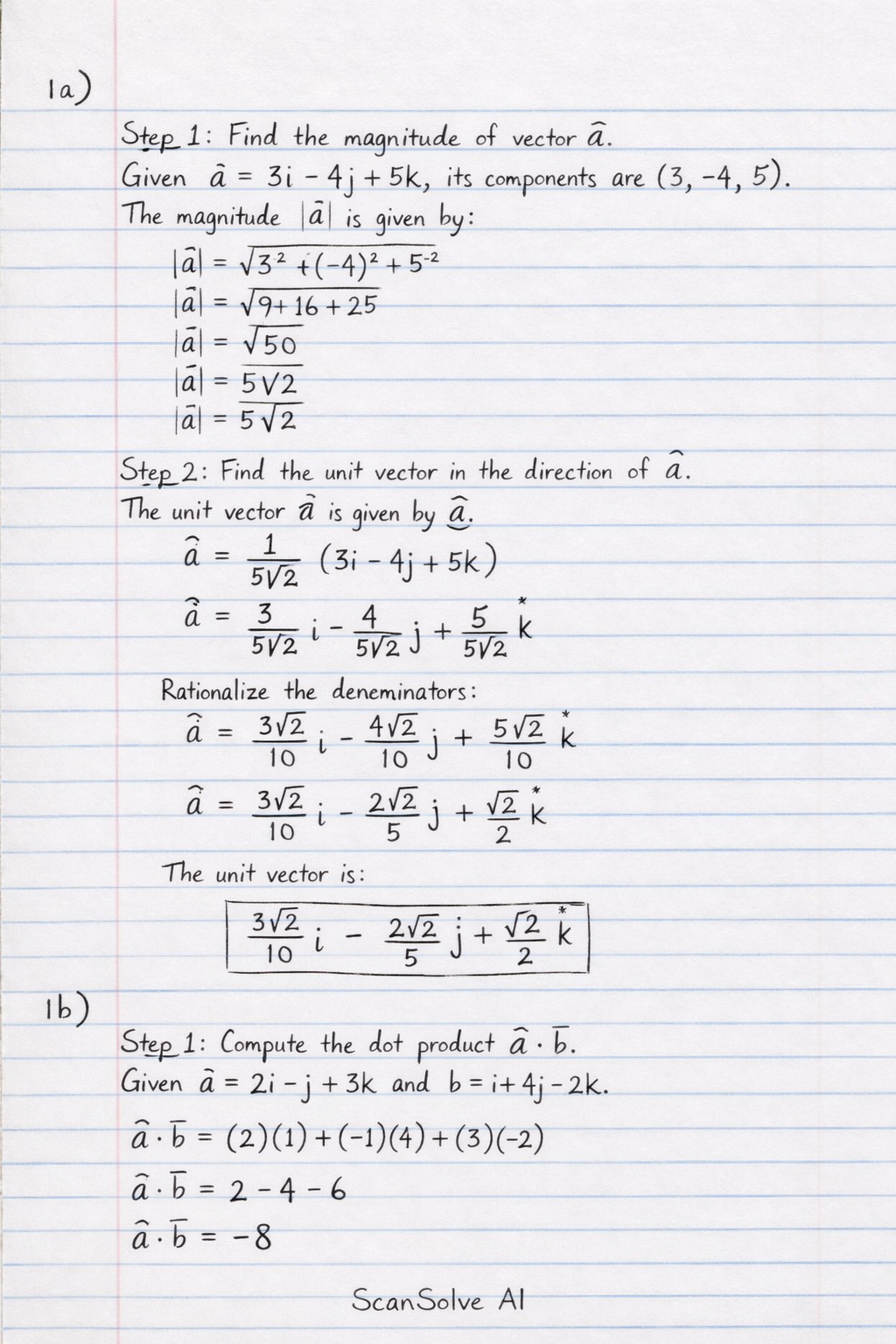
1a)
Step 1: Find the magnitude of vector a.
Given a=3i−4j+5k, its components are (3,−4,5).
The magnitude ∣a∣ is given by:
∣a∣=32+(−4)2+52∣a∣=9+16+25∣a∣=50∣a∣=52
Step 2: Find the unit vector in the direction of a.
The unit vector a^ is given by ∣a∣a.
a^=521(3i−4j+5k)a^=523i−524j+525k
Rationalize the denominators:
a^=1032i−1042j+1052ka^=1032i−522j+22k
The unit vector is 1032i−522j+22k.
1b)
Step 1: Compute the dot product a⋅b.
Given a=2i−j+3k and b=i+4j−2k.
a⋅b=(2)(1)+(−1)(4)+(3)(−2)a⋅b=2−4−6a⋅b=−8
Step 2: Compute the magnitudes of a and b.
∣a∣=22+(−1)2+32=4+1+9=14∣b∣=12+42+(−2)2=1+16+4=21
Step 3: Compute the angle θ between a and b.
Using the formula cosθ=∣a∣∣b∣a⋅b:
cosθ=1421−8cosθ=294−8cosθ=76−8
Rationalize the denominator:
cosθ=42−86cosθ=21−46θ=arccos(21−46)θ≈arccos(−0.4666)θ≈117.8∘
The dot product is −8 and the angle between them is approximately 117.8∘.
1c)
Step 1: Identify vectors a and b.
Given a=i+2j−k and b=3i−j+2k.
Step 2: Compute the dot product a⋅b.
a⋅b=(1)(3)+(2)(−1)+(−1)(2)a⋅b=3−2−2a⋅b=−1
Step 3: Compute the magnitude squared of b, ∣b∣2.
∣b∣2=32+(−1)2+22∣b∣2=9+1+4∣b∣2=14
Step 4: Compute the vector projection of a onto b.
The formula for the vector projection of a onto b is projba=∣b∣2a⋅bb.
projba=14−1(3i−j+2k)projba=−143i+141j−142kprojba=−143i+141j−71k
The vector projection is −143i+141j−71k.
2a)
Step 1: Identify vectors u and v.
Given u=(1,−2,3) and v=(4,0,−1).
Step 2: Compute the cross product u×v.
u×v=i14j−20k3−1u×v=i((−2)(−1)−(3)(0))−j((1)(−1)−(3)(4))+k((1)(0)−(−2)(4))u×v=i(2−0)−j(−1−12)+k(0−(−8))u×v=2i−j(−13)+k(8)u×v=2i+13j+8k
The cross product is 2i+13j+8k.
2b)
Step 1: Identify vectors p and q.
Given p=2i+j−k and q=i−3j+4k.
Step 2: Compute the cross product p×q.
p×q=i21j1−3k−14p×q=i((1)(4)−(−1)(−3))−j((2)(4)−(−1)(1))+k((2)(−3)−(1)(1))p×q=i(4−3)−j(8−(−1))+k(−6−1)p×q=i(1)−j(9)+k(−7)p×q=i−9j−7k
Step 3: Find the magnitude of the cross product.
The area of the parallelogram is ∣p×q∣.
∣p×q∣=12+(−9)2+(−7)2∣p×q∣=1+81+49∣p×q∣=131
The area of the parallelogram is 131 square units.
2c)
Step 1: Form a matrix with the given vectors as rows.
Given a=(1,2,3), b=(4,5,6), and c=(7,8,9).
Let M=147258369.
Step 2: Calculate the determinant of the matrix M.
If det(M)=0, the vectors are linearly dependent. If det(M)=0, they are linearly independent.
det(M)=1(5⋅9−6⋅8)−2(4⋅9−6⋅7)+3(4⋅8−5⋅7)det(M)=1(45−48)−2(36−42)+3(32−35)det(M)=1(−3)−2(−6)+3(−3)det(M)=−3+12−9det(M)=0
Since the determinant is 0, the vectors are linearly dependent.
The vectors are linearlydependent.
3a)
Step 1: Compute AB.
A=105216340,B=2−13012101AB=(1)(2)+(2)(−1)+(3)(3)(0)(2)+(1)(−1)+(4)(3)(5)(2)+(6)(−1)+(0)(3)(1)(0)+(2)(1)+(3)(2)(0)(0)+(1)(1)+(4)(2)(5)(0)+(6)(1)+(0)(2)(1)(1)+(2)(0)+(3)(1)(0)(1)+(1)(0)+(4)(1)(5)(1)+(6)(0)+(0)(1)AB=2−2+90−1+1210−6+00+2+60+1+80+6+01+0+30+0+45+0+0AB=9114896445
Step 3: Compute AB−BA.
AB−BA=9114896445−7−1810−1146117AB−BA=9−711−(−1)4−88−109−(−1)6−144−64−15−17AB−BA=212−4−210−8−23−12
The result is 212−4−210−8−23−12.
3b)
Step 1: Identify matrix C.
Was this helpful?
Need help with your own homework?
Get instant step-by-step solutions to any question. Free to start.
This mathematics problem involves applying core mathematical principles and formulas. Below you will find a complete step-by-step solution with detailed explanations for each step, helping you understand not just the answer but the method behind it.
ScanSolve AI Answer
1a) Step 1: Find the magnitude of vector a. Given a = 3i - 4j + 5k, its components are (3, -4, 5). The magnitude |a| is given by: |a| = sqrt(3^2 + (-4)^2 + 5^2) |a| = sqrt(9 + 16 + 25) |a| = sqrt(50) |a| = 5sqrt(2) Step 2: Find the unit vector in the direction of a. The unit vector a is given by (a)/(|a|). a = (1)/(5sqrt(2))(3i - 4j + 5k) a = (3)/(5sqrt(2))i - (4)/(5sqrt(2))j + (5)/(5sqrt(2))k Rationalize the denominators: a = 3sqrt(2)10i - 4sqrt(2)10j + 5sqrt(2)10k a = 3sqrt(2)10i - 2sqrt(2)5j + sqrt(2)2k The unit vector is 3sqrt(2)10i - 2sqrt(2)5j + sqrt(2)2k. 1b) Step 1: Compute the dot product a · b. Given a = 2i - j + 3k and b = i + 4j - 2k. a · b = (2)(1) + (-1)(4) + (3)(-2) a · b = 2 - 4 - 6 a · b = -8 Step 2: Compute the magnitudes of a and b. |a| = sqrt(2^2 + (-1)^2 + 3^2) = sqrt(4 + 1 + 9) = sqrt(14) |b| = sqrt(1^2 + 4^2 + (-2)^2) = sqrt(1 + 16 + 4) = sqrt(21) Step 3: Compute the angle between a and b. Using the formula = (a · b)/(|a||b|): = (-8)/(sqrt(14)21) = (-8)/(sqrt(294)) = (-8)/(7sqrt(6)) Rationalize the denominator: = -8sqrt(6)42 = -4sqrt(6)21 = (-4sqrt(6)21) ≈ (-0.4666) ≈ 117.8^ The dot product is -8 and the angle between them is approximately 117.8^. 1c) Step 1: Identify vectors a and b. Given a = i + 2j - k and b = 3i - j + 2k. Step 2: Compute the dot product a · b. a · b = (1)(3) + (2)(-1) + (-1)(2) a · b = 3 - 2 - 2 a · b = -1 Step 3: Compute the magnitude squared of b, |b|^2. |b|^2 = 3^2 + (-1)^2 + 2^2 |b|^2 = 9 + 1 + 4 |b|^2 = 14 Step 4: Compute the vector projection of a onto b. The formula for the vector projection of a onto b is proj_b a = (a · b)/(|b|^2) b. proj_b a = (-1)/(14)(3i - j + 2k) proj_b a = -(3)/(14)i + (1)/(14)j - (2)/(14)k proj_b a = -(3)/(14)i + (1)/(14)j - (1)/(7)k The vector projection is -(3)/(14)i + (1)/(14)j - (1)/(7)k. 2a) Step 1: Identify vectors u and v. Given u = (1, -2, 3) and v = (4, 0, -1). Step 2: Compute the cross product u × v. u × v = i & j & k \\ 1 & -2 & 3 \\ 4 & 0 & -1 u × v = i((-2)(-1) - (3)(0)) - j((1)(-1) - (3)(4)) + k((1)(0) - (-2)(4)) u × v = i(2 - 0) - j(-1 - 12) + k(0 - (-8)) u × v = 2i - j(-13) + k(8) u × v = 2i + 13j + 8k The cross product is 2i + 13j + 8k. 2b) Step 1: Identify vectors p and q. Given p = 2i + j - k and q = i - 3j + 4k. Step 2: Compute the cross product p × q. p × q = i & j & k \\ 2 & 1 & -1 \\ 1 & -3 & 4 p × q = i((1)(4) - (-1)(-3)) - j((2)(4) - (-1)(1)) + k((2)(-3) - (1)(1)) p × q = i(4 - 3) - j(8 - (-1)) + k(-6 - 1) p × q = i(1) - j(9) + k(-7) p × q = i - 9j - 7k Step 3: Find the magnitude of the cross product. The area of the parallelogram is |p × q|. |p × q| = sqrt(1^2 + (-9)^2 + (-7)^2) |p × q| = sqrt(1 + 81 + 49) |p × q| = sqrt(131) The area of the parallelogram is sqrt(131) square units. 2c) Step 1: Form a matrix with the given vectors as rows. Given a = (1, 2, 3), b = (4, 5, 6), and c = (7, 8, 9). Let M = 1 & 2 & 3 \\ 4 & 5 & 6 \\ 7 & 8 & 9 . Step 2: Calculate the determinant of the matrix M. If (M) = 0, the vectors are linearly dependent. If (M) ≠ 0, they are linearly independent. (M) = 1(5 · 9 - 6 · 8) - 2(4 · 9 - 6 · 7) + 3(4 · 8 - 5 · 7) (M) = 1(45 - 48) - 2(36 - 42) + 3(32 - 35) (M) = 1(-3) - 2(-6) + 3(-3) (M) = -3 + 12 - 9 (M) = 0 Since the determinant is 0, the vectors are linearly dependent. The vectors are linearly dependent. 3a) Step 1: Compute AB. A = 1 & 2 & 3 \\ 0 & 1 & 4 \\ 5 & 6 & 0 , B = 2 & 0 & 1 \\ -1 & 1 & 0 \\ 3 & 2 & 1 AB = (1)(2)+(2)(-1)+(3)(3) & (1)(0)+(2)(1)+(3)(2) & (1)(1)+(2)(0)+(3)(1) \\ (0)(2)+(1)(-1)+(4)(3) & (0)(0)+(1)(1)+(4)(2) & (0)(1)+(1)(0)+(4)(1) \\ (5)(2)+(6)(-1)+(0)(3) & (5)(0)+(6)(1)+(0)(2) & (5)(1)+(6)(0)+(0)(1) AB = 2-2+9 & 0+2+6 & 1+0+3 \\ 0-1+12 & 0+1+8 & 0+0+4 \\ 10-6+0 & 0+6+0 & 5+0+0 AB = 9 & 8 & 4 \\ 11 & 9 & 4 \\ 4 & 6 & 5 Step 2: Compute BA. BA = 2 & 0 & 1 \\ -1 & 1 & 0 \\ 3 & 2 & 1 1 & 2 & 3 \\ 0 & 1 & 4 \\ 5 & 6 & 0 BA = (2)(1)+(0)(0)+(1)(5) & (2)(2)+(0)(1)+(1)(6) & (2)(3)+(0)(4)+(1)(0) \\ (-1)(1)+(1)(0)+(0)(5) & (-1)(2)+(1)(1)+(0)(6) & (-1)(3)+(1)(4)+(0)(0) \\ (3)(1)+(2)(0)+(1)(5) & (3)(2)+(2)(1)+(1)(6) & (3)(3)+(2)(4)+(1)(0) BA = 2+0+5 & 4+0+6 & 6+0+0 \\ -1+0+0 & -2+1+0 & -3+4+0 \\ 3+0+5 & 6+2+6 & 9+8+0 BA = 7 & 10 & 6 \\ -1 & -1 & 1 \\ 8 & 14 & 17 Step 3: Compute AB - BA. AB - BA = 9 & 8 & 4 \\ 11 & 9 & 4 \\ 4 & 6 & 5 - 7 & 10 & 6 \\ -1 & -1 & 1 \\ 8 & 14 & 17 AB - BA = 9-7 & 8-10 & 4-6 \\ 11-(-1) & 9-(-1) & 4-1 \\ 4-8 & 6-14 & 5-17 AB - BA = 2 & -2 & -2 \\ 12 & 10 & 3 \\ -4 & -8 & -12 The result is 2 & -2 & -2 \\ 12 & 10 & 3 \\ -4 & -8 & -12 . 3b) Step 1: Identify matrix C. C = 2 & 1 & 3 \\ 4 & 0 & 2 \\ 1 & 5 &