We read your photo as:

Given y = x2 + ax + b, axis of symmetry x = -2, and passing through (-1,-5). Find a and b. Given y = (x+k)2 + 3x − 2y, find k if the minimum value is 5/3.

Mathematics

ScanSolve AI Answer

Answer

a=4,b=−2a=4, b=-2

k=134k=\frac{13}{4}

Step-by-step solution

2 steps
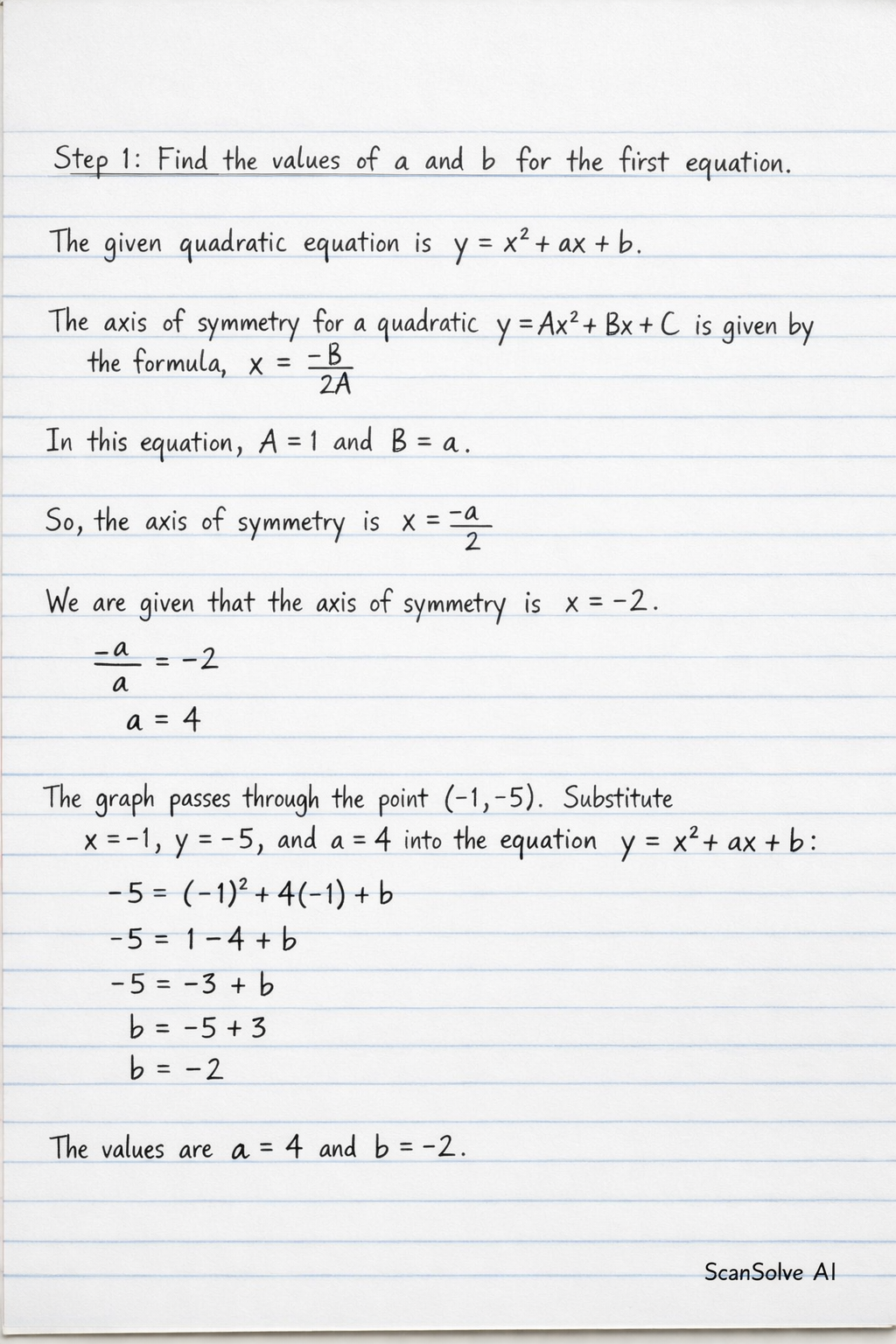
  1. Find the values of aa and bb for the first equation.

    The given quadratic equation is y=x2+ax+by = x^2 + ax + b.
    The axis of symmetry for a quadratic y=Ax2+Bx+Cy = Ax^2 + Bx + C is given by the formula x=−B2Ax = -\frac{B}{2A}.
    In this equation, A=1A=1 and B=aB=a.
    So, the axis of symmetry is x=−a2x = -\frac{a}{2}.
    We are given that the axis of symmetry is x=−2x = -2.

    −a2=−2-\frac{a}{2} = -2 a=4a = 4

    The graph passes through the point (−1,−5)(-1, -5). Substitute x=−1x=-1, y=−5y=-5, and a=4a=4 into the equation y=x2+ax+by = x^2 + ax + b:

    −5=(−1)2+4(−1)+b-5 = (-1)^2 + 4(-1) + b −5=1−4+b-5 = 1 - 4 + b −5=−3+b-5 = -3 + b b=−5+3b = -5 + 3 b=−2b = -2

    The values are a=4a=4 and b=−2b=-2.

  2. Find the value of kk for the second equation.

    The given equation is y=(x+k)2+3x−2yy = (x+k)^2 + 3x - 2y.
    First, rearrange the equation into the standard quadratic form y=Ax2+Bx+Cy = Ax^2 + Bx + C:

    y=x2+2kx+k2+3x−2yy = x^2 + 2kx + k^2 + 3x - 2y

    Add 2y2y to both sides:

    3y=x2+(2k+3)x+k23y = x^2 + (2k+3)x + k^2

    Divide by 3:

    y=13x2+2k+33x+k23y = \frac{1}{3}x^2 + \frac{2k+3}{3}x + \frac{k^2}{3}

    For a quadratic equation y=Ax2+Bx+Cy = Ax^2 + Bx + C, the minimum value (since A=13>0A = \frac{1}{3} > 0) occurs at the vertex and is given by C−B24AC - \frac{B^2}{4A}.
    In this equation, A=13A = \frac{1}{3}, B=2k+33B = \frac{2k+3}{3}, and C=k23C = \frac{k^2}{3}.
    The minimum value is:

    k23−(2k+33)24(13)\frac{k^2}{3} - \frac{\left(\frac{2k+3}{3}\right)^2}{4\left(\frac{1}{3}\right)} =k23−(2k+3)2943= \frac{k^2}{3} - \frac{\frac{(2k+3)^2}{9}}{\frac{4}{3}} =k23−(2k+3)29⋅34= \frac{k^2}{3} - \frac{(2k+3)^2}{9} \cdot \frac{3}{4} =k23−(2k+3)212= \frac{k^2}{3} - \frac{(2k+3)^2}{12}

    We are given that the minimum value is −4-4.

    k23−(2k+3)212=−4\frac{k^2}{3} - \frac{(2k+3)^2}{12} = -4

    Multiply the entire equation by 12 to eliminate the denominators:

    4k2−(2k+3)2=−484k^2 - (2k+3)^2 = -48

    Expand (2k+3)2(2k+3)^2:

    4k2−(4k2+12k+9)=−484k^2 - (4k^2 + 12k + 9) = -48 4k2−4k2−12k−9=−484k^2 - 4k^2 - 12k - 9 = -48 −12k−9=−48-12k - 9 = -48

    Add 9 to both sides:

    −12k=−48+9-12k = -48 + 9 −12k=−39-12k = -39

    Divide by −12-12:

    k=−39−12k = \frac{-39}{-12} k=134k = \frac{13}{4}

    The final answers are a=4,b=−2\boxed{a=4, b=-2} and k=134\boxed{k=\frac{13}{4}}.

Was this helpful?

Try one yourself

A new problem that tests the same skill.

Still stuck on this one?

Ask a follow-up, and the answer starts from this question.

Got a different question?Ask your own question
Handwritten step-by-step solution preview

Handwritten Step-by-Step Solution

Get this as a handwritten image on WhatsApp — like a tutor wrote it for you.

Try on WhatsApp