
We read your photo as:
Given z = (a+jb)/(c+jd), where a, b, c, d are real quantities, show that if z is real, then (a)/(b) = (c)/(d), and if z is entirely imaginary, then ac = -bd.
ScanSolve AI Answer
Answers
3 partsStep-by-step solution
8 stepsHere are the solutions for the remaining questions.
Part 11· 1 step
Given , where are real quantities.
Express in the form by multiplying the numerator and denominator by the conjugate of the denominator.
Since :
Group the real and imaginary terms:
Part a
If is real, its imaginary part must be zero.
Set the imaginary part of to zero.
Since , the numerator must be zero:
Rearrange the equation to show the required ratio.
Assuming and , divide both sides by :
Thus, if is real, then .
Part b
If is entirely imaginary, its real part must be zero.
Set the real part of to zero.
Since , the numerator must be zero:
Rearrange the equation to show the required ratio.
Assuming and , divide both sides by :
Thus, if is entirely imaginary, then .
Part 12
Given , obtain the values of and .
Simplify the right-hand side of the equation.
First, expand :
Next, expand :
Now, add these two results:
Equate the real and imaginary parts of the equation.
The original equation becomes:
Equating the real parts:
Equating the imaginary parts:
Solve the system of linear equations for and .
Add equation (1) and equation (2):
Substitute the value of into equation (1):
The values are .
Try one yourself
A new problem that tests the same skill.
Still stuck on this one?
Ask a follow-up, and the answer starts from this question.
More Mathematics Questions
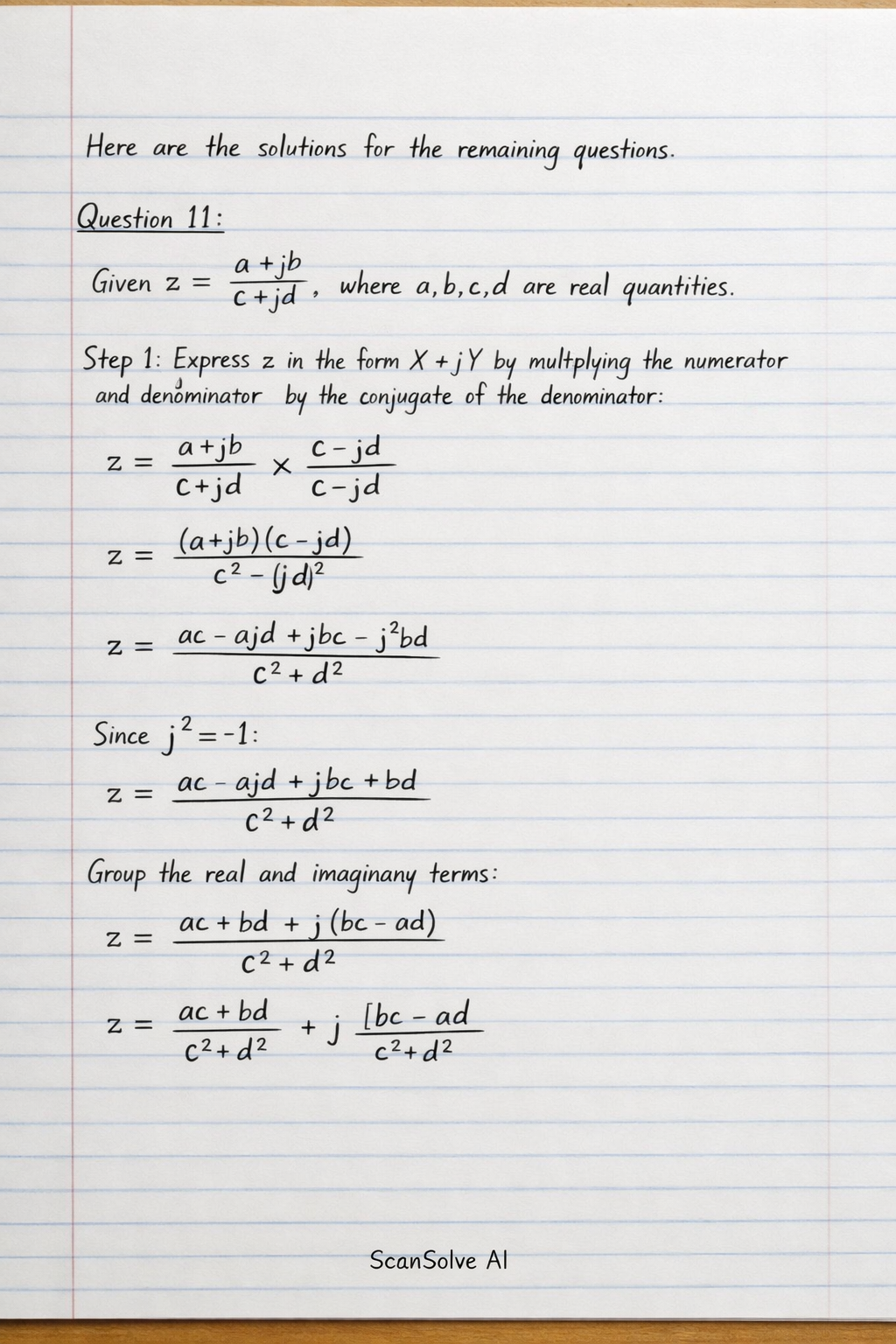
Handwritten Step-by-Step Solution
Get this as a handwritten image on WhatsApp — like a tutor wrote it for you.
Try on WhatsApp